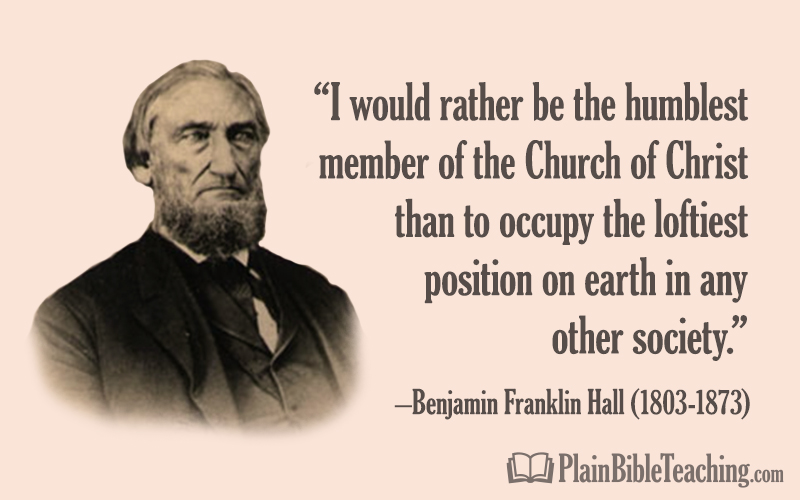
B.F. Hall: Choosing Truth Over an Education

B.F. Hall: Choosing Truth Over an Education

Benjamin Franklin Hall (1803-1873), at the age of 18 developed a desire to preach. But he felt that he needed an education in order to do it. His father was not a religious man and told him he could preach under one condition – that he leave home and never come back. So the young B.F. Hall left to pursue the education he thought would be necessary for him to preach.

Leaving home with nothing, Hall could not afford to pay for an education. But he had someone willing to pay for him – his brother-in-law. The only catch was that he join the Presbyterian Church. Hall was unwilling to do this, choosing to hold onto the truth rather than compromise to get something that he desired.
Continue Reading


The Body, Bride, and Church of Christ

Jesus offers an invitation to all men: “Come to Me, all who are weary and heavy-laden, and I will give you rest” (Matthew 11:28). He is able to offer this rest because of His work in reconciling man and God through the cross (Ephesians 2:13-16). After we obey the gospel by putting on Christ in baptism (Romans 6:3, 17), we are to “walk in newness of life” (Romans 6:4).

What do we call those who have obeyed the gospel? Individually, we call them Christians (Acts 11:26; 26:28; 1 Peter 4:16). But what about the universal body of all those who have become Christians? There are a few different terms used in the New Testament. In this article we will consider three – the body, the bride, and the church of Christ.
Continue Reading

The Application of Wisdom: Character (Part 2)

Notes on Proverbs

In addition to the lessons we can learn from the seven abominations, there are other character traits that one will gain from his pursuit of the wisdom that comes from above.
Continue Reading

An Institution of Higher Education

Yale University

In our society, a great deal of emphasis is placed upon obtaining a college education in order to prepare for secular employment. For many careers, this is helpful. For some, it is essential. Therefore, many people pursue a secular education in an institution of higher learning in order to best prepare themselves to find what they consider to be good jobs.

However, there is a type of education that is far more important than the education that prepares one for employment. This higher education is not for secular pursuits, but spiritual. It prepares us not for the work force (at least not directly), but for our service to God. Its purpose is not to help us obtain a high-paying job with good benefits, but to help us obtain eternal life.

Strangely, some act as though an institution devoted to secular education is also the preferred institution for their spiritual education. But God has created His own institution of higher education – the church. It has everything we need for the pursuit of a higher (i.e. from God) education. Let us notice what the Bible says about this institution of higher education.
Continue Reading

The Application of Wisdom: Character (Part 1)

Notes on Proverbs

As one learns to accept the wisdom that comes from above, the result will be a change of character. As we consider some of the character traits that one will gain from a pursuit of wisdom, let us first begin by contrasting them with the negative character traits of one who rejects divine wisdom. Below is a list the wise man gives of seven abominations.
Continue Reading

The Application of Wisdom: Introduction

Notes on Proverbs

It is absolutely essential that we recognize the appeal of wisdom. Once we know that wisdom is calling to us, we must learn to appreciate wisdom so that we have a reason to pay attention to wisdom’s appeals. Understanding this, we then need to work toward acquiring wisdom. But all of this is futile if, after we do all to acquire it, we do not apply wisdom.

The bulk of the book of Proverbs, and the majority of our study, focuses on the application of wisdom. When God reveals His wisdom, man is not to pursue it merely out of intellectual curiosity. God expects us to put what we learn into practice.
Continue Reading

Daniel Sommer on the Foolishness of Atheism

Though many in the world consider belief in God to be foolish, the psalmist declares that it is the fool who says there is no God (Psalm 14:1). In his book, Plain Sermons, Daniel Sommer explained the words of the psalmist and how they are true of the atheist.
Continue Reading