Rejoice in the Lord Always

Rejoice

Writing from prison, Paul told the brethren in Philippi, “Rejoice in the Lord always; again I will say, rejoice!” (Philippians 4:4). This instruction was so important that Paul repeated it. He also gave a similar command to the church in Thessalonica when he wrote, “Rejoice always” (1 Thessalonians 5:16).

Whenever we see a command like this, we ought to take note of it. We do not have the option to either rejoice or not rejoice depending on our circumstances. We are to “rejoice always.” The reason why this command must be given is because it is sometimes difficult or unnatural to rejoice in certain circumstances. Our lives here are filled with trials. Job lamented, “Man, who is born of woman, is short-lived and full of turmoil” (Job 14:1). The wise man noted the difficult nature of our existence here: “Because all his days his task is painful and grievous; even at night his mind does not rest” (Ecclesiastes 2:23). It is sometimes difficult to rejoice. But as Christians we must do so.
Continue Reading

By Faith Moses Left Egypt

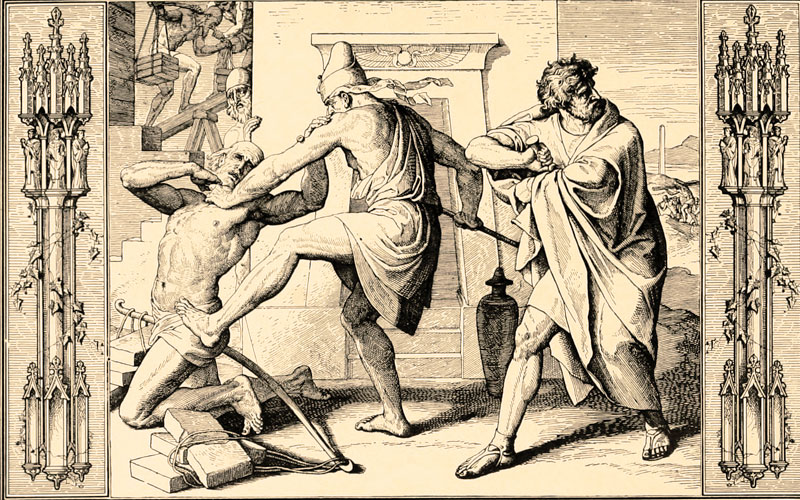
Moses Kills the Egyptian

Moses is one of the great characters in the Bible. His example of faith is pointed out to us in Hebrews 11 – the chapter of faith. The Hebrew writer mentioned a few things that Moses did to please God – he “refused to be called the son of Pharaoh’s daughter,” “kept the Passover,” and “passed through the Red Sea” (Hebrews 11:24, 28, 29). These are plainly understood from the history given in the book of Exodus.

However, one of the events mentioned has more questions surrounding it: “By faith he left Egypt, not fearing the wrath of the king; for he endured as seeing Him who is unseen” (Hebrews 11:27). What event was the Hebrew writer referring to when he wrote this? Was he talking about the exodus when Moses led the people out of the land of Egypt? Or was he talking about Moses’ departure from Egypt to the land of Midian after killing the Egyptian he saw mistreating one of his Hebrew brethren (Exodus 2:11-15)?
Continue Reading

New Bible

Bible

When I was in college I bought a New Testament that would fit in my back pocket. I wanted to have a Bible with me wherever I was in case an opportunity came up where it would be handy to have one. I have carried this New Testament in my back pocket for the last nine years.

Naturally, after years of regular use, this Bible slowly began to wear out. Recently it reached the point where pages were falling out. It was time to replace it. After searching the internet and receiving suggestions from others, I found an acceptable replacement. After receiving it, one of the first things I did was tear out a couple of pages.
Continue Reading

By Faith Abel Offered a Better Sacrifice Than Cain

Cain and Abel

Hebrews 11 contains many examples of faith. The first individual mentioned is Abel. His faith was demonstrated through the sacrifice he offered to God.

By faith Abel offered to God a better sacrifice than Cain, through which he obtained the testimony that he was righteous, God testifying about his gifts, and through faith, though he is dead, he still speaks” (Hebrews 11:4).

In Genesis 4, we read of the sacrifices of these two brothers.

So it came about in the course of time that Cain brought an offering to the Lord of the fruit of the ground. Abel, on his part also brought of the firstlings of his flock and of their fat portions. And the Lord had regard for Abel and for his offering; but for Cain and for his offering He had no regard. So Cain became very angry and his countenance fell” (Genesis 4:3-5).

Why did God accept Abel’s offering but not Cain’s? We are not told in Genesis, but we were told in Hebrews 11:4. Abel’s offering was accepted because it was offered “by faith.
Continue Reading

Quibbles About Baptism

Quibbles About Baptism

One of the major distinctions between brethren and the religious world relates to how we understand baptism. We teach that baptism is necessary for salvation (Mark 16:16; 1 Peter 3:21), is for the remission of sins (Acts 2:38; 22:16), and is our entrance into the Lord’s kingdom (Acts 2:41, 47; 1 Corinthians 12:13). Many others teach that baptism is an outward sign of an inward grace (that we are saved before and without baptism) and that it is for membership in a local church or denominational body.

Of course, there are no passages in the New Testament that teach baptism is an outward sign of an inward grace or that we are baptized to gain membership into a local church (and certainly not into a denomination since the New Testament does not speak about them at all). Instead of trying to twist passages in order to provide positive support for these ideas, denominationalists will generally will try to make arguments against the necessity of baptism. They quibble about various passages to try to attack the truth about baptism. Let us notice some passages that people try to use in arguing that baptism is not essential for salvation.
Continue Reading

Hearers and Doers

James 1:22

Therefore, putting aside all filthiness and all that remains of wickedness, in humility receive the word implanted, which is able to save your souls. But prove yourselves doers of the word, and not merely hearers who delude themselves” (James 1:21-22).

James made a contrast between those who are hearers only and those who are doers. When it comes to receiving the word of God, we must do more than just hear it; we must practice it. Our obedience is tied to the salvation of our souls (cf. 1 Peter 1:22).
Continue Reading

Jerusalem’s Failings

Destruction of Jerusalem

The prophet Zephaniah warned of the coming judgment against Jerusalem. It would be good for us to consider the reasons why judgment was coming. We can be punished, just as they were, for the same failings. So how did Jerusalem fail?

She heeded no voice, she accepted no instruction. She did not trust in the Lord, she did not draw near to her God” (Zephaniah 3:2).

Zephaniah gave four reasons why the people of Jerusalem were going to be punished. Let us consider each of these.
Continue Reading