Preaching Politics

Michelle Obama recently said there is “no better place” than church to talk about political issues. To some extent she is right. While not all political matters are worthy of our discussion in the assembly of the saints, those “political” matters that are addressed in the Bible will be taught by faithful men who are striving to speak as the oracles of God (1 Peter 4:11), proclaiming the whole counsel of God (Acts 20:27). Therefore, we speak where the Bible speaks, even on certain “political” topics. Some examples of such topics are listed below:
Continue Reading

Trampled at the Gate (7/3)

Thought from today’s Bible reading from 2 Kings 5-8.

Now it came about after this, that Ben-hadad king of Aram gathered all his army and went up and besieged Samaria. There was a great famine in Samaria; and behold, they besieged it, until a donkey’s head was sold for eighty shekels of silver, and a fourth of a kab of dove’s dung for five shekels of silver” (2 Kings 6:24-25)

Times were desperate in Samaria. With the city under siege, food was scarce, prices were high, and people had even started resorting to cannibalism in order to survive (2 Kings 6:26-29). Elisha prophesied that conditions would soon change.
Continue Reading

"Treason! Treason!" (6/30)

Thought from today’s Bible reading from 2 Chronicles 19-23.

Part of today’s reading describes a tumultuous period in the history of Judah. Jehoram reigned for eight years before dying of sickness (21:5, 18-19). He was such a miserable king that “he departed with no one’s regret” (21:20). His youngest son, Ahaziah succeeded him after his older sons were killed (22:1). Ahaziah reigned for one year before being put to death by Jehu (22:2, 7-9). The killing of Ahaziah came as a result of God’s commission to Jehu to “cut off the house of Ahab” (22:7).

Ahab had been the king of Israel. But Ahaziah was the son of Jehoram, the son of Jehoshaphat, king of Judah – not to be confused with another Ahaziah, Ahab’s son who reigned for two years over Israel (1 Kings 22:40). How was Ahaziah, king of Judah, connected to the house of Ahab? By marriage (2 Chronicles 18:1).

Ahaziah was twenty-two years old when he became king, and he reigned on year in Jerusalem. And his mother’s name was Athaliah, the granddaughter of Omri” (22:2).

Continue Reading

The Fall of King Solomon

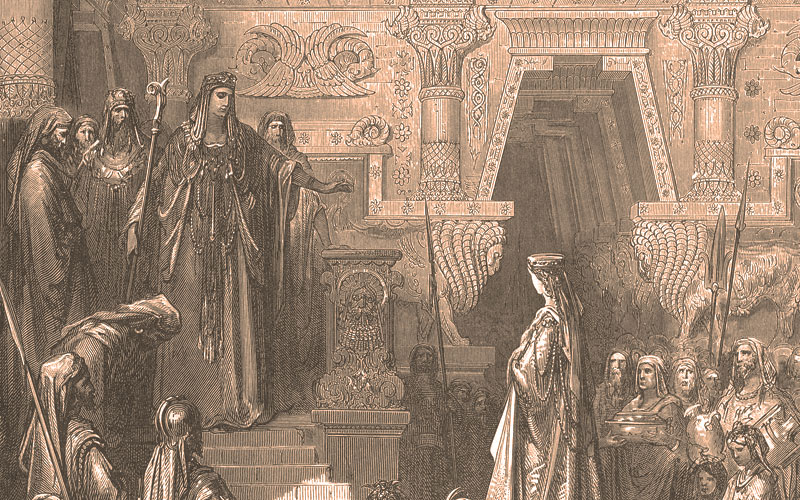
Solomon and the Queen of Sheba

When the Queen of Sheba visited Solomon, she wanted to find out for herself if the reports of his greatness and wisdom were true. As she discovered, they certainly were.

Then she said to the king, ‘It was a true report which I heard in my own land about your words and your wisdom. Nevertheless I did not believe the reports, until I came and my eyes had seen it. And behold, the half was not told me. You exceed in wisdom and prosperity the report which I heard. How blessed are your men, how blessed are these your servants who stand before you continually and hear your wisdom. Blessed be the Lord your God who delighted in you to set you on the throne of Israel; because the Lord loved Israel forever, therefore He made you king, to do justice and righteousness” (1 Kings 10:6-9).

It is interesting that she recognizes a fundamental principle that applies to all civil governments. They are in place to “do justice and righteousness.” Solomon recognized this as well.Continue Reading

The Difference Between Serving God and the Kingdoms of Men (6/24)

Thought from today’s Bible reading from 2 Chronicles 10-12.

When Rehoboam and the people “forsook the law of the Lord” (2 Chronicles 12:1), Shishak king of Egypt came to fight against him. Shemaiah the prophet revealed God’s judgment to Rehoboam: “You have forsaken Me, so I also have forsaken you to Shishak” (2 Chronicles 12:5). At this revelation, the king and his princes humbled themselves and repented, but there would still be consequences to suffer.

When the Lord saw that they humbled themselves, the word of the Lord came to Shemaiah, saying, ‘They have humbled themselves so I will not destroy them, but I will grant them some measure of deliverance, and My wrath shall not be poured our on Jerusalem by means of Shishak. But they will become his slaves so that they may learn the difference between My service and the service of the kingdoms of the countries’” (2 Chronicles 12:7-8).

As king, it would be easy for Rehoboam to be unable to relate to the plight of his people under an oppressive ruler. Rehoboam’s oppression of the people was the reason why the kingdom was divided and many left from serving him (2 Chronicles 10). But now, under the oppression of Shishak, he would learn what it is like to live under an oppressive king.
Continue Reading

"It Is Not for Kings to Drink Wine" (6/22)

Thought from today’s Bible reading from Proverbs 30-31.

It is not for kings, O Lemuel, it is not for kings to drink wine, or for rulers to desire strong drink, for they will drink and forget what is decreed, and pervert the rights of all the afflicted.

Give strong drink to him who is perishing, and wine to him whose life is bitter. Let him drink and forget his poverty and remember his trouble no more” (Proverbs 31:4-7).

There are at least four points to be made from the instructions given to Lemuel.
Continue Reading

Justice and Its Source (6/18)

Thought from today’s Bible reading from Proverbs 27-29.

Civil authorities have a role to play in handing down justice to men. Justice is one of the key components necessary to having stability and peace in a country.

The king gives stability to the land by justice, but a man who takes bribes overthrows it” (Proverbs 29:4).

But what is the basis of this justice? How should we (or the rulers) determine what is just in a given situation?
Continue Reading