Three Branches of Government

Three Branches of Government

The U.S. Constitution specifies three separate branches that make up our government: legislative, executive, and judicial. These branches of government are not unique to the United States. Every government will carry out these functions in one way or another.

When it comes to the rule of God, His government performs the same legislative, executive, and judicial functions. Isaiah wrote, “For the Lord is our judge, the Lord is our lawgiver, the Lord is our king; He will save us” (Isaiah 33:22). We live under a different covenant today than the Israelites did at the time of this writing. They were part of God’s kingdom in the nation of Israel. We are part of Christ’s kingdom today in the church. But even today, when we examine the rule of Christ, we see that Jesus completely and sufficiently carries out the role of each branch of government in His kingdom.
Continue Reading

What Judas Brought to the Garden

Judas Betrays Jesus

Judas is one of the most well-known villains in the Bible. Most people recognize him as being the one to betray Jesus. His decision to betray the Lord is what might be expected by one of his character. Jesus called him the “son of perdition” (John 17:12). He was identified as a thief (John 12:4-6). After betraying Jesus, instead of repenting and making things right, “he went away and hanged himself” (Matthew 27:4-5). Peter also pointed out that all of this was foreknown by God and revealed in prophecy (Acts 1:16-20).

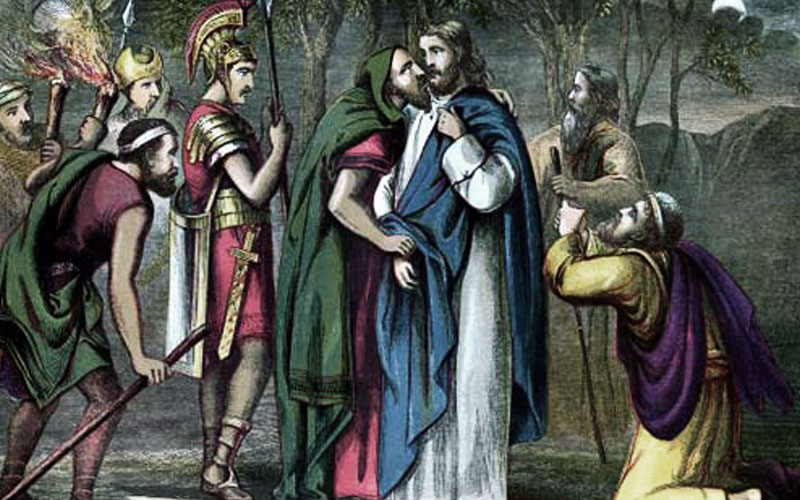
Shortly before being betrayed, Jesus “went forth with His disciples over the ravine of the Kidron, where there was a garden, in which He entered with His disciples” (John 18:1). It was here in the garden where Judas would betray the Lord. He knew the place to go because “Jesus had often met there with His disciples” (John 18:2).

So Judas went to the garden to betray Jesus. But notice what he brought with him. “Judas then, having received the Roman cohort and officers from the chief priests and the Pharisees, came there with lanterns and torches and weapons” (John 18:3). It is interesting to see what Judas brought to the garden, particularly in light of what Jesus brought to the world.
Continue Reading

Keywords in the Prophecy of the Coming Kingdom

Matterhorn mountain

Isaiah prophesied of a kingdom that was to come “in the last days” – the age that was ushered in following the coming of Christ into the world (cf. Hebrews 1:2). There are several keywords in this prophecy that we must understand if we are to appreciate what the passage teaches.

Now it will come about that in the last days the mountain of the house of the Lord will be established as the chief of the mountains, and will be raised above the hills; and all nations will stream to it.

And many peoples will come and say, ‘Come, let us go up to the mountain of the Lord, to the house of the God of Jacob; that He may teach us concerning His ways and that we may walk in His paths.’ For the law will go forth from Zion and the word of the Lord from Jerusalem.

And He will judge between the nations, and will render decisions for many peoples; and they will hammer their swords into plowshares and their spears into pruning hooks. Nation will not lift up sword against nation, and never again will they learn war” (Isaiah 2:2-4).

Let us briefly consider each of these key terms:
Continue Reading

Did Jesus Bend the Rules for the Woman Caught in Adultery?

Jesus and the Woman Taken in Adultery

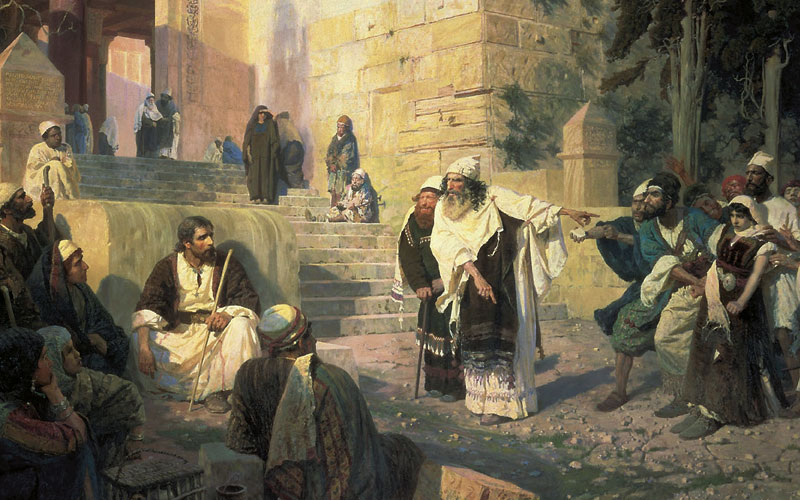
On one occasion when Jesus was in the temple, the scribes and Pharisees brought a woman before Him who had allegedly been caught in the act of adultery. It is an interesting account, and some have tried to use it to argue that we should not try to strictly follow God’s word. But as we examine the passage, we can see that Jesus teaches just the opposite – we must be careful and diligent to follow what God’s word teaches.

The scribes and Pharisees brought this woman before Jesus, claiming that she was “caught in adultery, in the very act” (John 8:4). Then they tested Jesus: “Now in the Law Moses commanded us to stone such women; what then do you say?” (John 8:5). They were trying to find some reason to accuse Him, presumably either to take Him before the Roman rulers or to turn the people against Him. In either case, Jesus initially ignored their question.

When they pressed Him, He responded, “He who is without sin among you, let him be the first to throw a stone at her” (John 8:7). Then, one by one, each of them left until there was no one left but Jesus and this woman. He asked her, “‘Woman, where are they? Did no one condemn you?’ She said, ‘No one, Lord,’ And Jesus said, ‘I do not condemn you, either. Go. From now on sin no more’” (John 8:10-11).
Continue Reading

The Three Things Jesus Accomplished in His Death

Cross

Toward the end of a lengthy discussion of Jesus’ work as our high priest, the Hebrew writer provided a summary in his explanation of Psalm 40:6-8. In this explanation, he spoke of the three things Jesus came to the earth to accomplish.
Continue Reading

Rightly Dividing the Word

Paul gave this instruction to the young evangelist Timothy: “Be diligent to present yourself approved to God as a workman who does not need to be ashamed, accurately handling [rightly dividing, KJV] the word of truth” (2 Timothy 2:15). We need to learn how to handle God’s word accurately in order to be approved before Him.
Continue Reading

The Spirit of the Law vs. The Letter of the Law

American Law Digests

Not that we are adequate in ourselves to consider anything as coming from ourselves, but our adequacy is from God, who also made us adequate as servants of a new covenant, not of the letter but of the Spirit; for the letter kills, but the Spirit gives life” (2 Corinthians 3:5-6).

But he is a Jew who is one inwardly; and circumcision is that which is of the heart, by the Spirit, not by the letter; and his praise is not from men, but from God” (Romans 2:29).

In these verses we see the contrast between the “Spirit” and the “letter.” This topic comes up in discussions with liberal brethren regarding their departure from the New Testament pattern. Those brethren use these verses to justify their practices and condemn so-called “legalism.”
Continue Reading