The Time When They Will No Longer Endure Sound Doctrine

Megachurch

As Paul began to close his second letter to Timothy, he “solemnly” charged him (2 Timothy 4:1) to carry out his work as a preacher. He told the young evangelist, “Preach the word; be ready in season and out of season; reprove, rebuke, exhort, with great patience and instruction” (2 Timothy 4:2).

Timothy was not at liberty to teach any message that he or others might prefer. He was to proclaim the word of God, just as Paul and the other apostles taught (2 Timothy 1:13). He was not to deviate from this message in any way – just as we must not alter the message (cf. Galatians 1:8-9; Revelation 22:18-19). The charge for him to “be ready in season and out of season” to preach this pure, unadulterated message of the gospel required a willingness to proclaim it even if it was unpopular, inconvenient, and difficult for people to accept.

However, since the message of the gospel is sometimes unpopular, inconvenient, and difficult for people to accept, many turn away from it. Sadly, this even happens among Christians and in local churches. Paul warned Timothy that he would encounter this:

For the time will come when they will not endure sound doctrine; but wanting to have their ears tickled, they will accumulate for themselves teachers in accordance to their own desires, and will turn away their ears from the truth and will turn aside to myths” (2 Timothy 4:3-4).


Continue Reading

Is the Bible Still Relevant Today? (11.17.22)

Subscribe: Apple Podcasts | Google Podcasts | Stitcher | Spotify | RSS

Plain Bible Teaching Podcast

This week we’re talking about the Bible and whether it is still relevant in our modern world. It is sometimes amazing to see just how different our world is today compared to how it was a hundred years ago – or even ten years ago. Not just technology, but also the values and morals of the world around us are completely foreign to what we knew if we “grew up in the church.” Because of this, many have concluded (sadly, even some in the church) that the Bible is just not relevant anymore. So that’s what we’re going to talk about today.Continue Reading

“O How I Love Your Law!” – The Message of Psalm 119

Open Bible, Turning Page

O how I love Your law! It is my meditation all the day” (Psalm 119:97).

With one hundred seventy-six verses, Psalm 119 is the longest chapter in the Bible. From beginning to end, it is focused on a single theme – the word of God. The psalm teaches us what the word of God is, what it does for us, and what it requires of us.

It would not be possible to cover everything in this psalm in one article.* Instead, in this article we are going to notice some of the highlights from this psalm to help deepen our understanding and strengthen our appreciation for the word of God. Each of these points is just as true today as when the psalm was originally written.Continue Reading

When We Disagree

Two Men Having an Argument

In our polarized world, disagreements are more pronounced, arguments are more public, and differences seem to be irreconcilable. Though we may immediately think of this in the context of social and political issues, it can also be true in matters of religion.

In reality though, there have always been disagreements on matters pertaining to faith. Some believe there is a God; others believe there is no God. Some believe that Jesus is the Son of God; others believe Jesus was only a prophet, teacher, or wise rabbi. The “Christian” world is filled with different ideas regarding salvation, sin, worship, the church, morality, and more – too many topics to list. Disagreements on such matters will always be present.

In this article, we will primarily be discussing disagreements between those who believe in Christ and recognize the Bible as the word of God.

If you and I disagree on some point pertaining to religious matters, there are four possibilities:Continue Reading

Dangers on the Safe Side (Part 1): Avoiding Controversy

Dangers on the Safe Side

For many Christians, controversy is undesirable. Debates, which were common in the nineteenth and early twentieth centuries, are rare today. In some ways, this is understandable. As our society has become more polarized and heated debates can erupt over issues that seem to be largely insignificant, it is tempting to want to stay “on the safe side” and avoid anything controversial (we do not want to “rock the boat”) so we can continue to get along with our brethren. However, there are dangers that come with avoiding controversy on spiritual issues.

Consider the example of the apostle Peter (also called Cephas):Continue Reading

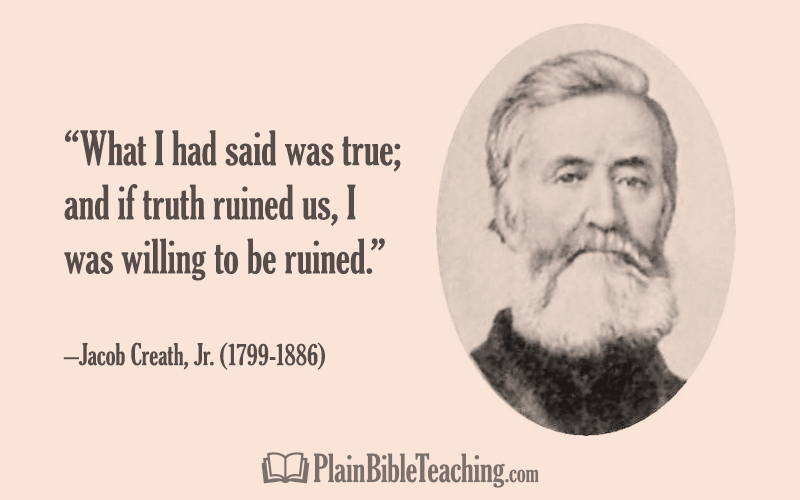
Jacob Creath, Jr.: Willing to Be Ruined

Jacob Creath, Jr. (1799-1886) was one of many preachers in the nineteenth century who began to question the commonly held doctrines among the denominations of which they were a part. Creath had been associated with the Baptists. In 1826, he received a letter of commendation from the Baptist Church in Great Crossings, Scott County, Kentucky in which he was called a “beloved brother,” a “faithful minister,” and one who “earnestly and zealously contends for ‘the faith once delivered to the saints’” (Memoir of Jacob Creath, Jr., p. 24-25). However, in 1829, Creath received another letter from this same congregation, requesting that he address reports of the “heresy” that he was preaching.

“DEAR BROTHER — I send you the request of the greatest portion of the Crossing Church. Their desire is, that you will give your views of man as a sinner, and how the change takes place, so as to constitute him born again. Or, in our familiar way, as Baptists, we want your views of experimental religion; how a sinner is brought from a state of enmity against the Saviour to be a lover and worshiper of Him.

“This request has grown partly from reports, and partly from a number of brethren, who have heard you preach since your return from the South, conceiving that you had abandoned your old mode and views of preaching, under which their hearts were many times gladdened, and have sat under your ministry with great delight; and we would ask our divine Master to grant you his Spirit, that you may rightly divide the word of truth, giving saint and sinner ‘his portion in due season.’” (Ibid., p. 29)

When Creath’s uncle, Jacob Creath, Sr., heard of the letter, he paid a visit to discuss it and see how the younger Creath intended to respond. Both men were connected to the Baptist Association at that time; and while Creath’s uncle agreed with him on this matter, he wanted to be more cautious in dealing with the issue. When he heard what his nephew planned to reply, the elder Creath said “it would ruin our cause.” The younger Creath answered, “What I had said was true; and if truth ruined us, I was willing to be ruined” (Ibid., p. 30).Continue Reading

Knowing the Difference between Good and Evil (01.13.22)

Subscribe: Apple Podcasts | Google Podcasts | Stitcher | Spotify | RSS

Plain Bible Teaching Podcast

This week we’re going to be talking about the difference between right and wrong. Can we know the difference between the two? Or is it difficult or impossible to label most things as good and evil? Our society is split on that question. We’re going to discuss that today.Continue Reading