“How Can a Young Man Keep His Way Pure?”

Man on wall

Psalm 119 contains 176 verses arranged in twenty-two stanzas. The entire psalm is dedicated to the praise of God’s word. The second stanza begins with a question: “How can a young man keep his way pure?” (Psalm 119:9). As we might expect, the answer to this question is found in the word of God.

Of course, the answer to this question is not limited in application to young men. It is profitable for all of God’s people. So let us examine this passage and see how we can keep our way pure before God.

How can a young man keep his way pure? By keeping it according to Your word. With all my heart I have sought You; do not let me wander from Your commandments. Your word I have treasured in my heart, that I may not sin against You. Blessed are You, O Lord; teach me Your statutes. With my lips I have told of all the ordinances of Your mouth. I have rejoiced in the way of Your testimonies, as much as in all riches. I will meditate on Your precepts and regard Your ways. I shall delight in Your statutes; I shall not forget Your word” (Psalm 119:9-16).

David mentioned eight things we can do to help keep our way pure.
Continue Reading

Lessons from the Limited Commission

We often remember the “Great Commission” in which Jesus told His apostles, “Go into all the world and preach the gospel to all creation” (Mark 16:15). However, prior to this, Jesus gave His apostles what we may call the “Limited Commission.” They were to “go to the lost sheep of the house of Israel” (Matthew 10:6).

Though we are living in the time since the giving of the Great Commission, there are still important lessons we can learn from the earlier Limited Commission that apply even today.
Continue Reading

Jeremiah’s Commission

Jeremiah

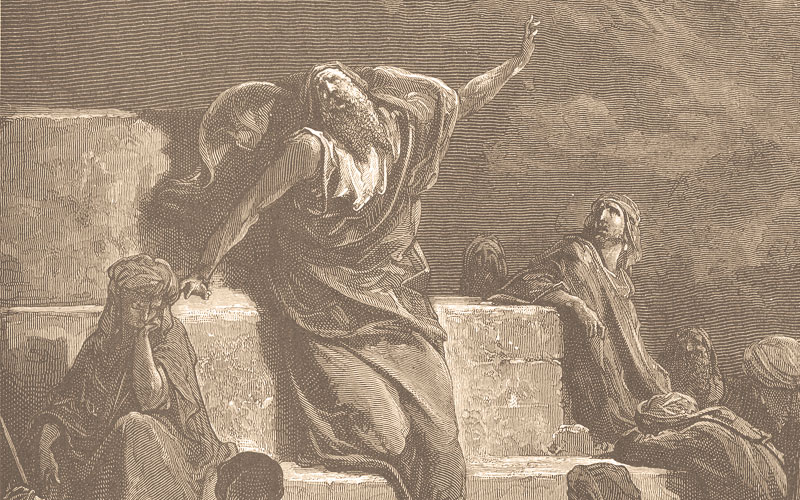
Even before he was conceived, Jeremiah was specifically appointed by God as a prophet (Jeremiah 1:5). We may not be called to do the work of a prophet today (cf. 1 Corinthians 13:8-10), but we can still learn from the instructions which were given to Jeremiah. We are obligated to teach and defend the truth (1 Timothy 3:15; Philippians 1:16-17). Studying Jeremiah’s commission helps us to learn how to do this.

Then the Lord stretched out His hand and touched my mouth, and the Lord said to me, ‘Behold, I have put My words in your mouth. See, I have appointed you this day over the nations and over the kingdoms, to pluck up and to break down, to destroy and to overthrow, to build and to plant’” (Jeremiah 1:9-10).

There were six things that Jeremiah would do in his prophesying – (1) pluck up, (2) break down, (3) destroy, (4) overthrow, (5) build, and (6) plant. These are the same six things we must do in our teaching today.

Before we consider these six things, it is important to note that all of this would be accomplished with the words of God (Jeremiah 1:9). In the same way, we will accomplish these six things by speaking “as the oracles of God” (1 Peter 4:11, NKJV). We must not look to human wisdom, commandments, traditions, or opinions to accomplish our goals in teaching. Instead, we must look exclusively to the word of God.

So let us notice the six things we must do as we teach God’s word.
Continue Reading

Robert Milligan: “By the Force of the Bible Alone”

Robert Milligan (1814-1875), like other early figures in the Restoration Movement, was raised in denominationalism and eventually learned the truth and abandoned the churches of men. In the case of Milligan, he was raised in the Presbyterian church. His commentary on Hebrews, which was published after his death, contains a biographical sketch at the end written by J.W. McGarvey. In it, McGarvey explained how Milligan came to learn the truth and leave the Presbyterian church to become part of the Lord’s church:
Continue Reading

The Four C’s of Effective Preaching

Speaker

Any preacher who is diligently striving to “do the work of an evangelist” (2 Timothy 4:5) will want to carry out that work as effectively as possible. But how can one effectively preach the gospel of Christ? In this article, I would like to consider four points explaining how this is done. These points are not based upon personal experience, human wisdom, or any sort of formal religious training. Rather, these points are taken directly from the word of God. If one wishes to preach the word of God effectively, he must learn how the Scriptures indicate that this is done.
Continue Reading

Are We Truly Disciples of Christ?

John 8:31

Many people claim to be disciples of Christ, but are they truly His disciples? Are we? This is a legitimate and important question. Notice what Jesus said:

So Jesus was saying to those Jews who had believed Him, ‘If you continue in My word, then you are truly disciples of Mine; and you will know the truth, and the truth will make you free’” (John 8:31-32).

When Jesus said, “then you are truly disciples of Mine,” He implied that some are not truly His disciples. So the question under consideration is vitally important: Are we truly disciples of Christ? We must be sure we can correctly answer this question for ourselves. We must also be prepared to try and help others to be able to correctly answer this question for themselves. The context of the above passage shows us what it means to be disciples of Christ.
Continue Reading

Hedges to Help Protect Us from Sin

Hedges

When Satan came before the Lord, God praised Job for his righteousness: “Have you considered My servant Job? For there is no one like him on the earth, a blameless and upright man, fearing God and turning away from evil” (Job 1:8). Satan, however, protested. In his mind, he believed that God was unfairly protecting Job from temptation: “Does Job fear God for nothing? Have You not made a hedge about him and his house and all that he has, on every side?” (Job 1:10). This “hedge” of divine blessing made Job less susceptible to temptation.

Of course, when God granted permission for this “hedge” to be removed, Job remained faithful (Job 1:22; 2:10). But the fact that Job had to work harder to resist the temptation to forsake God cannot be denied. Temptation was more severe when the “hedge” protecting Job was taken away.

As we make application to our lives, we should understand that we can have certain hedges to help protect us from sin. God has promised a way of escape so that every temptation can be defeated (1 Corinthians 10:13). The more hedges we have in place, the better we will be able to overcome temptation.

The only infallible safeguard against temptation is the word of God. The wise man wrote, “Every word of God is tested; He is a shield to those who take refuge in Him” (Proverbs 30:5). However, there are other hedges that we can put in place to help guard against temptation. We will consider a few of these in this article. We should understand that none of these safeguards are infallible, but they can greatly help if we use them properly.
Continue Reading