The World Could Not Contain the Books that Would Be Written (11/15)

Thought from today’s Bible reading from Luke 24; John 20-21.

The gospels record a relatively brief period in the life of Jesus on the earth. There are many things that Jesus said and did that were not recorded. John, at the end of his gospel, explained that it would not be possible to record everything.

And there are also many other things which Jesus did, which if they were written in detail, I suppose that even the world itself would not contain the books that would be written” (John 21:25).

If the gospels do not contain everything that Jesus said or did on the earth, then why did the gospel writers record what they did? Remember, Jesus promised to send the Holy Spirit to guide the apostles “into all the truth” (John 16:13). So why was it that the Holy Spirit had these men include certain things and omit other things? John gave the answer:
Continue Reading

“Pressed Into Service to Bear His Cross” (11/12)

Thought from today’s Bible reading from Matthew 27; Mark 15.

While on the way to crucify Jesus, the Roman soldiers compelled another man to carry Jesus’ cross. Why? Tradition tells us that Jesus stumbled on the way to Golgotha and, because He was physically unable to carry the cross, the soldiers found someone else to carry it. What does the text say?

After they mocked Him, they took the scarlet robe off Him and put His own garments back on Him, and led Him away to crucify Him. As they were coming out, they found a man of Cyrene named Simon, whom they pressed into service to bear His cross” (Matthew 27:31-32).

At what point did Jesus stumble or fall under the weight of the cross? It is absent from the text. Examining the other gospels will also reveal nothing about Jesus stumbling on the way to Golgotha (Mark 15:21; Luke 23:26; John 19:17).

So why was Simon forced to carry Jesus’ cross?
Continue Reading

“He Is Not the God of the Dead But of the Living” (11/4)

Thought from today’s Bible reading from Matthew 22; Mark 12.

The Sadducees did not believe in the resurrection. When they confronted Jesus on this point, they thought they had an unanswerable argument that would prove the foolishness of believing in the resurrection.

They presented a scenario in which a woman was married to seven brothers, each one followed the death of the next older brother (Matthew 22:23-27). The Sadducees then asked Jesus this question: “In the resurrection, therefore, whose wife of the seven will she be? For they all had married her” (Matthew 22:28). Notice how Jesus responded:

But Jesus answered and said to them, ‘You are mistaken, not understanding the Scriptures nor the power of God. For in the resurrection they neither marry nor are given in marriage, but are like angels in heaven.’

‘But regarding the resurrection of the dead, have you not read what was spoken to you by God: “I am the God of Abraham, and the God of Isaac, and the God of Jacob”? He is not the God of the dead but of the living’” (Matthew 22:29-32).

Jesus’ argument “silenced the Sadducees” (Matthew 22:34). They had no answer for Him. If God said, “I am” the God of Abraham, Isaac, and Jacob, even after these men were dead, then one should necessarily infer that these men continued to exist, even after death.
Continue Reading

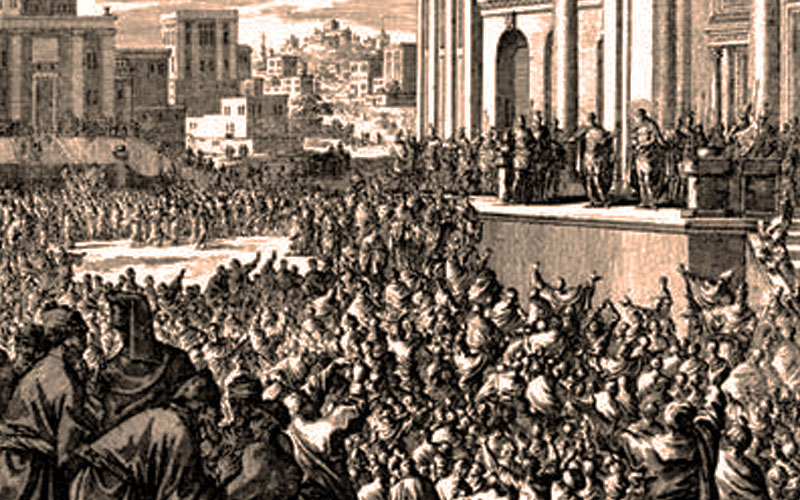
“We Have No King But Caesar”

Trial of Jesus

Pilate knew that the trial of Jesus was unique. Jesus explained to him that His kingdom was “not of this world” (John 18:36). Pilate then recognized that Jesus claimed to be a king (John 18:37), even though the Jews rejected Him as their king (John 18:33, 35). But the Jews’ rejection of Jesus was more than just a refusal to support Him as a king; they wanted to kill Him (John 18:31) even though Pilate was able to find “no guilt in Him” (John 18:38; 19:4, 6).

Then Pilate became “even more afraid” when the Jews told him that Jesus “made Himself out to be the Son of God” (John 19:7-8). How much of this Pilate believed is immaterial. The fact is that the events transpiring with the claims and charges being made were producing a volatile situation. So Pilate “made efforts to release Him” (John 19:12), but the Jews would not let him do it. Pilate then made one final effort to defuse the situation and allow the innocent Jesus to be released.

Now it was the day of preparation for the Passover; it was about the sixth house. And he said to the Jews, ‘Behold, your King!’ So they cried out, ‘Away with Him, away with Him, crucify Him!’ Pilate said to them, ‘Shall I crucify your King?’ The chief priests answered, ‘We have no king but Caesar.’ So he then handed Him over to them to be crucified” (John 19:14-16).

This case was not about some random insurrectionist. There was much more to this than Pilate could have imagined at the start. But in the end, the Jews – influenced by their leaders (Matthew 27:20) – very clearly and boldly repudiated Jesus and demanded His crucifixion. Why was this so significant? It has to do with what they rejected, and what they chose to focus on instead.
Continue Reading

“The Scripture Cannot Be Broken” (10/25)

Thought from today’s Bible reading from Luke 10-11; John 10:22-42.

When Jesus declared His oneness with the Father – thus affirming His deity – the Jews wanted to stone Him to death (John 10:30-31). They believed Jesus was guilty of blasphemy when He made such a claim. The problem, though, was not with Jesus’ words, but with their understanding of the Scriptures.

Jesus answered them, ‘I showed you many good works from the Father; for which of them are you stoning Me?’ The Jews answered Him, ‘For a good work we do not stone You, but for blasphemy; and because You, being a man, make Yourself out to be God.’ Jesus answered them, ‘Has it not been written in your Law, “I said, you are gods”? If he called them gods, to whom the word of God came (and the Scripture cannot be broken), do you say of Him, whom the Father sanctified and sent into the world, “You are blaspheming,” because I said, “I am the Son of God”? If I do not do the works of My Father, do not believe Me; but if I do them, though you do not believe Me, believe the works, so that you may know and understand that the Father is in Me, and I in the Father.’” (John 10:32-38).

Given the evidence they had, there was no reason why these Jews, if they were honest, should have rejected Christ. Yet, after Jesus said this, they tried “again to seize Him” (John 10:39).
Continue Reading

The Faith to Move Mountains

Mountain fog

The gospels record many occasions of Jesus casting out demons. On one such occasion, a man came requesting that Jesus heal his son of his demon possession (Matthew 17:14-15). What was interesting about this example was that this man first brought his son to Jesus’ disciples, but “they could not cure him” (Matthew 17:16). But when Jesus told this father to bring his son, Jesus immediately cast out the demon and cured the boy (Matthew 17:17-18).

Afterward, the disciples asked Jesus why they had been unable to cast out the demon. His answer provides an important lesson for us about faith.

Then the disciples came to Jesus privately and said, ‘Why could we not drive it out?’ And He said to them, ‘Because of the littleness of your faith; for truly I say to you, if you have faith the size of a mustard seed, you will say to this mountain, “Move from here to there,” and it will move; and nothing will be impossible to you. But this kind does not go out except by prayer and fasting’” (Matthew 17:19-21).

Let us notice what Jesus was teaching His disciples about faith and how it applies to our lives today.
Continue Reading

“Take Care What You Listen To” (10/15)

Thought from today’s Bible reading from Matthew 8:14-34; Mark 4-5.

‘If anyone has ears to hear, let him hear.’ And He was saying to them, ‘Take care what you listen to. By your standard of measure it will be measured to you; and more will be given you besides’” (Mark 4:23-24).

Jesus made these comments after explaining the parable of the sower to His disciples. The four soils in the parable represented four different types of hearts that would hear the gospel. The type of heart one has will determine how he listens and what he chooses to listen to.
Continue Reading