Big Words in the Bible: Conclusion

Big Words in the Bible

There is no topic more important than our salvation. Understanding what the Bible teaches about this is crucial to appreciate what God has done and take advantage of His offer of eternal life.

As we have noticed in this series, the Bible uses some “big” words to explain this. This is not meant to hinder our understanding but to convey the concepts being described accurately. Even if these words are not common in our everyday vocabulary, we can understand them if we are willing to take the time to define them, see how they are used in the New Testament, and examine how they fit in the context of the passages in which they are used.Continue Reading

Big Words in the Bible: Introduction

Big Words in the BibleThe Bible has been written so that we can understand it. Paul told the brethren in Ephesus, “By referring to this, when you read you can understand my insight into the mystery of Christ” (Ephesians 3:4). He expected them to be able to take the letter he wrote them and come away with the same understanding that he had of the things that God revealed to him. As these inspired writings have been preserved for us, we can do the same today.

However, the fact that the Bible is understandable does not mean everything in it is easy to understand. Referring to Paul’s writings, Peter said, “As also in all his letters, speaking in them of these things, in which are some things hard to understand, which the untaught and unstable distort, as they do also the rest of the Scriptures, to their own destruction” (2 Peter 3:16). Peter did not say Paul’s writings were impossible to understand. But some passages are more difficult than others. Despite the difficulty, we still have Paul’s assurance that we “can understand” what we find in the inspired word of God. We just might need to put some additional effort into studying certain topics or passages.Continue Reading

Safe and Sane Solutions

Sommer: Safe and Sane Solutions

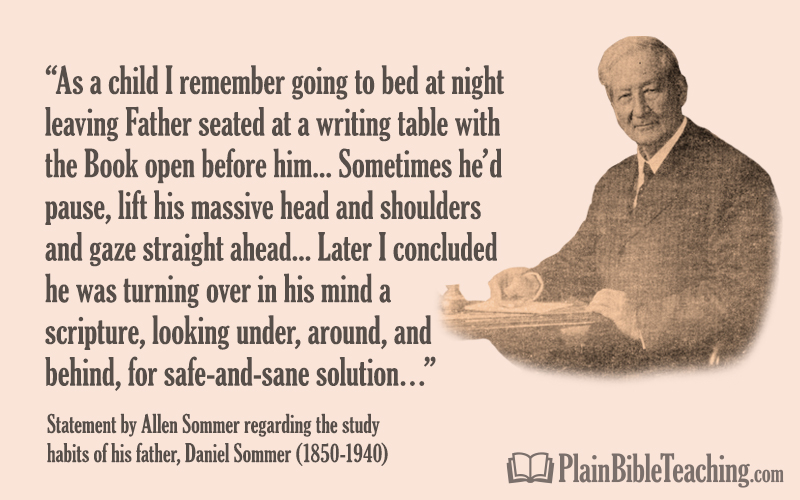
Few preachers associated with the Restoration Movement fought so strongly and effectively against innovations and apostasy than Daniel Sommer (1850-1940). His efforts were motivated by a profound respect for the word of God, and his ability to defend the truth as he did was possible because of his diligence in studying the Scriptures. This respect and diligence can be seen in the quote below from Allen Sommer – the son of Daniel Sommer – as he recalled the memory of his father.

“When he was home, as a child I remember going to bed at night leaving Father seated at a writing table with the Book open before him, and a piece of heavy paper or card-board bent around the coal-oil lamp chimney, to shade his eyes … there he was—reading and writing—always writing and reading … And when I sleepily drifted into the room next morning, there he was—reading that Book, and writing … always writing and reading. I wondered if he’d been there all night … Sometimes he’d pause, lift his massive head and shoulders and gaze straight ahead. I wondered then what he saw. Later I concluded he was turning over in his mind a scripture, looking under, around, and behind, for safe-and-sane solution…” (Faith and Facts Quarterly, Volume 48, Number 2, p. 19).

Daniel Sommer had such a habit of Bible study that his young son wondered if he ever went to sleep or stayed up all night with the word of God open before him. This diligence is commendable. We all need to strive to maintain such a habit of studying the Scriptures. Yet there was more involved in the study done by Sommer than just the time he spent in it. His young son noticed the time, but as Allen Sommer grew up, he realized that his father’s approach to the Scriptures – looking for a “safe-and-sane solution” to the issue at hand – enabled him to teach and defend the truth so effectively.Continue Reading

Road Trip (Part 3): The Road to Gaza

The Road to Gaza

On our next stop in this series, we are going to find a man who was going down the road to Gaza. Here we will learn about preaching Jesus.

But an angel of the Lord spoke to Philip saying, ‘Get up and go south to the road that descends from Jerusalem to Gaza.’ (This is a desert road.) So he got up and went; and there was an Ethiopian eunuch, a court official of Candace, queen of the Ethiopians, who was in charge of all her treasure; and he had come to Jerusalem to worship, and he was returning and sitting in his chariot, and was reading the prophet Isaiah. Then the Spirit said to Philip, ‘Go up and join this chariot.’ Philip ran up and heard him reading Isaiah the prophet, and said, ‘Do you understand what you are reading?’ And he said, ‘Well, how could I, unless someone guides me?’ And he invited Philip to come up and sit with him.

Now the passage of Scripture which he was reading was this: ‘He was led as a sheep to slaughter; and as a lamb before its shearer is silent, so He does not open His mouth. In humiliation His judgment was taken away; who will relate His generation? For His life is removed from the earth.’ The eunuch answered Philip and said, ‘Please tell me, of whom does the prophet say this? Of himself or of someone else?’ Then Philip opened his mouth, and beginning from this Scripture he preached Jesus to him.

As they went along the road they came to some water; and the eunuch said, ‘Look! Water! What prevents me from being baptized?’ And Philip said, ‘If you believe with all your heart, you may.’ And he answered and said, ‘I believe that Jesus Christ is the Son of God.’ And he ordered the chariot to stop; and they both went down into the water, Philip as well as the eunuch, and he baptized him. When they came up out of the water, the Spirit of the Lord snatched Philip away; and the eunuch no longer saw him, but went on his way rejoicing” (Acts 8:26-39).

This occurred at the time in which the disciples were “scattered” from Jerusalem due to persecution and “went about preaching the word” (Acts 8:4). Philip was among this number, but the Lord specifically directed him to go to this place. Let us notice some lessons from this.Continue Reading

Road Trip (Part 2): The Road to Emmaus

The Road to Emmaus

As we continue this series, let us notice two men who were traveling the road to Emmaus. As we go along with them, we will learn about recognizing Jesus.

And behold, two of them were going that very day to a village named Emmaus, which was about seven miles from Jerusalem. And they were talking with each other about all these things which had taken place. While they were talking and discussing, Jesus Himself approached and began traveling with them. But their eyes were prevented from recognizing Him. And He said to them, ‘What are these words that you are exchanging with one another as you are walking?’ And they stood still, looking sad. One of them, named Cleopas, answered and said to Him, ‘Are You the only one visiting Jerusalem and unaware of the things which have happened here in these days?’

And He said to them, ‘What things?’ And they said to Him, ‘The things about Jesus the Nazarene, who was a prophet mighty in deed and word in the sight of God and all the people, and how the chief priests and our rulers delivered Him to the sentence of death, and crucified Him. But we were hoping that it was He who was going to redeem Israel. Indeed, besides all this, it is the third day since these things happened. But also some women among us amazed us. When they were at the tomb early in the morning, and did not find His body, they came, saying that they had also seen a vision of angels who said that He was alive. Some of those who were with us went to the tomb and found it just exactly as the women also had said; but Him they did not see.’

And He said to them, ‘O foolish men and slow of heart to believe in all that the prophets have spoken! Was it not necessary for the Christ to suffer these things and to enter into His glory?’ Then beginning with Moses and with all the prophets, He explained to them the things concerning Himself in all the Scriptures. And they approached the village where they were going, and He acted as though He was going farther. But they urged Him, saying, ‘Stay with us, for it is getting toward evening, and the day is now nearly over.’ So He went in to stay with them.

When He had reclined at the table with them, He took the bread and blessed it, and breaking it, He began giving it to them. Then their eyes were opened and they recognized Him; and He vanished from their sight. They said to one another, ‘Were not our hearts burning within us while He was speaking to us on the road, while He was explaining the Scriptures to us?’ And they got up that very hour and returned to Jerusalem, and found gathered together the eleven and those who were with them, saying, ‘The Lord has really risen and has appeared to Simon.’ They began to relate their experiences on the road and how He was recognized by them in the breaking of bread” (Luke 24:13-35).

This occasion was one of the post-resurrection appearances of Jesus. Interestingly, even though these men were disciples, they did not recognize the Lord at first. Let us consider some points from this.Continue Reading

Tolbert Fanning’s Seven Rules for Studying the Bible

Tolbert Fanning: Study upon the Proper Plan

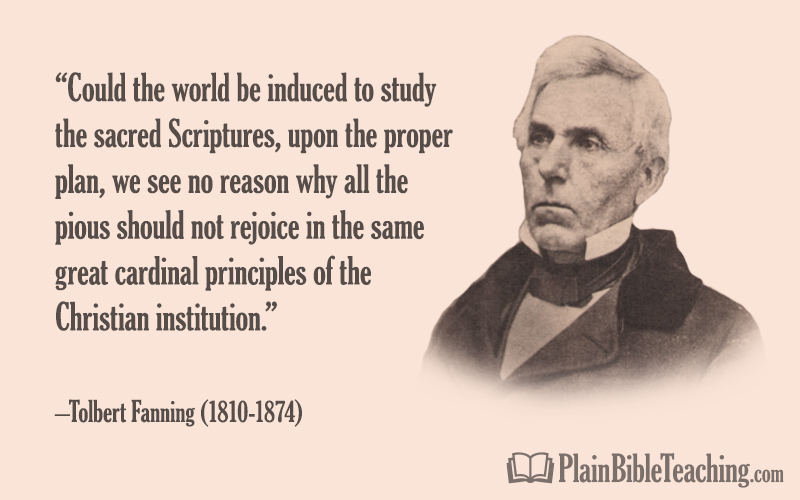
Most religiously-minded people will affirm that reading the Bible is vital. Many of these would also say that studying the Scriptures is important. Yet among those who read and study the Bible, there is usually a wide range of beliefs and practices that often conflict with and contradict one another. Is this to be expected and accepted? Or is that a sign that we should re-evaluate our approach in studying the Bible?

Tolbert Fanning (1810-1874) was a preacher from Tennessee who had a strong influence among brethren in the South. In his book The True Method of Searching the Scriptures, he outlined seven rules for studying the Bible. As we consider these rules, we will see that these are not just one man’s opinion; instead, these are some basic principles we need to apply if we are to understand God’s word in the way He intended us to understand it.

So let us briefly consider these seven rules for studying the Bible.Continue Reading

Pay Attention

Attention

We receive reminders throughout our lives to pay attention – to our spouses, children, parents, teachers, employers, etc. The Bible also emphasizes the importance of paying attention. In this article, we are going to see what we are – and are not – to pay attention to and why it matters.Continue Reading