“How Can a Young Man Keep His Way Pure?”

Man on wall

Psalm 119 contains 176 verses arranged in twenty-two stanzas. The entire psalm is dedicated to the praise of God’s word. The second stanza begins with a question: “How can a young man keep his way pure?” (Psalm 119:9). As we might expect, the answer to this question is found in the word of God.

Of course, the answer to this question is not limited in application to young men. It is profitable for all of God’s people. So let us examine this passage and see how we can keep our way pure before God.

How can a young man keep his way pure? By keeping it according to Your word. With all my heart I have sought You; do not let me wander from Your commandments. Your word I have treasured in my heart, that I may not sin against You. Blessed are You, O Lord; teach me Your statutes. With my lips I have told of all the ordinances of Your mouth. I have rejoiced in the way of Your testimonies, as much as in all riches. I will meditate on Your precepts and regard Your ways. I shall delight in Your statutes; I shall not forget Your word” (Psalm 119:9-16).

David mentioned eight things we can do to help keep our way pure.
Continue Reading

The Application of Wisdom: Teachings About God (Part 2)

Notes on Proverbs

Trust God

Trust in the Lord with all your heart and do not lean on your own understanding. In all your ways acknowledge Him, and He will make your paths straight. Do not be wise in your own eyes; fear the Lord and turn away from evil. It will be healing to your body and refreshment to your bones” (3:5-8).

Continue Reading

The Application of Wisdom: Teachings About God (Part 1)

Notes on Proverbs

The final point of application in our study of Proverbs has to do with God and our relationship to Him. The entire book of Proverbs has been a discussion of the wisdom that comes from above. Of course, the source of this wisdom is God Himself. But without understanding God and our place before Him, it would be difficult for us to find sufficient reason to trust that His way is best and live our lives according to it. Therefore, we must understand God to fully understand the importance of the wisdom contained in this book.
Continue Reading

Lessons from the Limited Commission

We often remember the “Great Commission” in which Jesus told His apostles, “Go into all the world and preach the gospel to all creation” (Mark 16:15). However, prior to this, Jesus gave His apostles what we may call the “Limited Commission.” They were to “go to the lost sheep of the house of Israel” (Matthew 10:6).

Though we are living in the time since the giving of the Great Commission, there are still important lessons we can learn from the earlier Limited Commission that apply even today.
Continue Reading

The Application of Wisdom: Teachings About Government

Notes on Proverbs

Given the way people talk about government as it relates to the Scriptures, many might assume that there is very little in the way of instruction regarding government in the book of Proverbs. Yet there are quite a few passages that teach us about government, as well as providing instructions both to those in government and those who are subject to governing authorities. We begin with the following verse:

Righteousness exalts a nation, but sin is a disgrace to any people” (14:34).

Continue Reading

“Raccoon” John Smith: A Conscience Not For Sale

The conscience, if properly trained and used, will help one to be faithful to the Lord. Once one knows the truth, his conscience helps motivate him to practice it. If he does not, his conscience strikes him with guilt, motivating him to repentance.

Unfortunately, there are many who know the truth, but choose not to practice it. They may feel guilty at first, but eventually they become “seared in their own conscience as with a branding iron” (1 Timothy 4:2). They have forfeited their good conscience and all the benefits of it. Many sacrifice their conscience for such things as riches, comfort, security, and the approval of others.

This was the test put against “Raccoon” John Smith when he left the Baptist church in order to practice and preach the simple gospel of Christ. Yet Smith made it clear that his conscience could not be bought with any earthly enticements.
Continue Reading

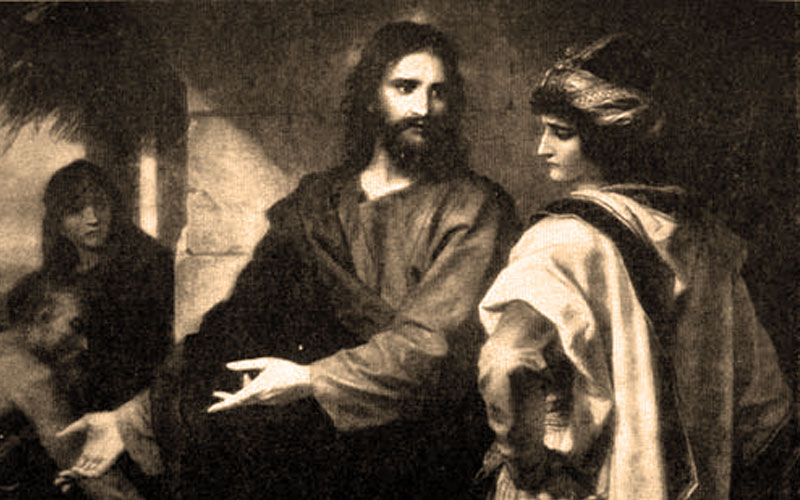
“What Am I Still Lacking?”

Jesus and the Rich Young Ruler

When we begin reading the account of the rich young ruler who came to Jesus (Matthew 19:16-22), we read of one who seemed to be a good man with a good attitude who showed a lot of promise in becoming a disciple of Christ. Notice the good qualities we are told about this man:

  1. He was spiritually minded – He was interested in eternal life and came to Jesus in order to find out how to obtain it (Matthew 19:16).
  2. He was religious – When Jesus listed some of the commandments that he needed to keep, the young man said, “All these things I have kept” (Matthew 19:20).
  3. He was interested in improving his service to God – After affirming that he had been keeping the commandments that Jesus mentioned, he asked, “What am I still lacking?” (Matthew 19:20).

Unfortunately, despite the promise that he showed initially, in the end he “went away grieving” (Matthew 19:22), presumably because he was unwilling to do what Jesus told him to do – sell his possessions, give to the poor, and follow Him (Matthew 19:21).

We need to be like the rich young ruler in the sense that we desire to grow and improve our service to God. However, unlike the rich young ruler, we must also be willing to do the work that is necessary to improve or fix what is lacking in our lives.

We might ask the same question as this man: “What am I still lacking?” Let us notice some things that might be lacking in our service to God so we can see the areas in which we may need to improve.
Continue Reading