Loyalty Rather Than Sacrifice (7/20)

Thought from today’s Bible reading from Hosea 1-7.

What shall I do with you, O Ephraim? What shall I do with you, O Judah? For your loyalty is like a morning cloud and like the dew which goes away early. Therefore I have hewn them in pieces by the prophets; I have slain them by the words of My mouth; and the judgments on you are like the light that goes forth. For I delight in loyalty rather than sacrifice, and in the knowledge of God rather than burnt offerings” (Hosea 6:4-6).

As the wise man said, “Many a man proclaims his own loyalty, but who can find a trustworthy man?” (Proverbs 20:6). It is one thing to claim to be loyal to the Lord. It is quite another to actually be loyal.
Continue Reading

He Broke in Pieces the Bronze Serpent (7/19)

Thought from today’s Bible reading from 2 Kings 18:1-8; 2 Chronicles 29-31; Psalm 48.

Hezekiah was one of the righteous kings of Judah. He did something interesting as he attempted to purge the land of sin.

He did right in the sight of the Lord, according to all that his father David had done. He removed the high places and broke down the sacred pillars and cut down the Asherah. He also broke in pieces the bronze serpent that Moses had made, for until those days the sons of Israel burned incense to it; and it was called Nehushtan.

He trusted in the Lord, the God of Israel; so that after him there was none like him among all the kings of Judah, nor among those who were before him. For he clung to the Lord; he did not depart from following Him, but kept His commandments, which the Lord had commanded Moses” (2 Kings 18:3-6).

Continue Reading

“These Who Have Turned the World Upside Down”

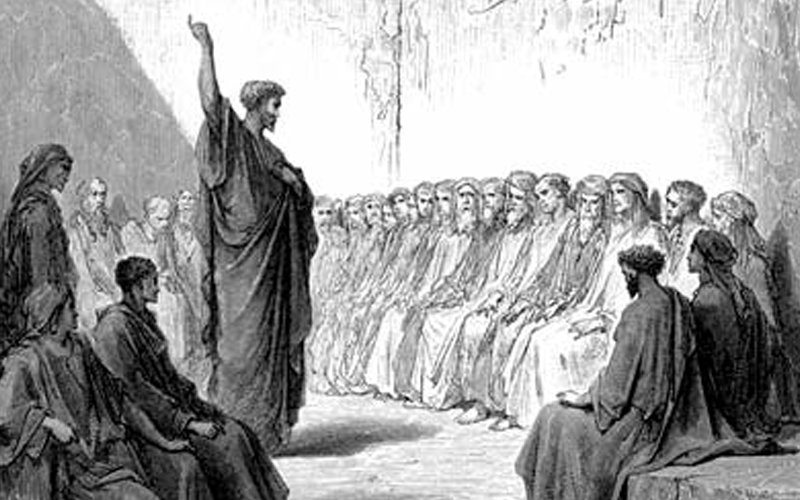
Paul preaching in Thessalonica

After just a few weeks of Paul preaching in Thessalonica, the gospel had been received by some of the Jews and “a large number of the God-fearing Greeks and a number of the leading women” (Acts 17:1-4). In an effort to try to silence this message, the Jews intended to capture Paul and Silas. When they could not find them, they took Jason and some of the brethren and brought them before the authorities in order to accuse them.

When they did not find them, they began dragging Jason and some brethren before the city authorities, shouting, ‘These men who have upset the world have come here also; and Jason has welcomed them, and they all act contrary to the decrees of Caesar, saying that there is another king, Jesus’” (Acts 17:6-7).

Continue Reading

He Casts Down the Unassailable City (7/18)

Thought from today’s Bible reading from Isaiah 23-27.

The following passage speaks of God’s judgment against the mighty Babylon, reminding us of the need to trust in the Lord.

Trust in the Lord forever, for in God the Lord, we have an everlasting Rock. For He has brought low the unassailable city; He lays it low, He lays it low to the ground, He casts it to the dust” (Isaiah 26:4-5).

Man tends to place a lot of confidence in his own strength and accomplishments. The city spoken of here was supposedly “unassailable.” The people of the city may have felt very secure. Opposing armies that might have considered attacking the city may have seen it as a daunting task. But even a city that is thought to be “unassailable” is not totally secure.
Continue Reading

“Let Us Eat and Drink, For Tomorrow We May Die” (7/17)

Thought from today’s Bible reading from Isaiah 18-22.

Judgment was coming against the people of God. Yet instead of this warning being met with careful self-examination and repentance, the people ignored it and acted as if nothing was wrong and nothing would happen.

Therefore in that day the Lord God of hosts called you to weeping, to wailing, to shaving the head and to wearing sackcloth. Instead, there is gaiety and gladness, killing of cattle and slaughtering of sheep, eating of meat and drinking of wine: ‘Let us eat and drink, for tomorrow we may die.’ But the Lord of hosts revealed Himself to me, ‘Surely this iniquity shall not be forgiven you until you die,’ says the Lord God of hosts” (Isaiah 22:12-14).

Interestingly, these people recognized the brevity and uncertainty of life. They knew that though they were here today, they could be gone tomorrow. Yet their response to this reality was feasting and revelry as if there was no more to look forward to past this life.
Continue Reading

Taunt Against the King of Babylon (7/16)

Thought from today’s Bible reading from Isaiah 13-17.

God was going to use the kingdom of Babylon to punish His people (Isaiah 13:1-16). After this, the Medes would rise up against Babylon and would overthrow it (Isaiah 13:17-22), resulting in God’s people being released from Babylonian captivity (Isaiah 14:1-3). The people were then instructed to “take up this taunt against the king of Babylon” (Isaiah 14:4). Part of this taunt was meant to ridicule the arrogance of Babylon.

How you have fallen from heaven, O star of the morning, son of the dawn! You have been cut down to the earth. You who have weakened the nations! But you said in your heart, ‘I will ascend to heaven; I will raise my throne above the stars of God, and I will sit on the mount of assembly in the recesses of the north. I will ascend above the heights of the clouds; I will make myself like the Most High. Nevertheless you will be thrust down to Sheol, to the recesses of the pit” (Isaiah 14:12-15).

The leaders of Babylon had tried to put themselves in the place of God. They failed, and God overthrew them. However, this attempt was nothing new. Babylon had its beginnings in an attempt to ascend up to heaven and occupy the place of God.
Continue Reading

Why Did Israel Fall? (7/15)

Thought from today’s Bible reading from 2 Chronicles 28; 2 Kings 16-17.

In the ninth year of Hoshea, the king of Assyria captured Samaria and carried Israel away into exile to Assyria, and settled them in Halah and Habor, on the river of Gozan, and in the cities of the Medes” (2 Kings 17:6).

After a long period of trouble and instability in Israel, the people were finally taken away from their homeland, the land that God had promised their fathers, and relocated by force to Assyria. Why would God bring this upon them? The text goes on to list the reasons why they were punished in this way.
Continue Reading








