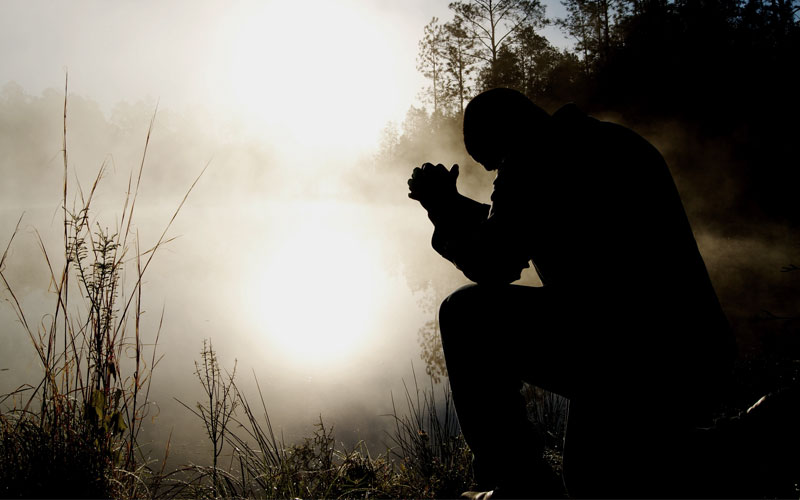
Pray for Those in Authority

Prayer

One of our specific obligations in prayer is to pray for those in positions of civil authority. Paul made this clear in his first letter to the young evangelist Timothy:

First of all, then, I urge that entreaties and prayers, petitions and thanksgivings, be made on behalf of all men, for kings and all who are in authority, so that we may lead a tranquil and quiet life in all godliness and dignity. This is good and acceptable in the sight of God our Savior, who desires all men to be saved and to come to the knowledge of the truth” (1 Timothy 2:1-4).

Not only did Paul teach that Christians are to pray for their leaders, he explained why we are to pray for them. There is a specific desire for which we should pray that is according to the will of God. Before we consider this, we should first be reminded of the purpose for which God ordained civil authorities.
Continue Reading


Hypocritical Condemnation – Judah and Tamar (1/25)

Thought from today’s Bible reading from Genesis 38-40.

Genesis 38 is a tragedy caused by the moral bankruptcy of the individuals involved. First Judah’s son Er was killed for his wickedness (Genesis 38:7). With his widow Tamar left childless, the responsibility fell to his brother Onan to have children with her. He forsook this responsibility and was killed (Genesis 38:8-10). Then Judah told Tamar to remain unmarried until the third son, Shelah, was old enough to marry her (Genesis 38:11).

However, Judah did not honor his promise. So Tamar decided to trick her father-in-law, pose as a harlot, and commit fornication with him. In the process she conceived (Genesis 38:12-18). Eventually, her sin would be obvious.
Continue Reading

Preparing to Offer Sacrifices to God (1/24)

Thought from today’s Bible reading from Genesis 35-37.

Then God said to Jacob, ‘Arise, go up to Bethel and live there, and make an altar there to God, who appeared to you when you fled from your brother Esau.’ So Jacob said to his household and to all who were with him, ‘Put away the foreign gods which are among you, and purify yourselves and change your garments; and let us arise and go up to Bethel, and I will make an altar there to God, who answered me in the day of my distress and has been with me wherever I have gone’” (Genesis 35:1-3).

Jacob was to build an altar to worship God. But three things had to be done first by those who would approach the Lord at Bethel. They had to put away any foreign gods, purify themselves, and change their garments.
Continue Reading

Unworthy of God’s Lovingkindness (1/23)

Thought from today’s Bible reading from Genesis 32-34.

When Jacob departed from Laban and traveled toward his home country, he was fearful of the prospect of meeting his brother Esau. This was certainly understandable since Esau was seeking to kill him when he left (Genesis 27:41-43). When he heard that Esau was coming to meet him with four hundred men (Genesis 32:6), Jacob prayed to God.

O God of my father Abraham and God of my father Isaac, O Lord, who said to me, ‘Return to your country and to your relatives, and I will prosper you,’ I am unworthy of all the lovingkindness and of all the faithfulness which You have shown to Your servant; for with my staff only I crossed this Jordan, and now I have become two companies. Deliver me, I pray, from the hand of my brother, from the hand of Esau; for I fear him, that he will come and attack me and the mothers with the children” (Genesis 32:9-11).

Continue Reading

"May the Lord Give Me Another Son" (1/22)

Thought from today’s Bible reading from Genesis 30-31.

After Leah bore four sons to Jacob (Genesis 29:31-35), her sister Rachel was jealous, wishing she would also be able to bear children. Her emotions got the best of her. She demanded of Jacob, “Give me children, or else I die” (Genesis 30:1). Jacob reminded her that he was not in the place of God; therefore, he could only do so much (Genesis 30:2).

After this, Rachel gives Jacob her handmaid and she bore him two sons (Genesis 30:3-8). Then Leah gave him her handmaid and she bore two more sons (Genesis 30:9-13). Later, Leah bore Jacob another two sons and a daughter (Genesis 30:17-21). All the while, Rachel was barren. Then, at last, God allowed her to conceive.
Continue Reading

Esau’s Blessing (1/21)

Thought from today’s Bible reading from Genesis 27-29.

Esau, as the firstborn, expected to receive the blessing from his father before he died. Isaac expected to give the blessing of the firstborn to Esau. Yet Jacob came first and deceived Isaac and received the blessing from his father (Genesis 27:18-29).

When it was discovered what had happened, Isaac “trembled violently” (Genesis 27:33) and Esau “cried out with an exceedingly great and bitter cry, and said to his father, ‘Bless me, even me also, O my father!’” (Genesis 27:34).

With the blessing of the firstborn given to Jacob, and Esau begging his father for a blessing, what would Isaac do now for his favored son?
Continue Reading

Esau Despised His Birthright (1/20)

Thought from today’s Bible reading from Genesis 25-26.

Esau and Jacob, though twin brothers, were very different from one another. “Esau became a skillful hunter, a man of the field, but Jacob was a peaceful man, living in tents” (Genesis 25:27). One day when Esau returned from the field hungry, Jacob took advantage of the opportunity to secure the birthright in exchange for his stew.

Esau said to Jacob, ‘Please let me have a swallow of that red stuff there, for I am famished.’ … But Jacob said, ‘First sell me your birthright.’ Esau said, ‘Behold, I am about to die; so what use then is the birthright to me?’ And Jacob said, ‘First swear to me’; so he swore to him, and sold his birthright to Jacob. … Thus Esau despised his birthright” (Genesis 25:30-34).

The birthright, among other things, was the right of the firstborn to the greater inheritance. Esau forfeited long-term prosperity for short-term comfort. He gave away the firstborn’s inheritance for a single meal.
Continue Reading







