God’s Laws Apply to All (9/29)

Thought from today’s Bible reading from Nehemiah 11-13; Psalm 126.

On that day they read aloud from the book of Moses in the hearing of the people; and there was found written in it that no Ammonite or Moabite should ever enter the assembly of God, because they did not meet the sons of Israel with bread and water, but hired Balaam against them to curse them. However, our God turned the curse into a blessing. So when they heard the law, they excluded all foreigners from Israel” (Nehemiah 13:1-3).

This instruction regarding the Ammonites and Moabites is found in Deuteronomy 23:3-5. When the people learned that “none of their descendants…shall ever enter the assembly of the Lord” (Deuteronomy 23:3), they excluded them from being able to enter the assembly.

Unfortunately, Eliashib the priest apparently believed that he and his relatives were exempt from this command.
Continue Reading

"You Have Nothing in Common with Us" (9/19)

Thought from today’s Bible reading from Ezra 4-6; Psalm 137.

When the people returned to Jerusalem to rebuild the temple, they received an offer of assistance from an unexpected source – the enemies of Judah and Benjamin.

Now when the enemies of Judah and Benjamin heard that the people of the exile were building a temple to the Lord God of Israel, they approached Zerubbabel and the heads of fathers’ households, and said to them, ‘Let us build with you, for we, like you, seek your God; and we have been sacrificing to Him since the days of Esarhaddon king of Assyria, who brought us up here.’ But Zerubbabel and Jeshua and the rest of the heads of fathers’ households of Israel said to them, ‘You have nothing in common with us in building a house to our God; but we ourselves will together build to the Lord God of Israel, as King Cyrus, the king of Persia has commanded us’” (Ezra 4:1-3).

Were the leaders of the people justified in rejecting this help? After all, these “enemies” did believe in God and offered sacrifices to Him. But just because they believed in the Lord and offered some kind of sacrifices, that did not make them brethren.
Continue Reading

“These Who Have Turned the World Upside Down”

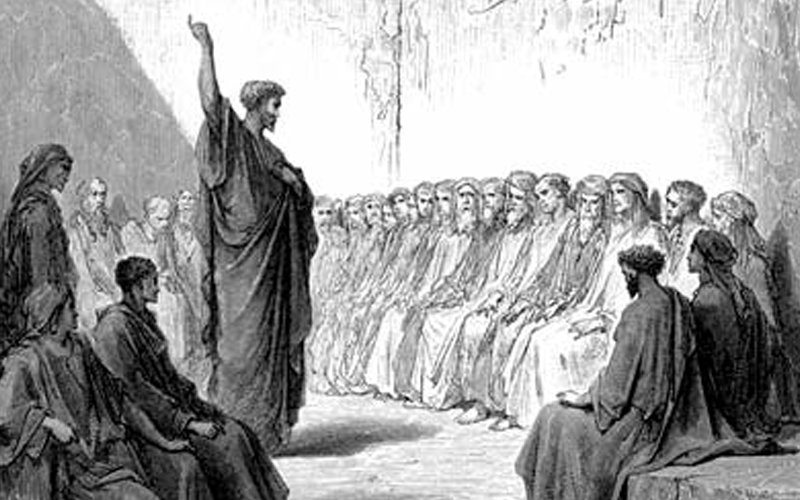
Paul preaching in Thessalonica

After just a few weeks of Paul preaching in Thessalonica, the gospel had been received by some of the Jews and “a large number of the God-fearing Greeks and a number of the leading women” (Acts 17:1-4). In an effort to try to silence this message, the Jews intended to capture Paul and Silas. When they could not find them, they took Jason and some of the brethren and brought them before the authorities in order to accuse them.

When they did not find them, they began dragging Jason and some brethren before the city authorities, shouting, ‘These men who have upset the world have come here also; and Jason has welcomed them, and they all act contrary to the decrees of Caesar, saying that there is another king, Jesus’” (Acts 17:6-7).

Continue Reading

What Is Lost Because of Sin

Satan tempts us to sin by highlighting its supposed benefits. The Scriptures acknowledge that there is a certain amount of pleasure that can be derived from sin. Yet Moses understood that such pleasure was “passing” and that the rewards for rejecting God could not compare with God’s rewards for the faithful (Hebrews 11:25-26). But Satan does not want us to look beyond what is immediately before us. He wants us to focus on the temporary pleasures we can gain from sin and ignore those things which we stand to lose because of sin.

What is it that we stand to lose because of sin? To answer this, let us consider what was lost in the beginning when sin was first introduced into the world.
Continue Reading

Destroying a City Over One Man (5/19)

Thought from today’s Bible reading from 2 Samuel 19-21.

Sheba, leader of a rebellion against David, was pursued and trapped by Joab in the city of Beth-maacah. In an effort to capture this man, Joab besieged the city and his men began attacking the wall in order to topple it (2 Samuel 20:14-15). As this was happening, a wise woman came out to reason with Joab in order to spare the city.

‘I am of those who are peaceable and faithful in Israel. You are seeking to destroy a city, even a mother in Israel. Why would you swallow up the inheritance of the Lord?’ Joab replied, ‘Far be it, far be it from me that I should swallow up or destroy! Such is not the case. But a man from the hill country of Ephraim, Sheba the son of Bichri by name, has lifted up his hand against King David. Only hand him over, and I will depart from the city.’ And the woman said to Joab, ‘Behold, his head will be thrown to you over the wall.’

Then the woman wisely came to all the people. And they cut off the head of Sheba the son of Bichri and threw it to Joab. So he blew the trumpet, and they were dispersed from the city, each to his tent. Joab also returned to the king in Jerusalem” (2 Samuel 20:19-22).

There are some principles of justice found in this account:
Continue Reading

The Desire for Unity (5/2)

Thought from today’s Bible reading from Psalm 133.

Behold, how good and how pleasant it is for brothers to dwell together in unity! It is like the precious oil upon the head, coming down upon the beard, even Aaron’s beard, coming down upon the edge of his robes. It is like the dew of Hermon coming down upon the mountains of Zion; for there the Lord commanded the blessing—life forever” (Psalm 133:1-3).

Unity among God’s people is something we should all desire. In this short psalm, David makes two comparisons to illustrate why unity is good and pleasant.
Continue Reading

Spiritual Pacifism (4/2)

Thought from today’s Bible reading from Judges 8-9.

After defeating the Midianites with only 300 men armed with trumpets and pitchers, Gideon pursued the kings of Midian, Zebah and Zalmunna. Along the way they stopped in Succoth hoping to receive bread to help them finish their mission. However, the leaders were not at all eager to help.

Then Gideon and the 300 men who were with him came to the Jordan and crossed over, weary yet pursuing. He said to the men of Succoth, ‘Please give loaves of bread to the people who are following me, for they are weary, and I am pursuing Zebah and Zalmunna, the kings of Midian.’

The leaders of Succoth said, ‘Are the hands of Zebah and Zalmunna already in your hands, that we should give bread to your army?’ Gideon said, ‘All right, when the Lord has given Zebah and Zalmunna into my hand, then I will thrash your bodies with the thorns of the wilderness and with briers’” (Judges 8:4-7).

The leaders of Succoth were perfectly willing to provide aid and support to Gideon and his men after the Midianite kings were killed. But while the kings were still alive, these men refused to get involved.
Continue Reading