Add to Your Faith (Part 3): Add Knowledge

Add to Your Faith

As we continue our series about characteristics we are to add to our faith, we now turn our attention to knowledge. In the previous lesson, we discussed moral excellence or virtue, which is a moral goodness that can be seen by others. If we want to continue to grow in that quality, we must know what is good and right.

Now for this very reason also, applying all diligence, in your faith supply moral excellence, and in your moral excellence, knowledge, and in your knowledge, self-control, and in your self-control, perseverance, and in your perseverance, godliness, and in your godliness, brotherly kindness, and in your brotherly kindness, love. For if these qualities are yours and are increasing, they render you neither useless nor unfruitful in the true knowledge of our Lord Jesus Christ” (2 Peter 1:5-8).

Continue Reading

Better Not to Know (Sermon #41)

Subscribe: iTunes | Stitcher | RSS

Better Not to Know (Sermon #41)

We’re in between season 12 and season 13. During the break we’re posting audio sermons each week instead of the regular episodes. The sermon for this week was preached on February 10, 2019 at the Eastside church of Christ in Morgantown, KY.

If you found this episode to be useful, please share it with others. Also, if you enjoyed the podcast, please leave a rating on iTunes or Stitcher. This also helps others hear about the podcast. Thanks.

Are You Perfect?

Perfect

[This article was written by Bill Reeves and has been reformatted for viewing online.]

1 Jn. 1:5-10, the controverted text (ver. 7) and context:

“And this is the message which we have heard from him and announce unto you, that God is light, and in him is no darkness at all. If we say that we have fellowship with him and walk in the darkness, we lie, and do not the truth: but if we walk in the light, as he is in the light, we have fellowship one with another, and the blood of Jesus his Son cleanseth us from all sin [conditionally, ver. 9!]. If we say that we have no sin [that is, deny the reality of sin as the Gnostics did], we deceive ourselves, and the truth is not in us. If [conditionality] we confess our sins [anytime they are committed], he is faithful and righteous to forgive us our sins, and to cleanse us from all unrighteousness. If we say that we have not sinned [as the Gnostics did, and therefore would not confess their sins] we make him a liar [as they did], and his word is not in us [as it is not in them].”

The phrase “walking in the light” has been used by neo-Calvinistic brethren to assert that if one is “walking in the light” (as they define it), that God continually cleanses them of their sins even as they sin! The bottom line of the issue is the so-called “depraved nature” in man.

“Are you perfect?” is the question often stated by the proponents of this error in an effort to stop the mouths of their opponents. The question is totally invalid, until the terms are defined! Let them tell us what they mean by the word “perfect” in their question. They don’t do it! It is a scare tactic. The question is supposed to halt the one questioned, because no one wants to appear as if he never sins, nor could ever sin again in the future, that he is absolutely like God in sinlessness (although he actually is, when pardoned by God – he has no sins!).Continue Reading

Add Knowledge (Season 12, Episode 4)

Subscribe: iTunes | Stitcher | RSS

Add Knowledge (Season 12, Episode 4)

In this season, we’re discussing Peter’s admonition to add to your faith (2 Peter 1:5-11).

One of the qualities are are to add to our faith is knowledge. In this episode, we discuss what this is, what it looks like with and without faith, and how we go about adding it to our faith.

Mentioned in this episode:

  • Plain Bible Teaching Quarterly Review – Free PDF for Plain Bible Teaching subscribers. Sign up here!

If you found this episode to be useful, please share it with others. Also, if you enjoyed the podcast, please leave a rating on iTunes or Stitcher. This also helps others hear about the podcast. Thanks.

From Saul to Paul (Sermon #29)

Subscribe: iTunes | Stitcher | RSS

From Saul to Paul (Sermon #29)

We’re in between season 10 and season 11. During the break we’re posting audio sermons each week instead of the regular episodes. The sermon for this week was preached on March 11, 2018 at the Eastside church of Christ in Morgantown, KY.

If you found this episode to be useful, please share it with others. Also, if you enjoyed the podcast, please leave a rating on iTunes or Stitcher. This also helps others hear about the podcast. Thanks.

The Psalm of the Word (Part 13): Understanding

The Psalm of the Word

O how I love Your law!
It is my meditation all the day.

Your commandments make me wiser than my enemies,
For they are ever mine.

I have more insight than all my teachers,
For Your testimonies are my meditation.

I understand more than the aged,
Because I have observed Your precepts.

I have restrained my feet from every evil way,
That I may keep Your word.

I have not turned aside from Your ordinances,
For You Yourself have taught me.

How sweet are Your words to my taste!
Yes, sweeter than honey to my mouth!

From Your precepts I get understanding;
Therefore I hate every false way.

(Psalm 119:97-104)

God meant for His word to be understood and it can be understood by anyone. Furthermore, with the right attitude, we can continue to progress in our understanding, even to the point that we surpass those who might be expected to be “older and wiser” than we are. So let us consider what the psalmist said about the understanding we gain from God’s word.
Continue Reading

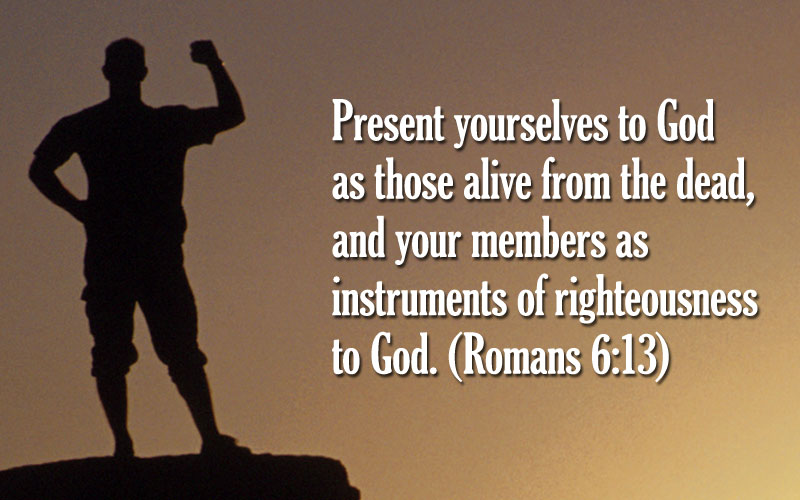
Using Our Bodies as Instruments of Righteousness

Romans 6:13

Therefore do not let sin reign in your mortal body so that you obey its lusts, and do not go on presenting the members of your body to sin as instruments of unrighteousness; but present yourselves to God as those alive from the dead, and your members as instruments of righteousness to God. For sin shall not be master over you, for you are not under law but under grace” (Romans 6:12-14).

Our bodies can be used one of two ways – either for God or for sin. As Christians, we are to present our bodies as living sacrifices to God (Romans 12:1). Our bodies are “for the Lord” (1 Corinthians 6:13); therefore, Paul said, “Glorify God in your body” (1 Corinthians 6:20).

How do we use the members of our bodies as instruments of righteousness? Let us consider what the Scriptures teach about this.
Continue Reading