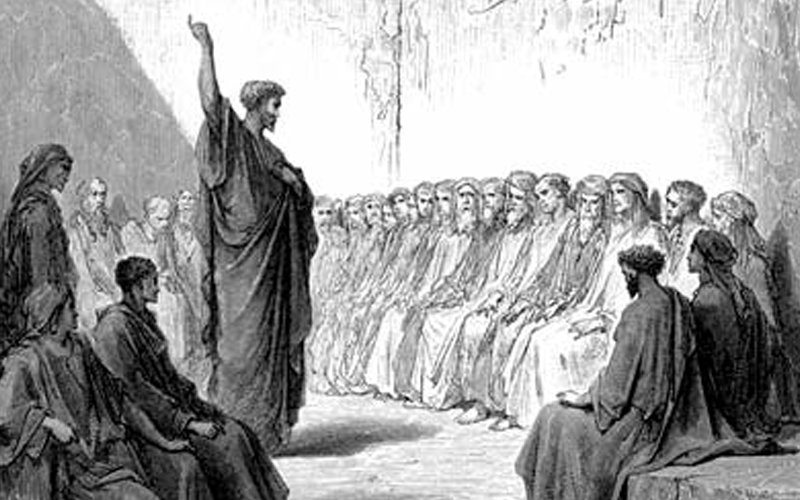
A Stone of Stumbling

Jesus first came to “the lost sheep of the house of Israel” (Matthew 15:24). The Jews had the benefit of the Law to lead them to Christ (Galatians 3:24). They saw the miracles and heard His teaching. Yet the majority rejected Him. Why? Peter explained by quoting the prophet Isaiah. Jesus was rejected because He was “a stone of stumbling and a rock of offense” (1 Peter 2:8). Let us notice some of the reasons why Jesus was to the Jewish people “a stone of stumbling.
Continue Reading

Samuel’s First Message from the Lord (4/8)

Thought from today’s Bible reading from 1 Samuel 1-3.

As a boy, Samuel “ministered to the Lord before Eli the priest” (1 Samuel 2:11). At this time the Lord spoke to Samuel, calling him three times, yet each time Samuel thought it was Eli who was calling him (1 Samuel 3:4-8).

Now Samuel did not yet know the Lord, nor had the word of the Lord yet been revealed to him” (1 Samuel 3:7).

Naturally, Samuel did not recognize the voice of the Lord. After Eli figured out what was happening and told him to listen to the word of the Lord, God revealed His message to the young boy.
Continue Reading

"You Will Not Be Able to Serve the Lord" (3/29)

Thought from today’s Bible reading from Joshua 22-24.

If it is disagreeable in your sight to serve the Lord, choose for yourselves today whom you will serve: whether the gods which your fathers served which were beyond the River, or the gods of the Amorites in whose land you are living; but as for me and my house, we will serve the Lord” (Joshua 24:15).

This is one of the more well-known verses in the Bible. Joshua, toward the end of his life, challenged the Israelites to choose to either serve God or not. His decision was already made – he and his house would serve the Lord. But he told them they would have to make their own choice.
Continue Reading

You Shall Not Neglect the Levite (3/16)

Thought from today’s Bible reading from Deuteronomy 14-16.

Also you shall not neglect the Levite who is in your town, for he has no portion or inheritance among you” (Deuteronomy 14:27).

The tribe of Levi was unique in the nation of Israel. Unlike the other tribes, the Levites did not receive a possession when the promised land was divided among the tribes. The reason for this had to do with the specific duty God gave to the Levites.

To the sons of Levi, behold, I have given all the tithe in Israel for an inheritance, in return for their service which they perform, the service of the tent of meeting. […] Only the Levites shall perform the service of the tent of meeting, and they shall bear their iniquity; it shall be a perpetual statute throughout your generations, and among the sons of Israel they shall have no inheritance. For the tithe of the sons of Israel, which they offer as an offering to the Lord, I have given to the Levites for an inheritance; therefore I have said concerning them, ‘They shall have no inheritance among the sons of Israel’” (Numbers 18:21-24).

The Levites were devoted to a spiritual work. Therefore, God made this provision for them. Though they had no inheritance in the land, they would receive their livelihood from the tithes given by the people.
Continue Reading

"What the Lord Speaks, That I Will Speak" (3/5)

Thought from today’s Bible reading from Numbers 23-25.

Balak, king of Moab, feared the Israelites. He saw what they had already done to the Amorites and sought help from Balaam to curse the people. But in three attempts, Balaam blessed the Israelites each time instead of cursing them.

Then Balak’s anger burned against Balaam, and he struck his hands together; and Balak said to Balaam, ‘I called you to curse my enemies, but behold, you have persisted in blessing them these three times! Therefore, flee to your place now. I said I would honor you greatly, but behold, the Lord has held you back from honor.’

Balaam said to Balak, ‘Did I not tell your messengers whom you had sent to me, saying, ‘Though Balak were to give me his house full of silver and gold, I could not do anything contrary to the command of the Lord, either good or bad, of my own accord. What the Lord speaks, that I will speak’?” (Numbers 24:10-13).

Balaam is more known for his faults than his virtues. Yet his attitude here is commendable. He told Balak that no matter what the king offered him, he could not speak anything but what the Lord revealed to him.
Continue Reading

By the Grace of God

Paul

In presenting evidence to support the resurrection of Christ, Paul told the brethren in Corinth of several eyewitnesses who could verify that Jesus did in fact rise from the dead. The last of these eyewitnesses that Paul mentioned was himself: “And last of all, as to one untimely born, He appeared to me also” (1 Corinthians 15:8).

At this point, Paul took a short break from his discussion about the historicity of Jesus’ resurrection to make a point about the grace of God:

For I am the least of the apostles, and not fit to be called an apostle, because I persecuted the church of God. But by the grace of God I am what I am, and His grace toward me did not prove in vain; but I labored even more than all of them, yet not I, but the grace of God with me. Whether then it was I or they, so we preach and so you believed” (1 Corinthians 15:9-11).

Paul made four points in these three verses about the grace of God. Let us consider these briefly.
Continue Reading

Benjamin Franklin’s Beginning in Preaching

Not long after being converted out of Methodism, the young Benjamin Franklin (1812-1878) began preaching, taking advantage of every opportunity he could find.

Benjamin FranklinAnd, as already mentioned in the preceding chapter, he at once began to preach, and he never stopped for anything but serious sickness of himself or family. At first it was only an effort to ‘exhort’ a little at the regular meetings of the church, or after someone else had preached. Then an appointment to preach somewhere at night, in some school-house, or in some private dwelling, was ventured upon. To these appointments he would often walk, three, four, or five miles, after a hard day’s work. Two or three of the young preachers generally met together and united in the exercises of the meeting. And thus, gradually, he directed the forces of his mind and body to the work, until he lost his interest in all other employments. Four years after his obedience to the Gospel he sold out the mill property, and was never afterward engaged in any regular secular business.” (The Life and Times of Benjamin Franklin, p. 59-60)

Continue Reading