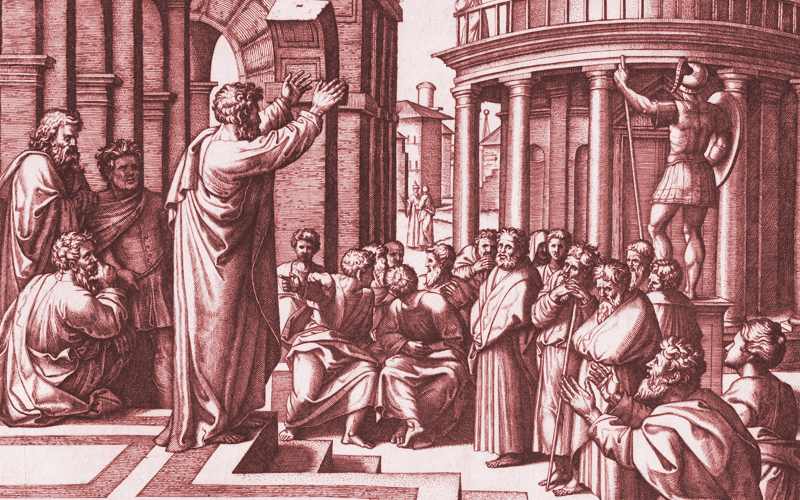
God’s Declaration to All Men

Paul in Athens

When Paul addressed the philosophers in Athens, he taught them about the “unknown God” (Acts 17:23). He explained how the living and true God is different from all man-made idols. God created the world, made us in His image, and provided us with all good things to enjoy. Paul concluded his message with the declaration that God was now making to all:

Therefore having overlooked the times of ignorance, God is now declaring to men that all people everywhere should repent, because He has fixed a day in which He will judge the world in righteousness through a Man whom He has appointed, having furnished proof to all men by raising Him from the dead” (Acts 17:30-31).

This message was not for the Athenians alone. All men who lived from that time to today, and for as long as the world stands, need to heed this message. So let us examine what God is declaring to us even today.Continue Reading

Steps to Achieving Righteousness

Walking Up Stairs

The book of James is filled with practical instructions for our lives as Christians. In the following passage, James discussed, in practical terms, how to be righteous.

This you know, my beloved brethren. But everyone must be quick to hear, slow to speak and slow to anger; for the anger of man does not achieve the righteousness of God. Therefore, putting aside all filthiness and all that remains of wickedness, in humility receive the word implanted, which is able to save your souls. But prove yourselves doers of the word, and not merely hearers who delude themselves” (James 1:19-22).

Our aim is to “achieve the righteousness of God.” How do we do that? James outlined four steps we can take to reach this goal.Continue Reading

The Lost Sheep

One Sheep

The parable of the lost sheep is one of the more well-known parables of Jesus. It teaches us of God’s love for us, even when we wander away from Him. It also shows us what our attitude should be toward those who wander off and are restored. It is good to be reminded of parables like this one, and also to make the proper application. Let us consider this parable together.

What man among you, if he has a hundred sheep and has lost one of them, does not leave the ninety-nine in the open pasture and go after the one which is lost until he finds it? When he has found it, he lays it on his shoulders, rejoicing. And when he comes home, he calls together his friends and his neighbors, saying to them, ‘Rejoice with me, for I have found my sheep which was lost!’ I tell you that in the same way, there will be more joy in heaven over one sinner who repents than over ninety-nine righteous persons who need no repentance” (Luke 15:4-7).

In order to understand the point of the parable, we need to recognize the circumstances in which it was given. Luke noted that “the tax collectors and the sinners were coming near [Jesus] to listen to Him” (Luke 15:1). Yet the parable was not directed at them. Instead, Jesus told it to Pharisees and scribes who “began to grumble” against Him because these individuals were coming to Him (Luke 15:2-3).

In the parable, Jesus described a man with one hundred sheep, and one of them wandered off. Rather than throwing up his hands and immediately giving up on the wayward sheep, he left to find it. Amazingly, he was successful, and when he returned with it, he rejoiced with his friends and neighbors. The sheep in the parable represent God’s people – those who already belonged in the fold, whether faithful or wayward.Continue Reading

Renewed Day by Day

Sunrise

Therefore we do not lose heart, but though our outer man is decaying, yet our inner man is being renewed day by day” (2 Corinthians 4:16).

Many see the start of a new year as a time of renewal – an opportunity to change the direction of their lives, to improve themselves in some way, and so on. The basic idea of this is good. However, as with all things, we need to think about it Biblically.

There are a few passages in the New Testament that talk about being renewed. When it is mentioned in the Bible, it is not tied to a certain day on the calendar. It is also not about just anything that might be new in our lives (new job, diet, exercise routine, etc.). Instead, the renewal discussed in the New Testament is always about improving our spiritual lives.

In this article, we will consider what the New Testament says about renewal – when it happens, what it means, and what the result of it is in our lives.Continue Reading

Sowing and Reaping

Sowing

Do not be deceived, God is not mocked; for whatever a man sows, this he will also reap” (Galatians 6:7).

God created this world, which operates according to the rules He has established. This was part of the foundation of His promise to Noah after the flood: “While the earth remains, seedtime and harvest, and cold and heat, and summer and winter, and day and night shall not cease” (Genesis 8:22). Each of these represented a natural cycle that God established in His creation. Yet one of these cycles – “seedtime and harvest” – referred to more than just a period of time. Harvest indeed follows seedtime or sowing. Yet the outcome of the harvest would depend – at least in part – on what was planted, when it was done, and how it was conducted.

This idea is universally familiar to us. Even if we do not engage in the work of farming, we understand this principle. So this illustration of sowing and reaping is used throughout the Bible to discuss more than just agriculture. We will notice a few passages that teach us about sowing and reaping to see what we are to do, what we are to avoid, and what the consequences are of our choices.Continue Reading

Pressing On Toward the Goal

Mountain Path

At the start of the new year, we focus a lot on goals we want to reach in the future. We may set goals regarding our health, work, or relationships. All of these may be good, but we need to make sure we never lose sight of what should be our primary goal. In writing about his goal to “attain to the resurrection from the dead” (Philippians 3:11), Paul said this:

Not that I have already obtained it or have already become perfect, but I press on so that I may lay hold of that for which also I was laid hold of by Christ Jesus. Brethren, I do not regard myself as having laid hold of it yet; but one thing I do: forgetting what lies behind and reaching forward to what lies ahead, I press on toward the goal for the prize of the upward call of God in Christ Jesus” (Philippians 3:12-14).

In these verses, Paul described three things that he was doing and that we also need to do as Christians. Let us consider them here.Continue Reading

An Unknown but Knowable God

Paul preaching in Athens

When Paul was in Athens, Luke recorded that “his spirit was being provoked within him as he was observing the city full of idols” (Acts 17:16). This prompted him to teach “in the synagogue” and “in the market place every day with those who happened to be present” (Acts 17:17). His message piqued the interest of the philosophers who brought him to the Areopagus so they could hear more about the “strange things” (Acts 17:20) he was teaching.

Though the people of the city were “very religious” (Acts 17:22), the God of heaven was “unknown” (Acts 17:23) to them. So Paul proceeded to teach them about the one true God.

The God who made the world and all things in it, since He is Lord of heaven and earth, does not dwell in temples made with hands; nor is He served by human hands, as though He needed anything, since He Himself gives to all people life and breath and all things; and He made from one man every nation of mankind to live on all the face of the earth, having determined their appointed times and the boundaries of their habitation, that they would seek God, if perhaps they might grope for Him and find Him, though He is not far from each one of us; for in Him we live and move and exist, as even some of your own poets have said, ‘For we are His children.’ Being then the children of God, we ought not to think that the Divine Nature is like gold or silver or stone, an image formed by the art and thought of man” (Acts 17:24-29).

We encounter many today who are like the Athenians. They simply do not know God. How can we begin to teach them? Consider what Paul explained on this occasion to these pagan philosophers.Continue Reading