Why Jesus Came to Save Us

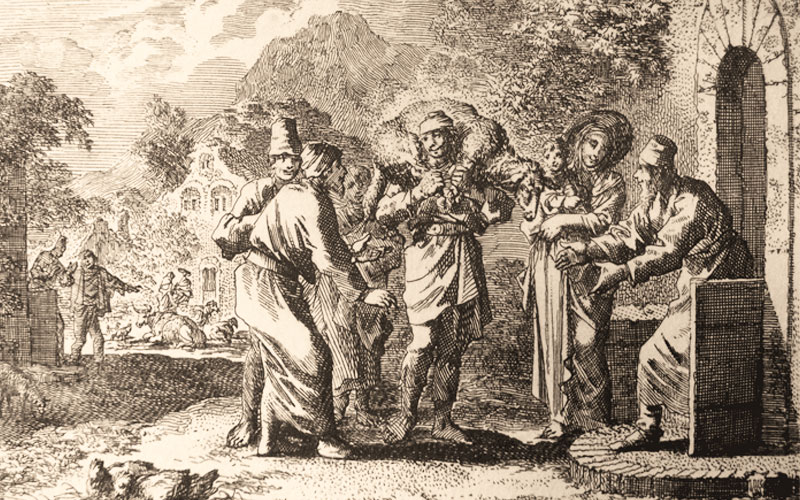
The Lost Sheep

Why did Jesus come to save us? There are several answers we could give that would be correct: He loved us (John 15:13), the Father loved us (John 3:16), He needed to fulfill “the eternal purpose” (Ephesians 3:11), He wanted to “bring us to God” (1 Peter 3:18), and so on. But why did we need to be saved? Notice what Jesus said:

For the Son of Man has come to seek and to save that which was lost” (Luke 19:10).

Simply put, Jesus came to save us because we were lost. In Luke 15, Jesus used three parables to describe things that were lost: the lost sheep (Luke 15:3-7), the lost coin (Luke 15:8-10), and the lost son (Luke 15:11-24). When we consider these three parables, we learn several lessons: (1) why being lost is dangerous for us, (2) why the Lord saw fit to seek for us when we were lost, and (3) what our responsibility is in being saved.
Continue Reading

“They May Have the Right to the Tree of Life” (12/31)

Thought from today’s Bible reading from Revelation 19-22.

Those who believe salvation is by grace or faith alone will often charge those of us who believe that obedience is necessary for salvation as trying to somehow earn salvation. While we should answer this false charge, we must also not be afraid to affirm all that the Scriptures teach. Notice these words near the close of the final book of the Bible:

Behold, I am coming quickly, and My reward is with Me, to render to every man according to what he has done” (Revelation 22:12).

Blessed are those who wash their robes, so that they may have the right to the tree of life, and may enter by the gates into the city” (Revelation 22:14).

We will be judged according to what we have done. We will be rewarded if our deeds are good when judged according to the Lord’s word. If we wash our robes, or “do his commandments” (KJV), we will enter the city and partake of the tree of life.
Continue Reading

A Message of Life or Death

2 Corinthians 2:15-16

Often when people want to emphasize the serious nature of a matter, they describe it as “a matter of life or death.” The gospel is certainly a serious matter as it pertains to our eternal life or death (Romans 6:23). But in another sense, the gospel is a message of either life or death depending on how it is received by the one who hears it. Notice what Paul wrote to the brethren in Corinth:

For we are a fragrance of Christ to God among those who are being saved and among those who are perishing; to the one an aroma from death to death, to the other an aroma from life to life” (2 Corinthians 2:15-16).

For some, the gospel is a message “from life to life.” For others, it is a message “from death to death.” Which one depends on how the hearer perceives it. Let us notice the difference in perspectives.
Continue Reading

“If You Continue in His Kindness” (12/10)

Thought from today’s Bible reading from Romans 11-13.

The “once saved, always saved” doctrine is very comforting for those who believe it – after one is saved, he does not need to worry about doing anything that would jeopardize his salvation. While this idea is appealing for obvious reasons, it is simply not true. Notice the following passage:

You will say then, ‘Branches were broken off so that I might be grafted in.’ Quite right, they were broken off for their unbelief, but you stand by your faith. Do not be conceited, but fear; for if God did not spare the natural branches, He will not spare you, either. Behold then the kindness and severity of God; to those who fell, severity, but to you, God’s kindness, if you continue in His kindness; otherwise you also will be cut off” (Romans 11:19-22).

Paul had just explained that after the Jews (in large part) rejected Christ, the gospel was then made available to the Gentiles (Romans 11:11). As a result, the Gentiles could be saved and “grafted in” to become part of God’s people.
Continue Reading

“Obedience of Faith” (12/7)

Thought from today’s Bible reading from Acts 20:1-3; Romans 1-3.

The epistle of Romans is widely regarded as Paul’s explanation of how we are justified by faith. This is certainly discussed in this letter (Romans 5:1), but many misapply these teachings because they begin with a flawed definition of faith.

Generally, those among Protestant churches define faith in such a way that it is completely separate from works. They believe that salvation could only come by one of two ways: by faith or by works. Therefore, they believe that since salvation is by faith (Romans 5:1), then there are no works (obedience) required on our part to be saved. The problem with this is that it is not taught in the New Testament.

Notice what Paul had to say about faith in the beginning of this letter:

Through whom we have received grace and apostleship to bring about the obedience of faith among all the Gentiles for His name’s sake…” (Romans 1:5).

Continue Reading

“That Very Hour of the Night” (11/23)

Thought from today’s Bible reading from Acts 15-16.

The conversion of the Philippian jailer is often used by those who wish to argue that belief is the only requirement God places upon man for his salvation. They try to find any passage they think will support their belief that baptism is not necessary for salvation. Yet this example that they often cite does not support their belief at all. In fact, it shows the great importance of baptism. Notice the context:

And after he brought them out, he said, ‘Sirs, what must I do to be saved?’ They said, ‘Believe in the Lord Jesus, and you will be saved, you and your household’” (Acts 16:30-31).

If we stop here (and many want to stop here), it may appear as though Paul told the jailer that belief is the only prerequisite to salvation. Yet when Paul told this man to believe, he did not know what to believe. He was not acquainted with the gospel. So Paul taught him.
Continue Reading

“What Prevents Me From Being Baptized?” (11/18)

Thought from today’s Bible reading from Acts 7-8.

Philip met a man from Ethiopia who was returning from worshiping in Jerusalem. This man invited Philip into his chariot to explain the passage he was reading in Isaiah.

Then Philip opened his mouth, and beginning from this Scripture he preached Jesus to him. As they went along the road they came to some water; and the eunuch said, ‘Look! Water! What prevents me from being baptized?’ And Philip said, ‘If you believe with all your heart, you may.’ And he answered and said, ‘I believe that Jesus Christ is the Son of God.’ And he ordered the chariot to stop; and they both went down into the water, Philip as well as the eunuch, and he baptized him” (Acts 8:35-38).

The eunuch wanted to know what prevented him from being baptized. Though they were on a “desert road” (Acts 8:26), with no local church around, this did not prevent him from being baptized. There was no need to wait for a regular assembly of the saints. There was also no need to wait for a special baptismal service like some denominations have today.
Continue Reading