The Restoration Plea

Cane Ridge Revival

In the first century, after the Lord’s church was established, there were no denominations like we have today. Of course, there were some who departed from the faith while still holding to a form of religion. A notable example is Diotrophes (3 John 9-11) who took control of a congregation and expelled those who wanted to follow the apostles’ doctrine. But generally, the churches in the first century could be accurately called “churches of Christ” (Romans 16:16) because they submitted to Christ’s authority and not to that of any man.

While the early church generally enjoyed unity by submitting to the authority of Christ alone, Paul warned of a movement that would change all of this. He wrote to the church at Thessalonica about “the apostasy” that was coming. He personified this great apostasy by calling it “the man of lawlessness” (2 Thessalonians 2:3). This “man of lawlessness” was described as one who “opposes and exalts himself above every so-called god or object of worship, so that he takes his seat in the temple of God, displaying himself as being God” (2 Thessalonians 2:4). This apostasy would be characterized by certain men exalting themselves among God’s people, claiming to speak for God and exercise authority over their brethren. It is called an apostasy because it would begin with some who were faithful Christians, but they would depart from the faith to follow their own doctrines and practices. This is exactly what denominationalism is. Denominationalism, beginning with the Catholic church, is the great apostasy.
Continue Reading

Non-Denominationalism

Last month I posted an article about the problem of denominationalism. Yet there seems to be a shift occurring in the religious world. We are seeing a gradual move from denominationalism to non-denominationalism. It is becoming more common to pass a church building and see that the name on the sign does not include a denominational distinction. That is one sign of this shift.

Denominational distinctions are becoming less important. It used to be that people would generally identify themselves by their denomination. They would think it strange when you said you were “just a Christian.” Now they tend to simply call themselves Christians, too. This may be a step in the right direction (Acts 11:26; 1 Corinthians 1:12-13), but there is still more that needs to be done. There are two things that have come from this decreased emphasis on denominational distinctions.
Continue Reading

Emphasizing Jesus Christ

Crosses

Paul told the saints in Corinth, “For I determined to know nothing among you except Jesus Christ, and Him crucified” (1 Corinthians 2:2). Why did Paul place such an emphasis on teaching Jesus? He explained: “So that your faith would not rest on the wisdom of men, but on the power of God” (1 Corinthians 2:5).

The Corinthians had a problem of following after men. This resulted in division as some were saying, “‘I am of Paul,’ and ‘I of Apollos,’ and ‘I of Cephas,’ and ‘I of Christ’” (1 Corinthians 1:12). Paul later explained that when they claimed loyalty to these men, they were carnally minded and immature (1 Corinthians 3:1-4).

The inspired apostle sought to correct this thinking so that they would focus on following Christ and not men. This is the first problem he addressed in his letter (1 Corinthians 1:10-17). But notice how he subtly made this point before he explicitly stated it.
Continue Reading

The Need for Factions

Knights

The title of this article may seem odd. Why would there ever be a need for factions among those claiming to follow Christ? After all, Jesus prayed that His disciples might “all be one” (John 17:21). Paul admonished the Ephesians to be “diligent to preserve the unity of the Spirit in the bond of peace” (Ephesians 4:3). Unity and harmony are desirable and ideal: “Behold, how good and how pleasant it is for brothers to dwell together in unity” (Psalm 133:1).
Continue Reading

Fellowship with One Another

Friends

Fellowship is a word that we often hear, but a topic that we do not hear discussed as often. When we discuss fellowship, we must understand the basis for our fellowship. Why do we have fellowship with one another? That question leads us to another question: Why do we not have fellowship with certain ones? This is the question many are uncomfortable with or are uninterested in discussing. So we frequently hear of fellowship, but not about fellowship. In this article, we will discuss fellowship, the basis for it, and the dangers of being too loose or restrictive in it.
Continue Reading

Doctrinal Unity

Many professing Christians are perfectly willing to admit that they have little or no interest in doctrine. They enjoy speaking and hearing of the story of Christ and the grace of God that was shown in His sacrifice. They desire to learn how to deal with the problems of life and how to be a good moral person. But there is less interest in doctrine because, allegedly, doctrine divides us. So they want to ignore doctrinal differences and unite on the basis of our common faith in Christ. This is the old “unity in diversity” mentality.

When we speak of ignoring doctrinal differences, what exactly does that mean? This may be a little hard to define, but things like the work, worship, and organization of the church would be considered matters of doctrine. Teaching on marriage, divorce and remarriage would be doctrine. How the Holy Spirit dwells in the Christian would considered doctrine. It seems as though almost anything that has the potential of causing division among those who believe in Christ is labeled as doctrine.
Continue Reading

Unity in the Ephesian Church

Unity is one of the predominant themes of Paul’s letter to the Ephesians. In the second chapter, he wrote of the unity between Jews and Gentiles (Ephesians 2:11-22). Historically, there was hostility between these two groups, but Jesus came and “made both groups into one and broke down the barrier of the dividing wall” (Ephesians 2:14). They were reconciled in “one body” (Ephesians 2:16). Earlier, Paul indicated that this body is the church (Ephesians 1:22-23). Jesus did not establish a church of the Jews and another church of the Gentiles. He built one church (cf. Matthew 16:18). All men who will be faithful to Him “are being built together into a dwelling of God in the Spirit” (Ephesians 2:22).

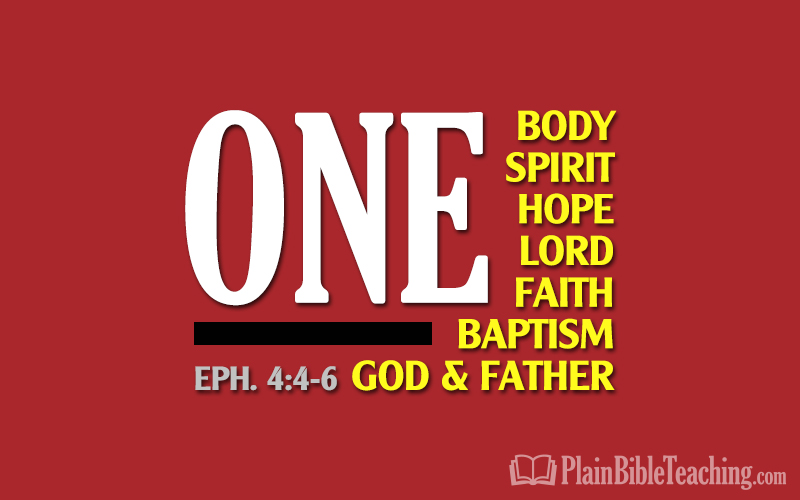
The fourth chapter also addresses the subject of unity. Paul instructed the brethren to be “diligent to preserve the unity of the Spirit in the bond of peace” (Ephesians 4:3). He wrote of one body, one Spirit, one hope, one Lord, one faith, one baptism, and one God and Father (Ephesians 4:4-6). A few verses later he mentioned different “offices” in the church (Ephesians 4:11) that were in place for “the equipping of the saints for the work of service, to the building up of the body of Christ” (Ephesians 4:12). The goal of this was that we might “attain to the unity of the faith” (Ephesians 4:13).
Continue Reading