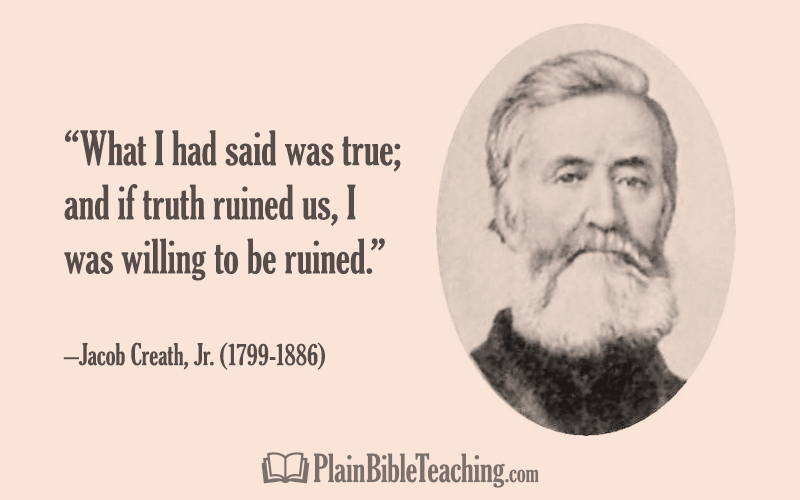
Jacob Creath, Jr. (1799-1886) was one of many preachers in the nineteenth century who began to question the commonly held doctrines among the denominations of which they were a part. Creath had been associated with the Baptists. In 1826, he received a letter of commendation from the Baptist Church in Great Crossings, Scott County, Kentucky in which he was called a “beloved brother,” a “faithful minister,” and one who “earnestly and zealously contends for ‘the faith once delivered to the saints’” (Memoir of Jacob Creath, Jr., p. 24-25). However, in 1829, Creath received another letter from this same congregation, requesting that he address reports of the “heresy” that he was preaching.
“DEAR BROTHER — I send you the request of the greatest portion of the Crossing Church. Their desire is, that you will give your views of man as a sinner, and how the change takes place, so as to constitute him born again. Or, in our familiar way, as Baptists, we want your views of experimental religion; how a sinner is brought from a state of enmity against the Saviour to be a lover and worshiper of Him.
“This request has grown partly from reports, and partly from a number of brethren, who have heard you preach since your return from the South, conceiving that you had abandoned your old mode and views of preaching, under which their hearts were many times gladdened, and have sat under your ministry with great delight; and we would ask our divine Master to grant you his Spirit, that you may rightly divide the word of truth, giving saint and sinner ‘his portion in due season.’” (Ibid., p. 29)
When Creath’s uncle, Jacob Creath, Sr., heard of the letter, he paid a visit to discuss it and see how the younger Creath intended to respond. Both men were connected to the Baptist Association at that time; and while Creath’s uncle agreed with him on this matter, he wanted to be more cautious in dealing with the issue. When he heard what his nephew planned to reply, the elder Creath said “it would ruin our cause.” The younger Creath answered, “What I had said was true; and if truth ruined us, I was willing to be ruined” (Ibid., p. 30).Continue Reading