A Message of Life or Death

2 Corinthians 2:15-16

Often when people want to emphasize the serious nature of a matter, they describe it as “a matter of life or death.” The gospel is certainly a serious matter as it pertains to our eternal life or death (Romans 6:23). But in another sense, the gospel is a message of either life or death depending on how it is received by the one who hears it. Notice what Paul wrote to the brethren in Corinth:

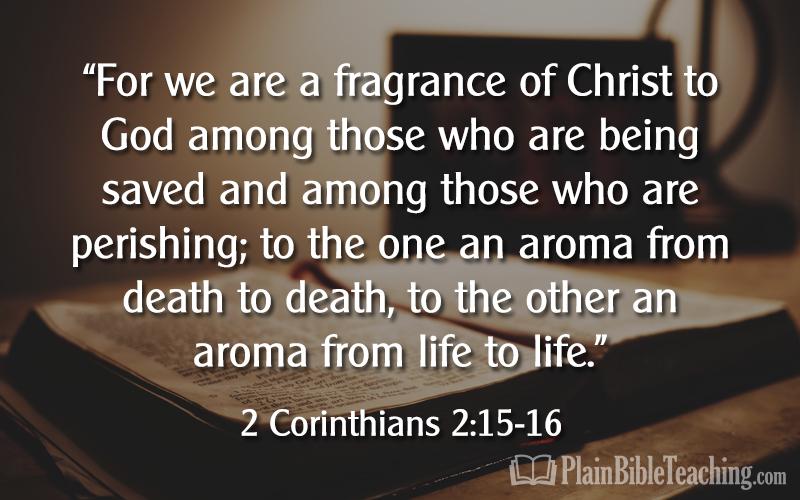
For we are a fragrance of Christ to God among those who are being saved and among those who are perishing; to the one an aroma from death to death, to the other an aroma from life to life” (2 Corinthians 2:15-16).

For some, the gospel is a message “from life to life.” For others, it is a message “from death to death.” Which one depends on how the hearer perceives it. Let us notice the difference in perspectives.
Continue Reading


A Little Wine (12/18)

Thought from today’s Bible reading from 1 Timothy 1-6.

Many professed Christians see no problem with the casual use of alcohol (often referred to as “social drinking”) provided that one does not become drunk. Yet the New Testament does not sanction this kind of drinking for the Christian. Paul’s instructions to Timothy about the use of wine are helpful in understanding this point.

No longer drink water exclusively, but use a little wine for the sake of your stomach and your frequent ailments” (1 Timothy 5:23).

In this passage, Paul encouraged Timothy to drink wine. Does this mean that we as Christians may drink alcohol, provided that we do not become drunk? Certainly not! Notice the lessons we can learn from this verse:
Continue Reading

To Live on in the Flesh Will Mean Fruitful Labor (12/17)

Thought from today’s Bible reading from Philippians 1-4.

For to me, to live is Christ and to die is gain. But if I am to live on in the flesh, this will mean fruitful labor for me; and I do not know which to choose” (Philippians 1:21-22).

Paul was confident in his hope of a home in heaven. This confidence was not based upon the belief that since he had been saved at one time, he would always be saved. Though many believe this today (“once saved, always saved”), Paul did not. He knew that if he quit serving the Lord, he would forfeit his salvation (1 Corinthians 9:27).

Paul’s hope was based upon the Lord’s promise to the faithful. Later, toward the end of his life, he would tell Timothy, “I have fought the good fight, I have finished the course, I have kept the faith; in the future there is laid up for me the crown of righteousness, which the Lord, the righteous Judge, will award to me on that day; and not only to me, but also to all who have loved His appearing” (2 Timothy 4:7-8). Paul could expect to receive his reward because he had fought, finished, and kept the faith.
Continue Reading

“The New Self, Which is in the Likeness of God” (12/16)

Thought from today’s Bible reading from Ephesians 1-6.

In the beginning, man was made in the image of God (Genesis 1:27). This did not mean that man’s physical appearance was like that of God. “God is spirit” (John 4:24) and does not have a flesh and blood body like we do. Man was made in God’s image in the sense that he had a spirit that would live on after his physical body went to the grave. In this way, man was distinguished from the animals (Ecclesiastes 3:21).

However, there is another sense in which man can be in the likeness of God. Christians are not just to be distinguished from the animals, as all men are, but are to be different from the world. Notice what Paul told the brethren in Ephesus:

That, in reference to your former manner of life, you lay aside the old self, which is being corrupted in accordance with the lusts of deceit, and that you be renewed in the spirit of your mind, and put on the new self, which is in the likeness of God and has been created in righteousness and holiness of the truth” (Ephesians 4:22-24).

Continue Reading

Be Thankful (12/15)

Thought from today’s Bible reading from Colossians 1-4; Philemon 1.

Thankfulness is a recurring theme throughout the Bible. The following passage helps show how thankfulness should be a normal and consistent trait for the Christian.

Let the peace of Christ rule in your hearts, to which indeed you were called in one body; and be thankful. Let the word of Christ richly dwell within you, with all wisdom teaching and admonishing one another in psalms and hymns and spiritual songs, singing with thankfulness in your hearts to God. Whatever you do in word or deed, do all in the name of the Lord Jesus, giving thanks through Him to God the Father” (Colossians 3:15-17).

What we learn from these three verses is that thankfulness is not an isolated characteristic in a Christian’s life but is intertwined with all that we say and do.
Continue Reading

The Sect That Is Spoken Against Everywhere (12/14)

Thought from today’s Bible reading from Acts 27-28.

When Paul came to Rome as a prisoner, he was able to meet with “the leading men of the Jews” (Acts 28:17) and talk to them about why he was there and to explain to them the truth about the gospel he taught. However, these men knew little about Paul but had heard of a certain “sect” about which they were curious.

They said to him, ‘We have neither received letters from Judea concerning you, nor have any of the brethren come here and reported or spoken anything bad about you. But we desire to hear from you what your views are; for concerning this sect, it is known to us that it is spoken against everywhere’” (Acts 28:21-22).

All they knew about this “sect” was that it had a bad reputation. But their reasonable approach to learning about it was commendable. Notice what they did and did not do:
Continue Reading

Accusations Made Against Paul (12/13)

Thought from today’s Bible reading from Acts 24-26.

When Paul stood before Felix, a lawyer named Tertullus brought accusations against him on behalf of the Jews. Notice the charges that were made:

For we have found this man a real pest and a fellow who stirs up dissension among all the Jews throughout the world, and a ringleader of the sect of the Nazarenes. And he even tried to desecrate the temple; and then we arrested him” (Acts 24:5-6).

Tertullus made four accusations against Paul. Similar ones may be made against those who teach the truth today. Notice what these accusations were:
Continue Reading







