Benjamin Franklin: Hope for Greater Disagreement

Benjamin Franklin - Benjamin Franklin: Hope for Greater Disagreement

Benjamin Franklin (1812-1878), one of the more influential preachers in the Restoration Movement, made it his aim to preach in such a way that his message was clearly understood. Notice the following quote from a sermon he delivered on the subject of foot-washing:

All we ask of those who may differ with us, is to give us a patient and impartial hearing, and then, if we cannot agree, it is hoped the disagreement will be greater than it was before” (They Heard Him Gladly, p. 221).

Continue Reading

Robert Milligan: Rather Die Than Be a Stumbling Block

In the nineteenth century, Robert Milligan (1814-1875) was influential as a preacher, writer, and professor. He did much work in each of these areas despite physical infirmities that plagued him throughout his life. As can be seen in the following quote, he was deeply concerned as a professor for his students, even going so far as to refuse certain treatments for his sickness so as not to be a stumbling block to his students.
Continue Reading

“It Means What It Says”

Almon Beach Green (1808-1886) grew up in Norton, Ohio in the 19th century – a time in which many were beginning to question the conflicting teaching among the denominations. He determined to investigate the Scriptures for himself and began reading through the New Testament. As he read, he became more convinced that the Bible was inspired and not the product of mere men. When he reached Peter’s statement in Acts 2:38, he sought some help in understanding it.
Continue Reading

Samuel Robert Cassius: “I Had Rather Preach the Gospel for What I Can Eat”

"I had rather preach the gospel for what I can eat..."

Samuel Robert Cassius (1853-1931) was an African-American preacher and part of what is known as the Restoration Movement. He spent most of his years preaching in Oklahoma. During this time, he often struggled to support his family and, of necessity, engaged in other work than just preaching to provide for them. The following excerpt from the book, To Save My Race from Abuse, contains an appeal he made for others to support his work.

In 1907, Cassius disclosed a plan to wipe out his monetary debts so that he could ‘devote all my time to the ministry’ the following year. ‘This is my earnest desire. Not that I am not willing to work, but because I love to preach.’ Giving his most articulate expression about his passion for preaching, he continued, ‘I had rather preach the gospel for what I can eat, than to live in plenty at anything else. God has raised me up for this very work, and I am not happy or contented at anything else’” (To Save My Race From Abuse, p. 86).

Continue Reading

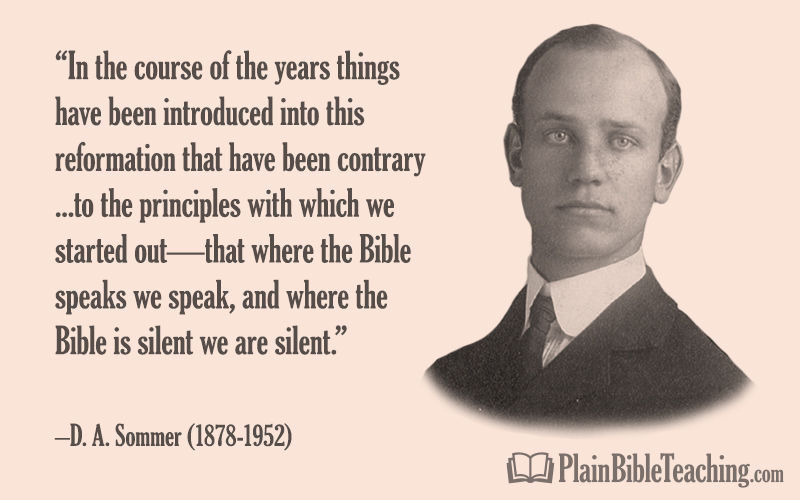
D.A. Sommer: The Same Movement, Yet We Are Different

D.A. Sommer: The Same Movement

Daniel Austen Sommer (1878-1952) was the son of the gospel preacher Daniel Sommer. In 1916, D.A. Sommer debated J. Roy Wright of the Christian church. The debate dealt with several issues, including instrumental music in worship and missionary societies. In his first speech, Sommer pointed out something that he and Wright had in common.
Continue Reading

Pardee Butler: “You Can Not Teach an Old Dog New Tricks”

Pardee Butler: You Can Not Teach an Old Dog New Tricks

Pardee Butler (1816-1888) was an evangelist who spent much of his time preaching in Kansas. He first came to Kansas in 1855 prior to it entering the union. During this time, there was an intense – often violent – debate over whether Kansas would be a free state or a slave state. Butler, with his abolitionist views, suffered physical attacks from pro-slavery settlers. Below is his reaction to a warning about the threat of such violence for refusing to support the sinful practice of slavery that was common in those days.
Continue Reading

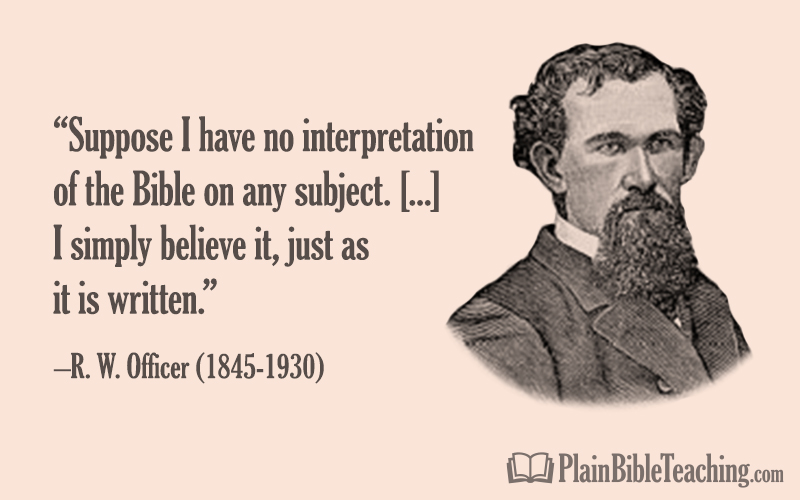
R.W. Officer: “Suppose I Have No Interpretation of the Bible on Any Subject”

R. W. Officer: No Interpretation

Robert Wallace Officer (1845-1930), at one point in his life, served as a missionary for the Liberty Baptist Association. During this six year period, he faced several charges of heresy. Below is an excerpt from a heresy trial in which Dr. J.R. Graves examined him to determine his “soundness of faith.”
Continue Reading