The Root of the Problem (Part 1): The Problem of Sin

The Root of the Problem: Why We Sin & How We Can Overcome

There are many problems facing the world today, such as poverty, injustice, famine, and disease. Great amounts of time, effort, and resources are used to try to find solutions to these problems. Even if we have not felt the effects of these ourselves, it is natural as human beings to feel empathy toward those who are suffering. This is particularly true if we heed Jesus’ command to “love your neighbor as yourself” (Matthew 22:39).

As difficult as these problems are to face, there is something that is much more destructive and prevalent. That problem is sin.
Continue Reading

“We Are Unworthy Slaves”

Luke 17:10

Much of the denominational world is under the heavy influence of Calvinism. As a result, many people believe the false concepts of unconditional election and irresistible grace. Because of this, they object to the teaching that obedience is necessary for salvation – even though this is what the Bible teaches (cf. Hebrews 5:9; James 2:24). They argue that if one believes that salvation is conditioned upon obedience, then that one must believe he can “earn” his salvation. Yet this is not the case. Notice what Jesus said in the following passage:

Which of you, having a slave plowing or tending sheep, will say to him when he has come in from the field, ‘Come immediately and sit down to eat’? But will he not say to him, ‘Prepare something for me to eat, and properly clothe yourself and serve me while I eat and drink; and afterward you may eat and drink’? He does not thank the slave because he did the things which were commanded, does he? So you too, when you do all the things which are commanded you, say, ‘We are unworthy slaves; we have done only that which we ought to have done’” (Luke 17:7-10).

Jesus’ words in this passage are helpful in showing us the connection between grace and obedience. So let us briefly examine this passage.
Continue Reading

Teaching Questions

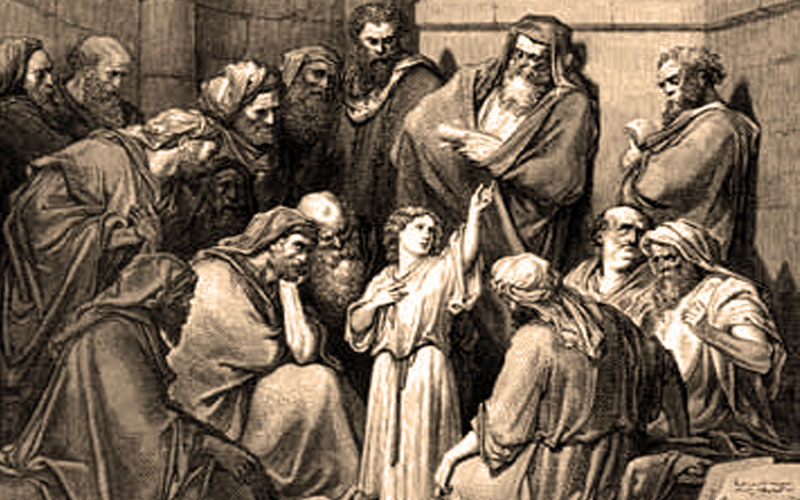
Jesus as a Boy in the Temple

In our last article, we looked at some good questions asked of a teacher that related to spiritual things. However, not all questions are asked by those needing information. Sometimes questions are asked by a teacher as a way to challenge his audience. Notice the example of Jesus when He was a young boy:

Then, after three days they found Him in the temple, sitting in the midst of the teachers, both listening to them and asking questions. And all who heard Him were amazed at His understanding and His answers” (Luke 2:46-47).

Jesus was God in the flesh (John 1:1, 14). He was not asking questions because He lacked understanding and was seeking instruction. He asked questions as a way to teach. The understanding and answers He imparted while His flesh and blood body was just twelve years old amazed those who heard Him.

This was not the only time Jesus employed this method of teaching. In this article, we will notice just a few examples in the Scriptures of questions that were asked by teachers as a way to lead their hearers to the truth.
Continue Reading

Continue in the Grace of God

For by grace you have been saved…” (Ephesians 2:8). The fact that salvation is by grace is one of the few points on which most – if not all – self-proclaimed Bible believing Christians will agree. But though we will all agree on the concept of salvation by grace, there is disagreement when you get below the surface.

A common misconception in the religious world is that we are saved by grace alone. Those who believe this will contend that salvation is wholly in the hands of God and that man can do nothing to impact his salvation – either to become saved or to remain saved. This doctrine of grace saving us unconditionally is completely false. Paul said, “The grace of God has appeared, bringing salvation to all men” (Titus 2:11). But this simply means that God has made salvation available to all men by His grace. It does not mean that all will be saved. Jesus made it clear that many would go down the path that leads to destruction (Matthew 7:13-14).

When Paul and Barnabas were teaching in Antioch of Pisidia, Luke recorded a summary of their message that helps present a picture for us as to what Christians need to remember with regard to God’s grace.
Continue Reading

“They May Have the Right to the Tree of Life” (12/31)

Thought from today’s Bible reading from Revelation 19-22.

Those who believe salvation is by grace or faith alone will often charge those of us who believe that obedience is necessary for salvation as trying to somehow earn salvation. While we should answer this false charge, we must also not be afraid to affirm all that the Scriptures teach. Notice these words near the close of the final book of the Bible:

Behold, I am coming quickly, and My reward is with Me, to render to every man according to what he has done” (Revelation 22:12).

Blessed are those who wash their robes, so that they may have the right to the tree of life, and may enter by the gates into the city” (Revelation 22:14).

We will be judged according to what we have done. We will be rewarded if our deeds are good when judged according to the Lord’s word. If we wash our robes, or “do his commandments” (KJV), we will enter the city and partake of the tree of life.
Continue Reading

“We Are Unworthy Slaves” (10/28)

Thought from today’s Bible reading from Luke 16:1-17:10.

Many people in religion have the notion that if we say that any act of obedience is required of us in our salvation, we are somehow trying to earn our salvation. Yet this is not the case. Jesus made it clear in the following passage that obedience is necessary, even though obedience will never result in one earning his salvation.

Which of you, having a slave plowing or tending sheep, will say to him when he has come in from the field, ‘Come immediately and sit down to eat’? But will he not say to him, ‘Prepare something for me to eat, and properly clothe yourself and serve me while I eat and drink; and afterward you may eat and drink’? He does not thank the slave because he did the things which were commanded, does he? So you too, when you do all the things which are commanded you, say, ‘We are unworthy slaves; we have done only that which we ought to have done’” (Luke 17:7-10).

Even if we do everything that the Lord expects of us, we should not think that we have earned anything from Him. After all, we are His servants. Therefore, it is expected that we will obey. Each time when we perform an act of obedience, there will still be more for us to do to follow.
Continue Reading

"For My Holy Name" (9/7)

Thought from today’s Bible reading from Ezekiel 35-37.

After punishing the people for their sins, God revealed to Ezekiel that He was going to restore them to their land. But it is important to notice why God was going to restore them.

Therefore say to the house of Israel, ‘Thus says the Lord God, “It is not for your sake, O house of Israel, that I am about to act, but for My holy name, which you have profaned among the nations where you went. I will vindicate the holiness of My great name which has been profaned among the nations, which you have profaned in their midst. Then the nations will know that I am the Lord,” declares the Lord God, “when I prove Myself holy among you in their sight. For I will take you from the nations, gather you from all the lands and bring you into your own land”‘” (Ezekiel 36:22-24).

God wanted the people of Israel to clearly understand the reason why He was restoring them to their land. It was not because of them and what great works they had accomplished. Rather, it was because of God and His desire that His name not be profaned among the nations.
Continue Reading