Big Words in the Bible (Part 4): Justification

Big Words in the Bible

We have already discussed how we are reconciled to God and set apart as His special people (sanctified). This means we can be in a right standing before God. Yet it is important to understand how this comes about. Paul used the example of Abraham to explain this.

What then shall we say that Abraham, our forefather according to the flesh, has found? For if Abraham was justified by works, he has something to boast about, but not before God. For what does the Scripture say? ‘Abraham believed God, and it was credited to him as righteousness.’ Now to the one who works, his wage is not credited as a favor, but as what is due. But to the one who does not work, but believes in Him who justifies the ungodly, his faith is credited as righteousness…” (Romans 4:1-5).

The Greek word for justification (dikaiosis), which is used in verses that follow our text (Romans 4:25; 5:18), refers to God declaring man to be free from guilt and right before Him. The word in our text (dikaioo) means that one is declared to be acceptable to God. The words translated righteous (dikaios) and righteousness (dikaiosyne) are related to this. God can declare us to be right before Him because of Jesus’ death on the cross. Without His sacrifice, we could not be right (justified) before God.Continue Reading

Understanding Legalism

Jewish Rulers Take Counsel Against Jesus

For many religious people, the term legalism has a strong negative connotation. Yet others may be unfamiliar with it. To be fair, it is not a term found in the Bible. Instead, it has been coined to describe a certain approach to the Bible.

Legalism is associated with the idea of strictness, narrow-mindedness, and being judgmental. The Pharisees are the classic example of “legalists.” However, while the Pharisees may have been strict, narrow-minded, and judgmental, there was more to them than that. At times, they justified certain sins and acts of disobedience, including the refusal to help their aged parents in need (Matthew 15:3-6). At other times, Jesus rebuked them for what could be described as spiritual mediocrity as they hypocritically taught others to do what they refused to do (Matthew 23:2-4) and presented an appearance of holiness while being spiritually corrupt in their hearts (Matthew 23:27-28).

Just as there is more to the Pharisees than the common stereotype, I believe there is more to “legalism” than the popular concept of it.Continue Reading

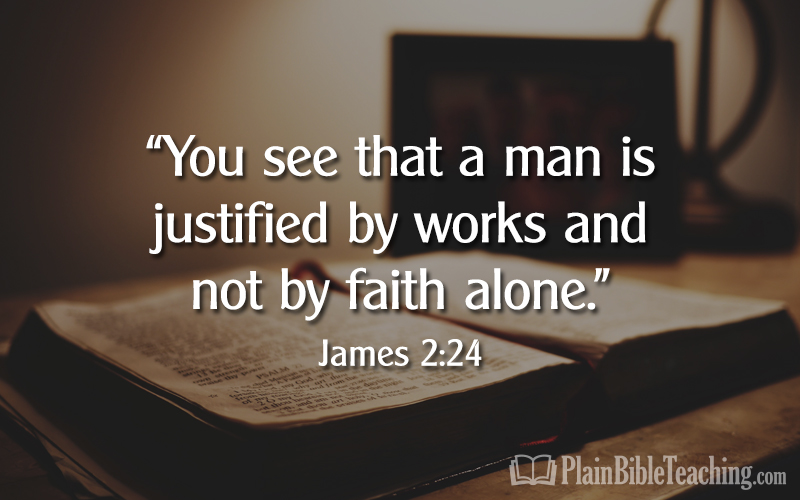
Justified by Works

James 2:24

One of the topics James discussed in his letter was the connection between faith and works. Many people have difficulty understanding this subject. The reason is not really that it is difficult; rather, they have simply been taught differently from what the Bible teaches. James used the example of Abraham to show how we can be justified by works.

Was not Abraham our father justified by works when he offered up Isaac his son on the altar? You see that faith was working with his works, and as a result of the works, faith was perfected; and the Scripture was fulfilled which says, ‘And Abraham believed God, and it was reckoned to him as righteousness,’ and he was called the friend of God. You see that a man is justified by works and not by faith alone” (James 2:21-24).

This is an important passage for us to understand – both for putting it into practice and also to be able to explain it to others.Continue Reading

“If God Is For Us”

Man on a mountain

Paul’s words at the end of Romans 8 were meant to be a source of encouragement for the saints in Rome. They ought to be for us as well.

What then shall we say to these things? If God is for us, who is against us?” (Romans 8:31).

But in all these things we overwhelmingly conquer through Him who loved us” (Romans 8:37).

We must always remember that “God is for us.” Knowing this, we can make it through any challenge that may come against us. Let us take a closer look at the text.Continue Reading

By What Are We Justified?

Man at sunset

The concept of justification is of major importance in the gospel. But what does it mean to be justified? Thayer defines the word as declaring or pronouncing one to be just, righteous, or such as he ought to be.

In the New Testament, justification is about God recognizing us as being righteous or right before Him. This divine recognition is key. We are not righteous simply by declaring ourselves to be righteous. We may claim it, but that does not make it so. How then can we be justified? The New Testament mentions several things by which we are justified. We will notice them in this article.
Continue Reading

By What Are We Justified? (Sermon #13)

Subscribe: iTunes | Stitcher | RSS

By What Are We Justified? (Sermon #13)

We’re in between season 6 and season 7 which will start on July 25th. During the break we’re posting audio sermons each week instead of the regular episodes. The sermon for this week was preached on April 9, 2017 at the Eastside church of Christ in Morgantown, KY.

If you found this episode to be useful, please share it with others. Also, if you enjoyed the podcast, please leave a rating on iTunes or Stitcher. This also helps others hear about the podcast. Thanks.

The Importance of Faith (Part 2): Justification

The Importance of Faith (Part 2): Justification

Therefore, having been justified by faith, we have peace with God through our Lord Jesus Christ” (Romans 5:1).
Continue Reading