Robert Milligan (1814-1875), like other early figures in the Restoration Movement, was raised in denominationalism and eventually learned the truth and abandoned the churches of men. In the case of Milligan, he was raised in the Presbyterian church. His commentary on Hebrews, which was published after his death, contains a biographical sketch at the end written by J.W. McGarvey. In it, McGarvey explained how Milligan came to learn the truth and leave the Presbyterian church to become part of the Lord’s church:
Continue Reading
May 9, 2013
Robert Milligan: “By the Force of the Bible Alone”
March 28, 2013
J.S. Sweeney: Sprinkling & Pickling
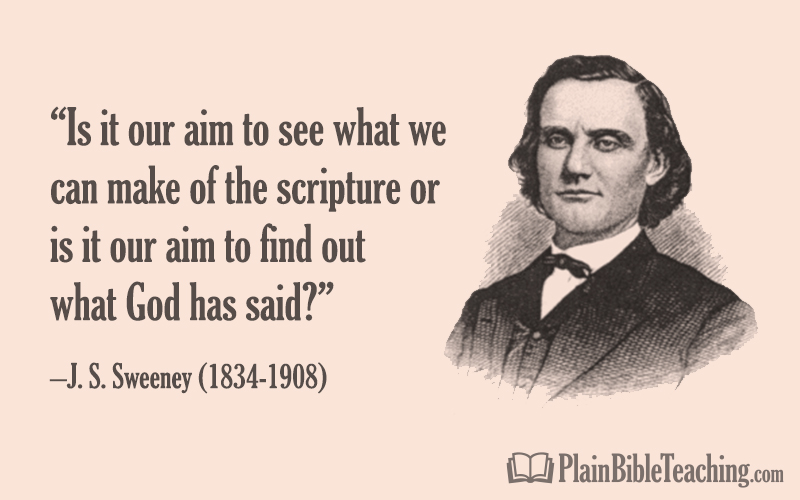
There is a lot of opposition in the religious world to the Bible’s teaching on baptism. The Greek word baptizo is where we get the English word baptize. It means to immerse. Yet if you look up the definition of baptize in an English dictionary, it will likely include the act of sprinkling along with immersion. Why? It is because sprinkling is commonly accepted in the religious world, and has been for some time.
J.S. Sweeney (1834-1908), a gospel preacher, was debating the Scriptural mode of baptism with a man named Jacob Ditzler. Ditzler tried to make the argument that sprinkling was authorized and used a dictionary to make his point. Sweeney’s humorous yet brilliant response is recounted below:
Continue Reading
March 19, 2013
“These Were More Noble-Minded”
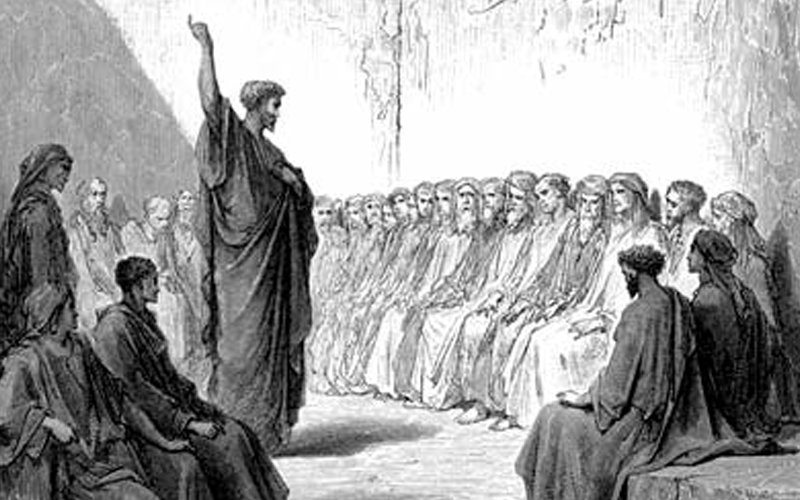
Paul was in Thessalonica for just three weeks when he had to quickly leave the city under the cover of darkness because of the uproar that was caused by his preaching (Acts 17:1-10). When he left, he went to Berea. Undeterred by his experience in Thessalonica, he preached in this new city as well. Luke noted the significant reaction of the Bereans:
“Now these were more noble-minded than those in Thessalonica, for they received the word with great eagerness, examining the Scriptures daily to see whether these things were so” (Acts 17:11).
Luke compared the Thessalonians and the Bereans in their reaction to the gospel. The Bereans were “more noble-minded” in that they “received the word with great eagerness.” This does not mean that everyone in Thessalonica rejected the gospel – some were persuaded (Acts 17:4). This also does not mean that everyone in Berea accepted the gospel – the Jews of Thessalonica were able to come to Berea and turn “the crowds” against Paul (Acts 17:13). But there is an important difference between the first recipients of the gospel in each city – those in the synagogues (Acts 17:2, 10). Notice what Luke recorded about Paul’s custom in preaching.
Continue Reading
January 1, 2013
Practical Ways for Developing a Better Understanding of God’s Word

At the start of the new year, many have made the determination to increase their knowledge and understanding of the Bible. This is certainly commendable. The Bible is the inspired word of God (2 Timothy 3:16). It contains the “words of eternal life” (John 6:68). The gospel is “the power of God for salvation” (Romans 1:16). No book is more deserving of our attention than the Bible.
It is one thing to want to grow in knowledge of the Bible. It is another to actually do it. So as we begin this new year, I want to consider some practical ways in which each one of us can develop a better understanding of the word of God.
Continue Reading
November 17, 2012
“Uneducated and Untrained Men” (11/17)
Thought from today’s Bible reading from Acts 4-6.
After being arrested, Peter and John found themselves before the Jewish Council. This group included the priests, rulers, elders, and scribes (Acts 4:5-6). Among this group was Annas the high priest and Caiaphas, two who were instrumental in bringing about the death of Jesus; and Gamaliel, a well-respected teacher of the Law (Acts 5:34).
For many, this would have been an intimidating audience to have to address. Yet Peter and John boldly defended the cause of Christ. The members of the Council were surprised at their boldness.
“Now as they observed the confidence of Peter and John and understood that they were uneducated and untrained men, they were amazed, and began to recognize them as having been with Jesus. And seeing the man who had been healed standing with them, they had nothing to say in reply” (Acts 4:13-14).
However, Peter and John were not “uneducated and untrained” as the Council members supposed. They had been taught by the Master Teacher. They had been trained by the Son of God. But they did not have a “formal” education and training under a mere human teacher.
Continue Reading
November 4, 2012
“He Is Not the God of the Dead But of the Living” (11/4)
Thought from today’s Bible reading from Matthew 22; Mark 12.
The Sadducees did not believe in the resurrection. When they confronted Jesus on this point, they thought they had an unanswerable argument that would prove the foolishness of believing in the resurrection.
They presented a scenario in which a woman was married to seven brothers, each one followed the death of the next older brother (Matthew 22:23-27). The Sadducees then asked Jesus this question: “In the resurrection, therefore, whose wife of the seven will she be? For they all had married her” (Matthew 22:28). Notice how Jesus responded:
“But Jesus answered and said to them, ‘You are mistaken, not understanding the Scriptures nor the power of God. For in the resurrection they neither marry nor are given in marriage, but are like angels in heaven.’
“‘But regarding the resurrection of the dead, have you not read what was spoken to you by God: “I am the God of Abraham, and the God of Isaac, and the God of Jacob”? He is not the God of the dead but of the living’” (Matthew 22:29-32).
Jesus’ argument “silenced the Sadducees” (Matthew 22:34). They had no answer for Him. If God said, “I am” the God of Abraham, Isaac, and Jacob, even after these men were dead, then one should necessarily infer that these men continued to exist, even after death.
Continue Reading
October 23, 2012
Are You Redeeming the Time?
[The following was slightly adapted from a sermon outline by A.W. Dicus entitled, ‘Christian Economics.’]
 Each week contains 10,080 minutes. What do people do with their time?
The time spent by a fairly active church member on spiritual activities:
- Attends on Sunday, three hours = 180 minutes
- Attends on Wednesday night = 60 minutes
- Reads the Bible two hours = 120 minutes
- Prays 15 minutes daily = 105 minutes
- Visits the sick, three hours = 180 minutes
- Total time for the Lord = 645 minutes