Advice to Young Preachers

Bible study

Some might wonder how it is that someone like myself – a thirty year old with no “full-time” preaching experience – would be so bold as to hand out advice to young preachers (many of whom would be my peers). I am not so arrogant as to think that I have wisdom that compares with a man who has been preaching the gospel for decades. But I do have the Scriptures – the inspired word of God (2 Timothy 3:16). Therefore, when I teach the things that come from God (cf. 1 Peter 4:11), I can do so as Titus was told to teach – “with all authority” (Titus 2:15). So let us briefly look at some of the Bible instructions on preaching that young (and old) preachers need to always remember.
Continue Reading

Who Are You Who Judge Your Neighbor?

James 4:12

We live in a time when tolerance is a chief virtue – not tolerance in the way the Bible defines it, but tolerance for almost any sort of sin or error that may be practiced or promoted by man. As a result, our society is most intolerant of what could be seen as one person judging another. After all, what business do we have judging anyone else?

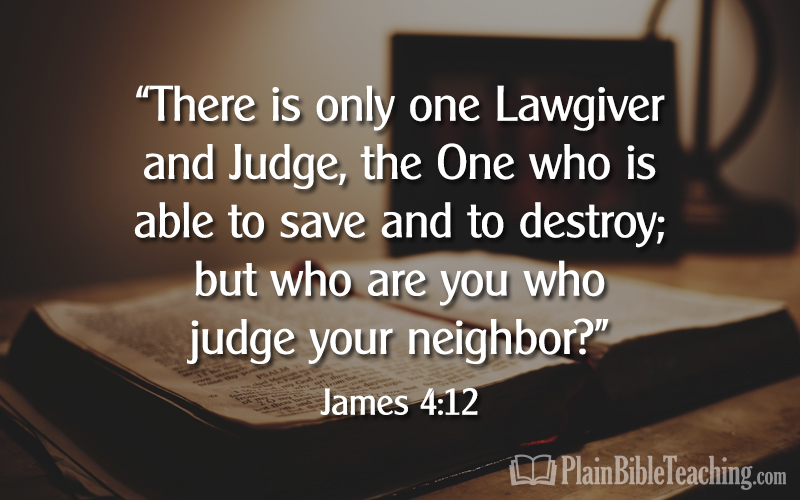
This is a good question to consider. We certainly must not judge when it is not our place to do so. James wrote, “There is only one Lawgiver and Judge, the One who is able to save and to destroy; but who are you who judge your neighbor?” (James 4:12). Paul wrote, “Now accept one who is weak in faith, but not for the purpose of passing judgment on his opinions” (Romans 14:1). A little bit later he asked: “But you, why do you judge your brother: Or you again, why do you regard your brother with contempt? For we will all stand before the judgment seat of God” (Romans 14:10). One of the most quoted statements by Jesus was spoken in His Sermon on the Mount: “Do not judge so that you will not be judged” (Matthew 7:1).

Do these passages teach that all judgments we might make are wrong? Conversely, is it possible to be wrongly accused of judging others?
Continue Reading

Be Filled With The Spirit

In the letter to the church at Ephesus, Paul commanded, “And do not get drunk with wine, for that is dissipation, but be filled with the Spirit” (Ephesians 5:18). Many believe that a Christian being filled with the Spirit is wholly dependent upon some direct action by God. This is puzzling, considering that Paul phrases this as a command. A commandment implies a responsibility to obey. Therefore, we are responsible for being “filled with the Spirit.” So how are we to do this?

Continue Reading

Blessings and Burdens of Spiritual Independence

Earlier this week, Americans celebrated Independence Day, commemorating the day when the thirteen colonies declared their independence from England. In breaking ties, the colonies affirmed that they were able to govern themselves and no longer needed to be dependent upon a distant monarch.

There were certainly blessings that came from this independence. The most notable were freedom and having a government that could better relate to the concerns of the people. However, with independence also comes burdens – additional responsibilities that must now be fulfilled by the independent entity since they would no longer be dependent upon others as they were previously.

Blessings and burdens will exist anytime a person or a people determine to be independent from others. It was true with the thirteen American colonies. At the time of the Exodus when the Israelite people became independent from the Egyptians, they enjoyed blessings (freedom from bondage) and faced burdens (they could no longer rely upon the Egyptians to provide for them – Exodus 16:3). When a young adult moves out of the house and becomes independent from his parents, there are blessings in his new independence and burdens in the greater responsibilities since he now has to provide for himself. Independence, in any context, contains both blessings and burdens.

In this article, I want us to examine our independence as it pertains to spiritual matters. Through the provisions He has given, God has made it so that each one of us can faithfully serve Him, regardless of what others might choose to do. This is not to say that we should not work together or that we cannot help one another; rather, we must take responsibility as individuals for our own spiritual lives.Continue Reading

Sins of the Rich Man

Jesus’ story of the rich man and Lazarus (Luke 16:19-31) is fairly well-known to most Bible students. One man lived a life of luxury but found himself in torments after he died. The other was a poor beggar in this life yet was comforted after death in a place of paradise.

Once in torments, the rich man appealed to Abraham to allow Lazarus to go to his brothers and warn them of the punishment that awaited them (Luke 16:27-28). Since the rich man ended up in this undesirable place, it would be good for us to notice this man’s sins that Jesus mentioned in this passage. These are a few of the things we need to avoid if we want to escape the terrible fate that belonged to this man.
Continue Reading

Do Not Go Back to the Old Law

Many professed Christians try to go back to the old law to determine what God requires of them today or to justify practices for which they can find no authority in the New Testament. Despite the fact that the Old Testament contains prophecy telling of a “new covenant” (Jeremiah 31:31-34) and the New Testament tells us the old law was “nailed…to the cross” (Colossians 2:14), many will blur the lines between the two laws; but this is dangerous. Let us notice a few reasons why.
Continue Reading

Hard-Headed Preachers

Hard-Headed Preachers

We do not typically think of the term “hard-headed” as being a compliment when it is used to describe someone. Yet the Bible teaches that it is an essential characteristic of one who would proclaim the word of God. When God commissioned Ezekiel to “go to the house of Israel and speak with My words to them” (Ezekiel 3:4), appointing him as “a watchman to the house of Israel” (Ezekiel 3:17), God gave the prophet a hard-headed demeanor so that he would be able to accomplish his task.
Continue Reading