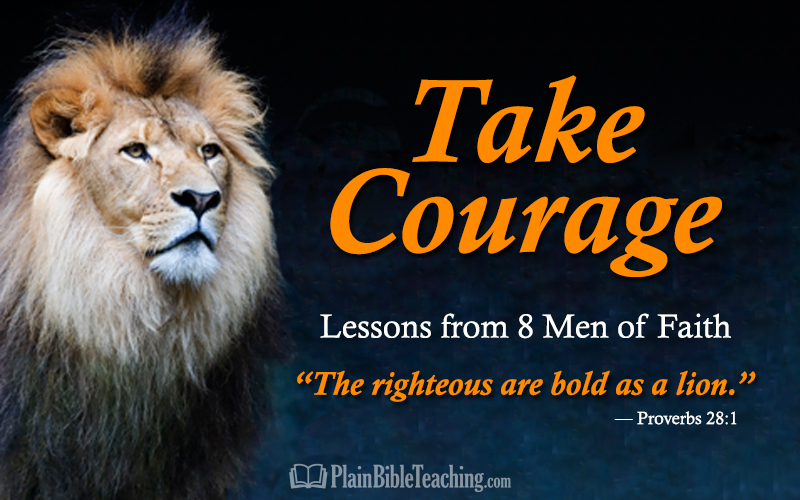
The final example in our study is Daniel. This lesson will focus on the courage he demonstrated in his willingness to violate the laws of men in order to be faithful to the Lord.
Continue Reading
The final example in our study is Daniel. This lesson will focus on the courage he demonstrated in his willingness to violate the laws of men in order to be faithful to the Lord.
Continue Reading
 Aaron Erhardt just released a new book: Characteristics of a Christian. The description from the Erhardt Publications website is below:
Characteristics of a Christian sets forth 10 qualities that Christians are to possess, including love, humility, hospitality, patience, boldness, etc. This book can be used effectively in adult and teenage classes. It is an “easy read” with questions at the end of each lesson.
The example of Shadrach, Meshach, and Abed-nego shows us the courage needed to put one’s complete trust in God. Of course, other men in the examples we have already noticed have trusted in God, but the example of Daniel’s friends is different – they did not receive special, direct revelation (as least not as far as we are told in the Scriptures) like many other Old Testament characters. Therefore, their example is very helpful for us today.
Continue Reading

“No temptation has overtaken you but such as is common to man; and God is faithful, who will not allow you to be tempted beyond what you are able, but with the temptation will provide the way of escape also, so that you will be able to endure it” (1 Corinthians 10:13).
In Paul’s letter to the church in Corinth, he told the brethren that temptation is “common to man.” In other words, it is to be expected. Unfortunately, all of us have given in to temptation at one time or another. Paul wrote, “For all have sinned and fall short of the glory of God” (Romans 3:23).
However, even though we have sinned in the past, that does not mean that we must do so again in the future, giving in to the same temptations over and over. We need to learn how to find the “way of escape” so that we might keep ourselves from sin. In this article, we will discuss what the Scriptures teach about how to find the way of escape.
Continue Reading
Paul’s letter to the Galatians was addressed to the churches of that region – Antioch of Pisidia, Iconium, Lystra, and Derbe. These churches were established during Paul’s first preaching journey (Acts 13-14). The Christians in this region experienced a lot of opposition to the gospel, yet this was not what caused them to slide into apostasy. Instead, their apostasy was caused by something much more subtle. This lesson examines the history of the establishment of these churches and what eventually threatened to lead them away from Christ.
Continue Reading
A restoration took place in the days of Josiah, king of Judah. He sought to restore the practices of the Law of Moses that had been abandoned.
Continue Reading









What does “propitiation” mean? How is “justification” connected to salvation? What does “sanctification” look like in our day-to-day lives? The Bible uses some powerful words to describe God’s plan to save mankind. However, these words are not always easy to understand, especially when they are not part of our everyday vocabulary. This book explores key Bible terms that unlock the message of the gospel.
Big Words in the Bible examines five important words – Propitiation, Reconciliation, Sanctification, Justification, and Resurrection – using plain language to see how the Scriptures describe these concepts and how the apostle Paul employs them in his letter to the Romans. This book also contains an appendix with eleven additional articles to explore these topics further.
Whether you are new to the Bible and want to grow in your understanding or want a simple way to explain these core gospel doctrines to others, this book will be helpful. With a focus on the Scriptures, Big Words in the Bible helps break down these fundamental topics to shed light on the life-changing message of the gospel and the salvation found in it.
Available in print and digital format.

This work is licensed under a Creative Commons Attribution-NonCommercial-ShareAlike 3.0 Unported License.
If you have further questions about using any of the material on this site, please contact me.