Repent and Be Converted

After Peter healed the lame man and had the opportunity to teach the crowd that had gathered, he told them, “Repent therefore and be converted, that your sins may be blotted out, so that times of refreshing may come from the presence of the Lord” (Acts 3:19, NKJV).

Most of the denominational world believes that conversion is necessary for salvation. Peter plainly affirmed this as he told the people here that the blotting out of their sins was dependent upon them being converted. But what conversion was Peter talking about here? This is where you will begin to get some disagreement. Is one converted when he prays a “sinner’s prayer” and invites Jesus into his heart? Is he converted when he makes a verbal confession that he believes that Jesus is Lord? Or is there something else that Peter has in mind?
Continue Reading

The Poor Widow’s Oil

A poor widow came to Elisha after her husband died. She was in desperate need of any help the prophet could give her. She cried out to him, “Your servant my husband is dead, and you know that your servant feared the Lord; and the creditor has come to take my two children to be his slaves” (2 Kings 4:1).

Before we look at some lessons from the help that Elisha gave this widow, it is important to first notice a couple of facts about her deceased husband. The text states that he was one of the “sons of the prophets,” a servant to Elisha. Furthermore, his widow testified that he “feared the Lord” (2 Kings 4:1). This was not a worthless or wicked individual. He was a faithful servant of God and His prophet.

As we read the account of Elisha helping this poor widow, we see that God made provision for her – she was miraculously given enough oil to fill every container she was able to borrow from her neighbors. She was then able to sell the oil, solving her great financial dilemma (2 Kings 4:2-7).

Now, let us notice a few lessons from this story.
Continue Reading

Blessings and Burdens of Spiritual Independence

Earlier this week, Americans celebrated Independence Day, commemorating the day when the thirteen colonies declared their independence from England. In breaking ties, the colonies affirmed that they were able to govern themselves and no longer needed to be dependent upon a distant monarch.

There were certainly blessings that came from this independence. The most notable were freedom and having a government that could better relate to the concerns of the people. However, with independence also comes burdens – additional responsibilities that must now be fulfilled by the independent entity since they would no longer be dependent upon others as they were previously.

Blessings and burdens will exist anytime a person or a people determine to be independent from others. It was true with the thirteen American colonies. At the time of the Exodus when the Israelite people became independent from the Egyptians, they enjoyed blessings (freedom from bondage) and faced burdens (they could no longer rely upon the Egyptians to provide for them – Exodus 16:3). When a young adult moves out of the house and becomes independent from his parents, there are blessings in his new independence and burdens in the greater responsibilities since he now has to provide for himself. Independence, in any context, contains both blessings and burdens.

In this article, I want us to examine our independence as it pertains to spiritual matters. Through the provisions He has given, God has made it so that each one of us can faithfully serve Him, regardless of what others might choose to do. This is not to say that we should not work together or that we cannot help one another; rather, we must take responsibility as individuals for our own spiritual lives.Continue Reading

The Path to Citizenship

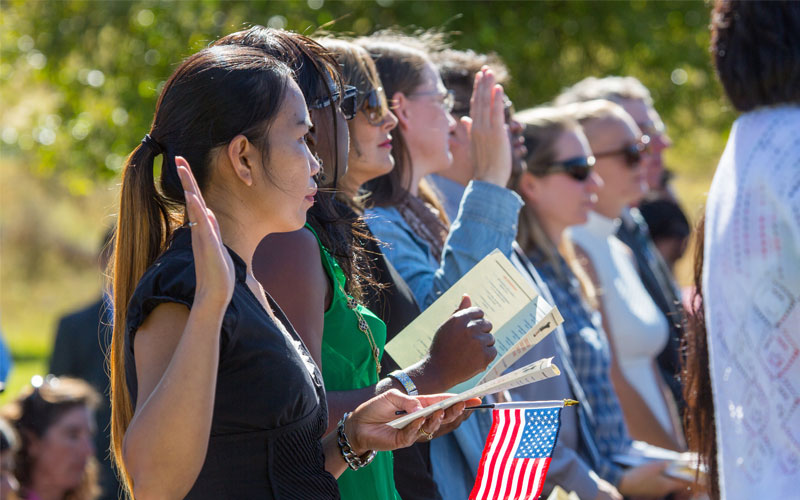
Oath of citizenship

The debate over illegal immigration is a hot topic in our country. For various reasons, millions of people from other countries have decided their lives would be better in the United States of America. This country has always welcomed immigrants and has established a system through which they can go in order to obtain citizenship in the United States.

Many pursue residence in this country and later citizenship through the established legal path. Many others, however, begin their pursuit by entering the country illegally. There are now millions of “illegal immigrants” currently residing within our borders, resulting in a great political debate as to what to do about these individuals. Should they be made to follow the immigration laws that have already been established? Should the government enact some sort of new law that would grant citizenship to those who, for whatever reason, chose to ignore the current law and enter this country illegally.

We likely all have our opinions as to what we believe the civil authorities ought to do on this issue, but this is not the place to discuss those opinions. I bring this up because in this debate we can draw a spiritual application regarding the greatest and most blessed citizenship. As Christians, “our citizenship is in heaven” (Philippians 3:20). Let us notice some parallels between our heavenly citizenship and the current immigration debate.
Continue Reading

Sins of the Rich Man

Jesus’ story of the rich man and Lazarus (Luke 16:19-31) is fairly well-known to most Bible students. One man lived a life of luxury but found himself in torments after he died. The other was a poor beggar in this life yet was comforted after death in a place of paradise.

Once in torments, the rich man appealed to Abraham to allow Lazarus to go to his brothers and warn them of the punishment that awaited them (Luke 16:27-28). Since the rich man ended up in this undesirable place, it would be good for us to notice this man’s sins that Jesus mentioned in this passage. These are a few of the things we need to avoid if we want to escape the terrible fate that belonged to this man.
Continue Reading

Study Guide for 1 & 2 Peter and Jude

This material covers the epistles written by Peter and Jude which encourage us to stand firm in the grace of God and the truth of His word, not allowing ourselves to be hindered by false teachers, scoffers, or persecutors.
Continue Reading

The “Miracle” of Birth

Baby yawning

It is common to hear people speak of the “miracle of birth.” The birth of a child is truly an amazing event that is only possible because of our Creator. Yet the term miracle is often misused and abused by people to simply describe something incredible or coincidental. The miracles described in the Bible, however, are different. Speaking in Biblical terms, is it accurate to describe birth as a miracle?
Continue Reading