
Ezekiel 18 addresses the justice of God – how He treats individuals, both the righteous and the wicked, and how He will judge us. Let us examine what this chapter teaches us about God and His justice.
Continue Reading
Ezekiel 18 addresses the justice of God – how He treats individuals, both the righteous and the wicked, and how He will judge us. Let us examine what this chapter teaches us about God and His justice.
Continue Reading
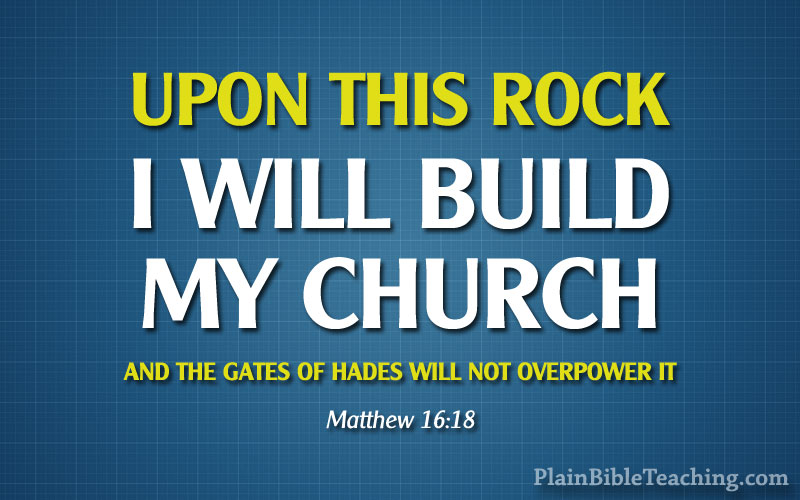
“Simon Peter answered, ‘You are the Christ, the Son of the living God.’ And Jesus said to him, ‘Blessed are you, Simon Barjona, because flesh and blood did not reveal this to you, but My Father who is in heaven. I also say to you that you are Peter, and upon this rock I will build my church; and the gates of Hades will not overpower it’” (Matthew 16:16-18).
One of the more significant statements in the revelation of God’s plan was Jesus’ promise to His apostles, “I will build My church” (Matthew 16:18). Let us break down this statement and see what Jesus is teaching here.
Continue Reading

Keeping up with the news can often be a depressing and frustrating endeavor. As Christians, we know “the world is passing away” (1 John 2:17) and will one day “be destroyed” (2 Peter 3:10), yet “our citizenship is in heaven” (Philippians 3:20). So is there any good reason for Christians to pay attention to current events? Yes! Consider the following reasons.
Continue Reading
[This article was written by Bryan Dockens.]
“The virtuous wife” brings her husband “no lack of gain” (Proverbs 31:10-11).
While maintaining a reasonable effort to keep her husband attracted (Proverbs 5:19; Song of Songs 7:1-9), the woman of valor acknowledges the fleeting nature of outward glamour (Proverbs 31:30). Instead, she chooses to emphasize inward beauty (1st Peter 3:3-4; 1st Timothy 2:9-10) and is therefore not one to waste the family’s hard-earned income on expensive clothing, fashion accessories, or cosmetics for herself. Similarly, gym memberships and exercise equipment are not considered priority expenses (1st Timothy 4:8).
Continue Reading

As the religious world prepares for the Easter holiday this Sunday, let us be reminded of what the Bible has to say on the topic.
Is Easter in the Bible? Yes and no, depending on what is meant by the question. Is the word Easter in the Bible. Yes, if you are reading the King James Version. When Herod killed James and saw that it pleased the Jews, he intended to do the same to Peter. Luke recorded, “And when he had apprehended him, he put him in prison, and delivered him to four quarternions of soldiers to keep him; intending after Easter to bring him forth to the people” (Acts 12:4).
However, if you read from a different translation, such as the New American Standard Bible, a different word is used instead of Easter: “…intending after the Passover to bring him out before the people.” Which is the correct translation? The Greek word used here is pascha (Passover). It refers to the feast of Unleavened Bread that was instituted for the Jews under the Old Law (cf. Exodus 12:1-27). Easter does not belong in Acts 12:4.
Continue Reading

The New Testament stresses the importance of Christians being part of a local congregation. But how does one join or place membership with a local church? At what point does one become a part of a congregation of God’s people? If we look at Saul’s effort to join the church in Jerusalem, we will see that there are two steps necessary for one to place membership with a local church.
Continue Reading

We do not typically think of the term “hard-headed” as being a compliment when it is used to describe someone. Yet the Bible teaches that it is an essential characteristic of one who would proclaim the word of God. When God commissioned Ezekiel to “go to the house of Israel and speak with My words to them” (Ezekiel 3:4), appointing him as “a watchman to the house of Israel” (Ezekiel 3:17), God gave the prophet a hard-headed demeanor so that he would be able to accomplish his task.
Continue Reading










What does “propitiation” mean? How is “justification” connected to salvation? What does “sanctification” look like in our day-to-day lives? The Bible uses some powerful words to describe God’s plan to save mankind. However, these words are not always easy to understand, especially when they are not part of our everyday vocabulary. This book explores key Bible terms that unlock the message of the gospel.
Big Words in the Bible examines five important words – Propitiation, Reconciliation, Sanctification, Justification, and Resurrection – using plain language to see how the Scriptures describe these concepts and how the apostle Paul employs them in his letter to the Romans. This book also contains an appendix with eleven additional articles to explore these topics further.
Whether you are new to the Bible and want to grow in your understanding or want a simple way to explain these core gospel doctrines to others, this book will be helpful. With a focus on the Scriptures, Big Words in the Bible helps break down these fundamental topics to shed light on the life-changing message of the gospel and the salvation found in it.
Available in print and digital format.

This work is licensed under a Creative Commons Attribution-NonCommercial-ShareAlike 3.0 Unported License.
If you have further questions about using any of the material on this site, please contact me.