The Religion of Peace

The adherents of Islam and their sympathizers spend a lot of effort trying to paint Islam as a “religion of peace.” The well-documented history of terrorist attacks carried out in the name of Allah make it difficult to defend this position. An examination of the Quran does not help either, as it calls for Muslims to “fight and slay the infidel wherever you find them” (Quran 9:5).

The latest black mark against this “religion of peace” comes in the response to Terry Jones burning a copy of the Quran. This man is a relative nobody in a tiny church in Florida. His actions in burning a copy of the Quran are so insignificant that it is an embarrassment that the media actually reported on it. Yet they did and word has spread far and wide about this event. Since then, Muslims on the other side of the globe in Afghanistan have responded by rioting and murdering dozens of people who are connected to Terry Jones only in that they are non-Muslims (infidels).
Continue Reading

What Happened After Saul’s Conversion?

Saul escaping Damascus in a basket

We often talk about the conversion of Saul – later known as the apostle Paul – because of the important lessons to be found in it about how one becomes a Christian. But what about what happened after Saul’s conversion? There are important lessons here as well. Let us look at what Saul did following his conversion.
Continue Reading

Some Reflections on the 2011 Florida College Chorus Tour

Being a former student of Florida College and knowing a good number of people who have an affinity to the school, I thought it was important to pass along this article about the troubling practice of the Florida College Chorus performing religious songs.

The performance of these types of songs by the Chorus is nothing new. But the announcement for this year’s tour indicated that “songs, narrations, and scripture readings focusing on the death and resurrection of Jesus” would be included in the performance. During the two years I attended Florida College, I never attended a Chorus concert (even then, I was uncomfortable with these religious songs being performed as entertainment). Shortly after leaving the school, I reluctantly agreed to attend one of these performances when the Chorus came to town on their tour — perhaps I would see my concerns were unfounded (I learned they were not). But I do not remember “narrations and scripture readings” being part of the performance. This appears to be one more step away from the New Testament pattern and toward a pattern of denominational-styled worship experiences.
Continue Reading

The Faith of Daniel’s Friends

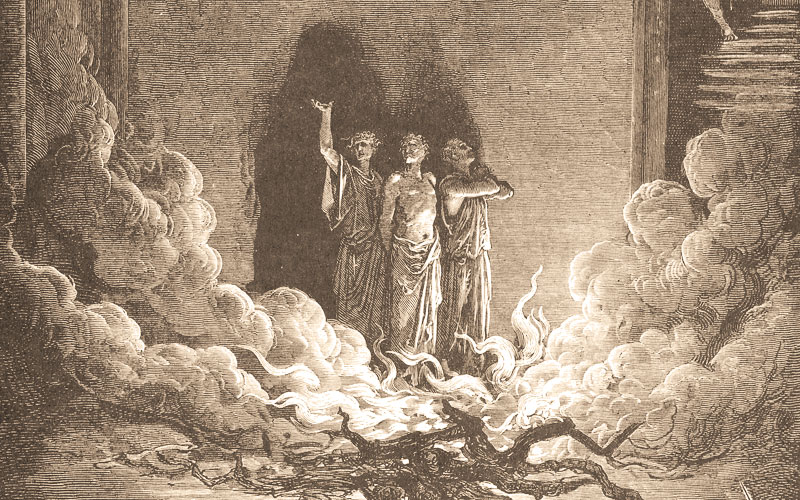
Shadrach, Meshach, and Abed-nego

While the Jews were in Babylonian captivity, King Nebuchadnezzar made a huge, golden statue and commanded the people of every nation and language to fall down and worship the image when they would hear the sound of the music. Those who refused would be cast into a furnace of fire (Daniel 3:1-6).

Most of the people complied with the king’s order and worshiped the image at the prescribed times (Daniel 3:7). However, three young men – Shadrach, Meshach and Abed-nego – did not (Daniel 3:12). These men were among the Jews who had been taken captive and were companions of Daniel (Daniel 1:6-7). They now found themselves before an angry king:
Continue Reading

The Plumb Line

Plumb Line

God showed the prophet Amos three visions that warned about the coming judgment against Israel (Amos 7:1-9). After the first two visions, Amos protested, pleading for mercy on behalf of Israel. But after the third vision he did not. What was different about the third vision? Answering this question will provide a valuable lesson for us today.
Continue Reading

Reminders from the Tragedy in Japan

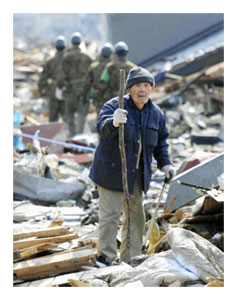
An elderly man looks for his house through the rubble in Rikuzentakata, Iwate Prefecture, northern Japan.It is truly sad to read news reports and see pictures and videos of the devastating effects of the earthquake and tsunami that occurred in northern Japan. While our hearts go out to the victims and our prayers are for all those affected, it is also important to remember some important lessons that this tragedy teaches us.

Riches are uncertain — Paul told Timothy, “Instruct those who are rich in this present world not to be conceited or to fix their hope on the uncertainty of riches, but on God, who richly supplies us will all things to enjoy” (1 Timothy 6:17). The material possessions we currently have are not guaranteed to remain in the future. While we may use and enjoy the things of this life, we must remember that they are not of lasting significance. Jesus said, “not even when one has an abundance does his life consist of his possessions” (Luke 12:15). Therefore, He says, “Do not store up for yourselves treasures on earth, where moth and rust destroy, and where thieves break in and steal. But store up for yourselves treasures in heaven, where neither moth nor rust destroys, and where thieves do not break in or steal; for where your treasure is, there your heart will be also” (Matthew 6:19-21).
Continue Reading

How Could a Loving God Send Anyone to Hell?

Many people struggle with the above question. We know that God, by His very nature, is love (1 John 4:8), and that hell is a place of eternal torments (Matthew 25:41, 46). How then could God condemn anyone to such a place? This does not fit with the concept many people have of a loving God. Therefore, many start to doubt the existence of hell or even the existence of God.

The Scriptures teach that God will send certain individuals to eternal punishment in hell. Not only that, but His doing so will not be inconsistent with His nature, but instead will be consistent with the way He is described in the Bible.
Continue Reading