The Missing Prophet

Adonijah

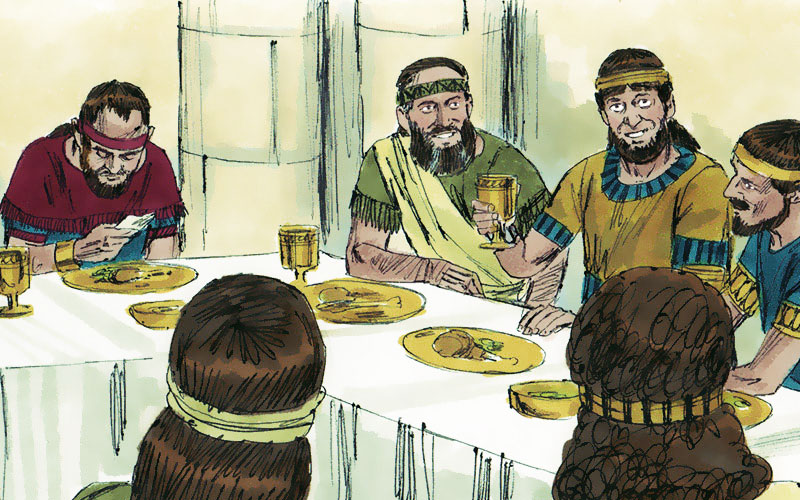
As David neared the end of his life, one of his sons, Adonijah, presumed to make himself king in David’s place (1 Kings 1:5). However, both David and the Lord indicated that Solomon should be king (1 Kings 1:17; 1 Chronicles 22:9-10). In the end, Solomon succeeded David on the throne (1 Kings 1:39) and Adonijah was put to death (1 Kings 2:24-25).

When we compare the rule of these two men — Solomon’s legitimate rule and Adonijah’s illegitimate rule — we find a notable difference between their administrations.
Continue Reading

The Flat Tax

Internal Revenue Service (IRS)

Almost everyone has an opinion when it comes to the topic of taxes. Most would agree that paying taxes is necessary in order for one’s government to be able to function, but the rate and method of taxation is where you find many different opinions. One idea that some have suggested is a flat tax. This would require everyone to pay the same percentage of their income. As with any proposal, you will find people for and against the idea.

I certainly have my opinions about taxes, but that is not the purpose of this article. However, it is interesting that a sort of flat tax can be found in the Law of Moses. Yet this flat tax did not result in everyone paying the same percentage; instead, they all paid the same amount. Notice the instructions regarding the contribution for atonement:
Continue Reading

While Pope John Paul II Moves Closer to “Sainthood,” I Am Already a Saint

The Catholic church is moving forward on their process of recognizing the late Pope John Paul II as a saint. Since a French nun’s recovery from Parkinson’s disease, after she had prayed to the pope, has been declared a “miracle,” John Paul will be “beatified” during a ceremony on May 1. Once he is “beatified,” Catholics will be able to publicly worship the deceased pope. After “beatification,” a second miracle will have to be “verified” to canonize him as a saint.

If you read through the New Testament, it becomes apparent that the Catholic traditions described above are completely foreign to the gospel. Nowhere do we find anything about a pope, let alone praying to or worshipping this man. We read nothing of “beatification” or “canonization.” One of the few familiar terms in the first paragraph is “saint.” Yet even this has been changed from the simple definition we find in the Scriptures.

According to Catholic doctrine and tradition, the late Pope John Paul II is one step closer to being canonized as a saint by the Church.

According to the New Testament, I am already a saint, along with everyone who faithfully follows the Lord.
Continue Reading

The Danger Posed by False Teachers

Danger sign

Near the close of his letter to the Romans, Paul issued a serious warning about the danger posed by false teachers and told the brethren what they must do about it.

Now I urge you, brethren, keep your eye on those who cause dissensions and hindrances contrary to the teaching which you learned, and turn away from them. For such men are slaves, not of our Lord Christ but of their own appetites; and by their smooth and flattering speech they deceive the hearts of the unsuspecting” (Romans 16:17-18).

This command to mark (identify) and avoid false teachers is often forsaken today in favor of ignoring, tolerating, or even accepting one who brings a different gospel. Why is that?

I will not get into the possible reasons for the failure to do what Paul said to do here. Each one should examine his own heart (cf. 2 Corinthians 13:5). But whatever the reason, failure to follow this command is a problem that needs to be corrected. Aside from the desire we ought to have to follow divine commandments (John 14:15), the New Testament gives several other reasons why we should not ignore, tolerate, or accept false teaching/teachers.
Continue Reading

Did God Use the “Big Bang” to Create the Universe?

Space

For a long time there has been a conflict between the teaching of the Bible and the beliefs of the scientific community in general over the origin of the universe. On one hand, you have the Biblical account of God creating the universe from nothing in six days. On the other hand, you have a theory held by many scientists that says the universe came into being when a ball of matter of unknown origin exploded (”Big Bang”), sending particles shooting through space, which eventually, somehow, formed planets and stars, bred life, and, over millions of years, through a long string of lucky mutations, those first single-cell organisms evolved into every living thing that we see in the world today.

Continue Reading

Water Separates

Water

There are a variety of views in the religious world about water baptism. Some believe it is unnecessary. Some call it a good work. Others describe it as an outward sign of an inward grace. The Scriptures teach that baptism plays a significant part in our personal salvation. Notice what Peter wrote:

For Christ also died for sins once for all, the just for the unjust, so that He might bring us to God, having been put to death in the flesh, but made alive in the spirit; in which also He went and made proclamation to the spirits now in prison, who once were disobedient, when the patience of God kept waiting in the days of Noah, during the construction of the ark, in which a few, that is, eight persons, were brought safely through the water. Corresponding to that, baptism now saves you—not the removal of dirt from the flesh, but an appeal to God for a good conscience—through the resurrection of Jesus Christ” (1 Peter 3:18-21).

Peter reminded his readers of the flood in Noah’s day and stated that it parallels baptism. In the time of the flood, there were two groups of people – those who were saved and those who were lost. The ones who were lost were those outside of the ark. The ones who were saved were those in the ark who “were brought safely through the water.” The water made a clear distinction between these two groups.
Continue Reading

Resolutions for the New Year

Notebook

As one year quickly draws to a close and we look forward to a new year, we usually take some time for self-evaluation and making resolutions to improve our lives. Many resolutions that are made have to do with our lives here on this earth: improving our finances and health, eliminating bad habits, etc. These are all good, but we must remember that improving our spiritual lives is far more important.

For bodily exercise is only of little profit, but godliness is profitable for all things, since it holds promise for the present life and also for the life to come” (1 Timothy 4:8).

In the new year, you may get in shape, eat healthier, quit a bad habit, and get out of debt. Those are all great goals, but none of them will matter if your spiritual life is not in order. So as you make your resolutions for the new year, here are six suggestions for improving your spiritual life.
Continue Reading