
The Honest and Good Heart

Wheat

In the previous article we looked at the parable of the sower, noting the four different soils which represented four different types of hearts. Each one responded differently to the word when it was sown among them. Despite these differences, we saw that the message (the seed, the word of God) was not changed. Rather than trying to change the message, we should strive to develop the “honest and good heart” (Luke 8:15) that Jesus said would be receptive to His saving gospel.

Jesus explained the illustration of the good soil: “But the seed in the good soil, these are the ones who have heard the word in an honest and good heart, and hold it fast, and bear fruit with perseverance” (Luke 8:15). Let us be reminded of what the honest and good heart will do and how we can develop this type of heart.
Continue Reading

The Seed of the Sower

The Sower

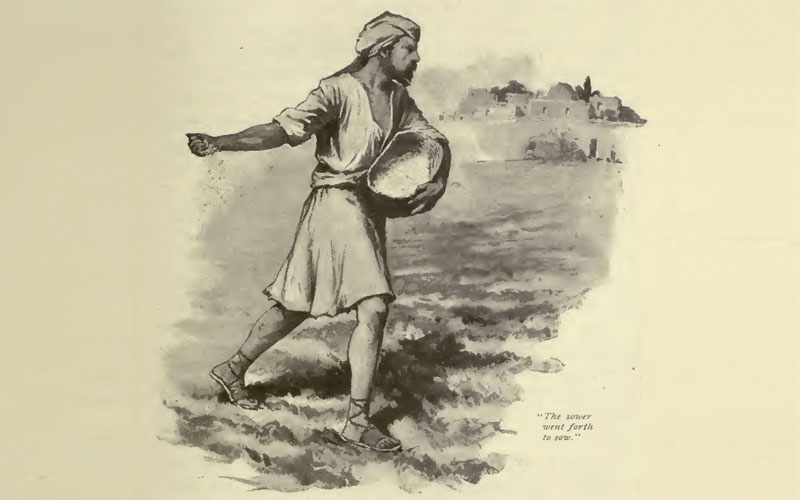
The parable of the sower is one of the more familiar parables spoken by Jesus. In it, He taught an important lesson about the type of message that is required in order to produce fruit.
Continue Reading

How God Is Able to Establish You

Bible

As Paul concluded his epistle to the Romans, he praised God for His ability to establish them (Romans 16:25-27). This means He was able to make them strong, complete, and equipped to follow Him and to face the trials that exist in this life. Is God able to establish us today? If so, how?

Earlier in this letter, Paul expressed a desire to come to them in Rome: “For I long to see you so that I may impart some spiritual gift to you, that you may be established” (Romans 1:11). What were these spiritual gifts that Paul would impart to them in order to establish them? These miraculous gifts of the Spirit are enumerated in the first letter to Corinth and included such gifts as knowledge, prophecy, and the ability to speak in tongues (1 Corinthians 12:7-11). Do we need to have some miraculous spiritual gift in order to be established today? If so, we are in trouble because Paul later said that such miraculous spiritual gifts would be “done away” and replaced with the completed revelation in the word of God (1 Corinthians 13:8-10). This is what we need in order to be established today – the word of God. In our text, Paul described the word in several different ways, showing how it is able to establish us.
Continue Reading

Preaching and Writing

Bible and Notebook

While I was in high school, I made the decision that when I grew up I wanted to be a gospel preacher. So at that point, I began writing religious articles. I did not care for writing in school and was never a gifted writer, so I needed to start practicing and improving my skills. I saw writing as an inherent part of the work of a preacher, as this would provide another avenue through which to spread the gospel message. So since I decided I was going to preach, I decided I also needed to write.

Nearly fifteen years later, it appears to me that preachers in general do not do as much writing as I thought they would. Dedicating time regularly to writing seems to be the exception rather than the rule. Maybe this has always been the case and my youthful naiveté led me to wrongly assume that writing was common for preachers. Perhaps more preachers are writing than the relative few of which I am aware. Or it could be that writing by gospel preachers has decreased in the last decade or so. Regardless of which one is closest to reality, I want to deal with some reasons why writing is a valuable endeavor for preachers and should not be quickly dismissed.
Continue Reading

“Give Me Neither Poverty Nor Riches”

Homeless

If we were able to make two requests that would help to improve our lives here on the earth, what would those requests be? Agur, the wise man to whom Proverbs 30 is attributed, told us what his two requests were:

Two things I asked of You, do not refuse me before I die: Keep deception and lies far from me, give me neither poverty nor riches; feed me with the food that is my portion, that I not be full and deny You and say, ‘Who is the Lord?’ Or that I not be in want and steal, and profane the name of my God” (Proverbs 30:7-9).

The second request – the desire for “neither poverty nor riches” – is what we will focus on in this article.
Continue Reading

When Disaster Strikes

Tornado Damage

Whenever a disaster occurs – whether it is a terrorist attack, natural disaster, or some tragic accident – people often wonder if God was somehow involved. If so, they wonder if the event was an execution of divine judgment against the victims or the greater nation/society as a whole.

Questions like these are nothing new. Jesus commented on this concept when He discussed a couple of tragedies with which His audience was familiar.

Now on the same occasion there were some present who reported to Him about the Galileans whose blood Pilate had mixed with their sacrifices. And Jesus said to them, ‘Do you suppose that these Galileans were greater sinners than all other Galileans because they suffered this fate? I tell you, no, but unless you repent, you will all likewise perish. Or do you suppose that those eighteen on whom the tower in Siloam fell and killed them were worse culprits than all the men who live in Jerusalem? I tell you, no, but unless you repent, you will all likewise perish’” (Luke 13:1-5).

It is important that we know why these things happen. As Jesus made clear, we should not be quick to attribute these things to God’s direct operation. Yet even when an event occurs without direct, divine involvement, there are still lessons we can learn from these disasters.
Continue Reading

Advice to Young Preachers

Bible study

Some might wonder how it is that someone like myself – a thirty year old with no “full-time” preaching experience – would be so bold as to hand out advice to young preachers (many of whom would be my peers). I am not so arrogant as to think that I have wisdom that compares with a man who has been preaching the gospel for decades. But I do have the Scriptures – the inspired word of God (2 Timothy 3:16). Therefore, when I teach the things that come from God (cf. 1 Peter 4:11), I can do so as Titus was told to teach – “with all authority” (Titus 2:15). So let us briefly look at some of the Bible instructions on preaching that young (and old) preachers need to always remember.
Continue Reading