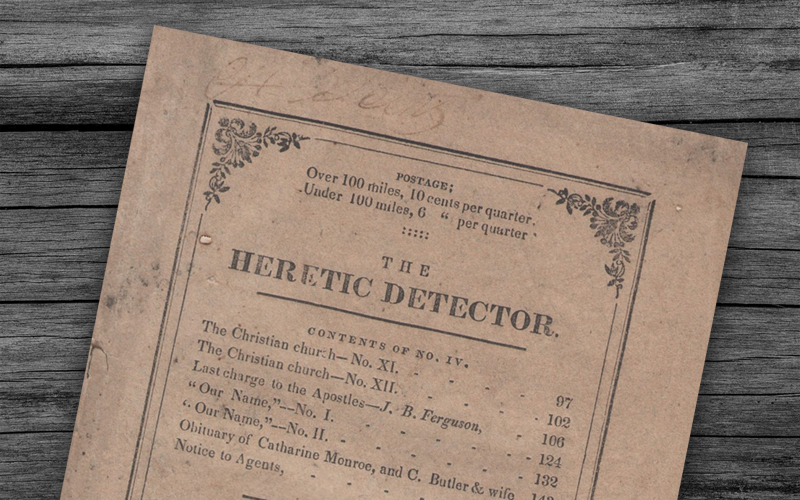
Arguments against the Missionary Society

American Christian Missionary Society

The Missionary Society was the source of the first major controversy and division among those associated with the Restoration Movement. What began as informal “association” meetings evolved into formal organizations to which churches would send delegates, and evangelists would be commissioned to preach in a particular area while receiving financial support from the society. As time passed and the brethren involved desired to extend the reach of their state societies, a larger society was created at the national level – the American Christian Missionary Society, which was formed in 1849.

The fundamental problem with this arrangement is that the New Testament contains no authority for the practice. Instead, it describes the local church as the only collectivity through which Christians engaged in the work of evangelism. The Missionary Society, in contrast, was a human institution that was founded, organized, directed, and funded by men. Yet in the first century, with only the work of individual Christians and local churches (which were designed by the Lord and followed His direction), the gospel spread quickly and broadly throughout the world.

Often, when brethren discuss the concept of the Missionary Society, they focus on this point: The local church is the organization specified by the Lord in the New Testament for spreading the gospel; therefore, every other organization used for this work (including the Missionary Society) is unauthorized.

That is a valid argument. However, this was not the only argument used by the opponents of the Missionary Society when it was first introduced. In the book Restoration Principles and Personalities, author Dabney Phillips described four general arguments that were used against the Missionary Society.Continue Reading

After the Time of the Apostles

The Crucifixion of Peter

Peter wrote his second epistle shortly before his death. In fact, he told the brethren that “the laying aside of [his] earthly dwelling [was] imminent” (2 Peter 1:14). Though not recorded in the Bible, historical accounts suggest that Peter was crucified in Rome.* Over the next several years, all the apostles would depart from this life, with most of their deaths resulting from persecution. Eventually, these brethren would be without Peter and any of the other apostles.

Today, we also have no living apostles.** Like the brethren at the end of the first century, we live in the world without personal direction from the ones chosen to be the “ambassadors for Christ” (2 Corinthians 5:20). We work to teach others without the ones commissioned by the Lord to “go into all the world and preach the gospel to all creation” (Mark 16:15). We carefully study the words they wrote as they revealed “the mind of Christ” (1 Corinthians 2:10-16) without the ability to hear them teach or to ask questions to help our understanding.

It might seem as though we are at a disadvantage. For the Christians living in the last part of the first century, the prospect of losing access to the living apostles may have felt the same. However, in this letter written near the end of his life, Peter assured them (and this applies to us as well) that they had everything they needed to serve God and obtain His promises.

Let us notice what Peter said about this just in the verses leading up to his statement about his death being “imminent” (2 Peter 1:14). What would they still have after the time of the apostles? What do we still have?Continue Reading

God’s Declaration to All Men

Paul in Athens

When Paul addressed the philosophers in Athens, he taught them about the “unknown God” (Acts 17:23). He explained how the living and true God is different from all man-made idols. God created the world, made us in His image, and provided us with all good things to enjoy. Paul concluded his message with the declaration that God was now making to all:

Therefore having overlooked the times of ignorance, God is now declaring to men that all people everywhere should repent, because He has fixed a day in which He will judge the world in righteousness through a Man whom He has appointed, having furnished proof to all men by raising Him from the dead” (Acts 17:30-31).

This message was not for the Athenians alone. All men who lived from that time to today, and for as long as the world stands, need to heed this message. So let us examine what God is declaring to us even today.Continue Reading

A Man of Integrity

Man at Sunset

Proverbs 31 is known for its description of the virtuous woman, also known as the excellent wife.* Job 31 provides a similar type of description for the man. It outlines what a man of integrity looks like.

Integrity is an uprightness of character that is displayed in every area of life. It is complete and consistent, not selective and sporadic. It is vital that men have integrity. By examining this chapter, we can see how to become men of integrity.Continue Reading

Leaving Behind the Fruit of Our Labor

Older Man Thinking

In the book of Ecclesiastes, the wise man spoke about the futility of life “under the sun.” One of the reasons why he saw his earthly existence as futile was that he would leave the fruit of his labor to someone else. In the passage below, he described the real possibility that his earthly possessions would be left to someone who would squander them or act foolishly with them.

So I hated life, for the work which had been done under the sun was grievous to me; because everything is futility and striving after wind.

Thus I hated all the fruit of my labor for which I had labored under the sun, for I must leave it to the man who will come after me. And who knows whether he will be a wise man or a fool? Yet he will have control over all the fruit of my labor for which I have labored by acting wisely under the sun. This too is vanity.

Therefore I completely despaired of all the fruit of my labor for which I had labored under the sun. When there is a man who has labored with wisdom, knowledge and skill, then he gives his legacy to one who has not labored with them. This too is vanity and a great evil.

For what does a man get in all his labor and in his striving with which he labors under the sun? Because all his days his task is painful and grievous; even at night his mind does not rest. This too is vanity” (Ecclesiastes 2:17-23).

What’s the point? In essence, this was what the wise man was asking. He viewed with despair the prospect of the material things he worked hard to obtain and maintain going to someone who would not appreciate or use them properly.

When we reach the age at which our time on earth is growing shorter, we will likely start having similar thoughts as the wise man. We may ask, What should happen with our wealth or possessions when we die? Are there principles and instructions in God’s word that will help us with this? Yes! We will consider some points in this article.Continue Reading

Steps to Achieving Righteousness

Walking Up Stairs

The book of James is filled with practical instructions for our lives as Christians. In the following passage, James discussed, in practical terms, how to be righteous.

This you know, my beloved brethren. But everyone must be quick to hear, slow to speak and slow to anger; for the anger of man does not achieve the righteousness of God. Therefore, putting aside all filthiness and all that remains of wickedness, in humility receive the word implanted, which is able to save your souls. But prove yourselves doers of the word, and not merely hearers who delude themselves” (James 1:19-22).

Our aim is to “achieve the righteousness of God.” How do we do that? James outlined four steps we can take to reach this goal.Continue Reading

21st Year of Plain Bible Teaching

Open Bible and Coffee Mug

Plain Bible Teaching launched on August 1, 2005, so we have just completed twenty years and are now beginning year number twenty-one!

I am very thankful that I have been able to do this for so long. I enjoy the work that goes into writing articles and creating other content, which is published here and on other platforms. However, looking at website analytics and social media statistics, as well as reading emails and messages sent to me, I know that this work is benefiting people throughout the country and around the world. I am grateful for that and recognize that all of this is only possible because of the blessings of God, so He is the one worthy of praise for whatever good might be done here.

I also want to take this opportunity to thank each one of you for reading, listening, watching, following, and sharing this material. I am also appreciative of all of the emails, messages, and face-to-face comments offering words of encouragement to me in this work. Whether you have been following Plain Bible Teaching since the beginning, have recently discovered it, or are somewhere in between, I’m glad you are here.Continue Reading