Let Not the Church Be Charged

Walking with Elderly Woman

If any man or woman that believeth have widows, let them relieve them, and let not the church be charged; that it may relieve them that are widows indeed” (1 Timothy 5:16, KJV).

This verse comes at the end of a section dealing with the care of certain widows. Paul had given Timothy instructions about which widows were to receive continual, ongoing support from the local church and which ones were not. In the case of widows who had family to care for them, the church was not to be charged with their care.

The idea of the church not being charged with something can certainly extend in application beyond just the care of certain widows.
Continue Reading

Do We Have Authority for a Church Building?

This question about whether or not the New Testament contains authority for a church building often comes up when discussing other issues that relate to Bible authority. When one points out that things like instrumental music in worship, missionary societies, and “fellowship” halls are unauthorized, there is sometimes the response that we do not have authority for a church building, either; therefore, it is inconsistent to oppose the others.

Most of the time, those who argue that there is a lack of authority for church buildings do not believe they are wrong. They just believe that we do not need Bible authority for everything we do and are simply pointing out what they believe to be is inconsistency (or hypocrisy) in those who oppose things such as instrumental music.

We must not be too quick to take the question of a congregation owning a building and lump it together with various unauthorized practices. Just because someone likens church buildings to fellowship halls and then demands that you either accept both or reject both does not mean the two belong in the same class. Each one must stand up to the scrutiny of the Scriptures alone. In this article, we will consider the question: Are church buildings authorized?
Continue Reading

“Come”

Revelation 22:17

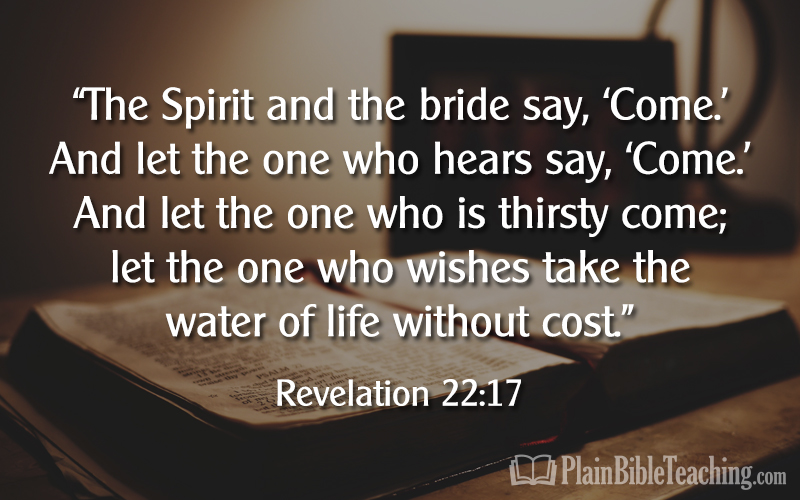
The Spirit and the bride say, ‘Come.’ And let the one who hears say, ‘Come.’ And let the one who is thirsty come; let the one who wishes take the water of life without cost” (Revelation 22:17).

This is an invitation for salvation that has been offered by Christ. It is for those who need the water of life. This means that it is for all, for “all have sinned and fall short of the glory of God” (Romans 3:23) and “the wages of sin is death” (Romans 6:23). All who wish to obtain the gift of salvation and be saved from their sins may come.
Continue Reading

Is One Church as Good as Another?

Church building

As we talk with people in the world, particularly those who are religious, one idea with which we are often confronted that one church is as good as another. Many people believe this. This can make it difficult in trying to lead someone to the truth. After all, if one is already part of a church, they can simply ignore what you say because their church is just as good as yours. So he has no reason to consider any discussion that might lead him to decide to leave his church. If one is not part of a church, and should he decide to attend one, it would not have to be where you attend. He could go anywhere, limited only by how far away from home he wants to drive. This concept that one church is as good as another must be eliminated if we want to have any success in leading souls to Christ. So it is good for us to consider the idea so we might be better prepared to handle various situations.
Continue Reading

Non-Denominationalism

Last month I posted an article about the problem of denominationalism. Yet there seems to be a shift occurring in the religious world. We are seeing a gradual move from denominationalism to non-denominationalism. It is becoming more common to pass a church building and see that the name on the sign does not include a denominational distinction. That is one sign of this shift.

Denominational distinctions are becoming less important. It used to be that people would generally identify themselves by their denomination. They would think it strange when you said you were “just a Christian.” Now they tend to simply call themselves Christians, too. This may be a step in the right direction (Acts 11:26; 1 Corinthians 1:12-13), but there is still more that needs to be done. There are two things that have come from this decreased emphasis on denominational distinctions.
Continue Reading

Measures of a Sound Church

Church building

How can we know if a local church is a sound church? First, what do we mean by a sound church? This particular phrase is not used in the New Testament. But the word “sound” is used to describe teaching, doctrine, and words (1 Timothy 1:10; 2 Timothy 1:13; 4:3). The Greek word which is translated “sound” means to have good health, to be well, and to be uncorrupted. This word can certainly be used in reference to a local church. So how do we know if a church is “sound”?
Continue Reading

Denominationalism

When talking with people and the topic of religion comes up, they sometimes ask, “What denomination are you a part of?” In answering this question, I tell them I am not part of a denomination. This is a strange concept for many and, as a result, provides some opportunity to discuss spiritual matters with them. Many cannot envision Christianity without denominations. Denominationalism is only natural for them. But is it something that should be accepted or rejected?
Continue Reading