When Every Man Does What Is Right in His Own Eyes

Riot

The book of Judges covers the period between the conquest of Canaan under Joshua to the time just before the kings. It was a time of wickedness, oppression, and anarchy (cf. Judges 2:11-15; 21:25). Toward the end of the book, we read about a man named Micah whose story typifies the culture as a whole. Notice the text:

Now there was a man of the hill country of Ephraim whose name was Micah. He said to his mother, ‘The eleven hundred pieces of silver which were taken from you, about which you uttered a curse in my hearing, behold, the silver is with me; I took it.’ And his mother said, ‘Blessed be my son by the Lord.’ He then returned the eleven hundred pieces of silver to his mother, and his mother said, ‘I wholly dedicate the silver from my hand to the Lord for my son to make a graven image and a molten image; now therefore, I will return them to you.’

So when he returned the silver to his mother, his mother took two hundred pieces of silver and gave them to the silversmith who made them into a graven image and a molten image, and they were in the house of Micah. And the man Micah had a shrine and he made an ephod and household idols and consecrated one of his sons, that he might become his priest.

In those days there was no king in Israel; every man did what was right in his own eyes” (Judges 17:1-6).

We do not know much about this man, but there are some important lessons from this account. His example serves as an illustration of what happens when “every man [does] what is right in his own eyes” (Judges 17:6). Since this same attitude is prevalent in our day and age, it will be beneficial to consider some lessons from the text.

So what happens when “every man [does] what is right in his own eyes”?Continue Reading

Fearfully and Wonderfully Made (08.11.22)

Subscribe: Apple Podcasts | Google Podcasts | Stitcher | Spotify | RSS

Plain Bible Teaching Podcast

This week, instead of a regular episode, I’m going to be sharing the audio from a sermon I preached recently for the congregation where I preach regularly – the Eastside church of Christ in Morgantown, KY. The sermon is titled, Fearfully and Wonderfully Made, and is based upon a passage in Psalm 139. So many of the problems in our society (abortion, transgenderism, racism, etc.) are the result of people either rejecting or never learning the principles contained in this passage. Since we discuss social issues on this podcast and this sermon is related to that, I thought it would be good to share.Continue Reading

Fearfully and Wonderfully Made

Baby

For You formed my inward parts; You wove me in my mother’s womb. I will give thanks to You, for I am fearfully and wonderfully made; wonderful are Your works, and my soul knows it very well” (Psalm 139:13-14).

The Bible clearly identifies God as the creator of all things. The verse above makes this personal, showing that each one of us has been created by Him. The psalmist used two words to describe this:

  • Fearfully – This word signifies something that causes one to revere or to stand in awe of something. The way God has formed each one of us is awe-inspiring and is a reason to approach Him in reverence.
  • Wonderfully – This word is used to describe something that is distinguished or set apart. God created us to be special among all the other things He has made.

The fact that we have been “fearfully and wonderfully made” teaches certain things about us. These are important to note, especially given certain mentalities and behaviors that are pervasive in our society.Continue Reading

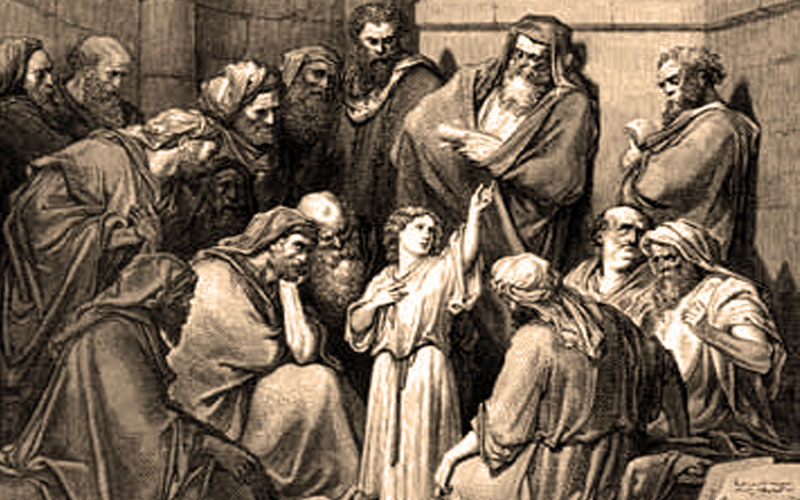
Growing in Wisdom, Stature, and Favor

Jesus as a Boy in the Temple

The four gospels focus primarily on the public ministry of Jesus leading up to His crucifixion and resurrection – a period of approximately three years. In addition to this, Matthew and Luke include some information about His birth and infancy. Luke also briefly records one event in Jesus’ childhood – the time when He was “lost” in the temple at twelve years old (Luke 2:41-51).

We may be curious about what happened as Jesus grew up, but the Scriptures are mostly silent about this. However, the Holy Spirit did see fit to include a statement about the growth of Jesus:

And Jesus kept increasing in wisdom and stature, and in favor with God and men” (Luke 2:52).

This may seem somewhat obvious and, therefore, almost insignificant. Yet this statement was given for a reason. If Jesus grew in wisdom, stature, and favor, then it should be expected for us to do the same. In this article, we are going to consider how we can grow in each of these areas.Continue Reading

Shout Joyfully to the Lord

Man under the Northern Lights

Shout joyfully to the Lord, all the earth. Serve the Lord with gladness; come before Him with joyful singing. Know that the Lord Himself is God; it is He who has made us, and not we ourselves; we are His people and the sheep of His pasture. Enter His gates with thanksgiving and His courts with praise. Give thanks to Him, bless His name. For the Lord is good; His lovingkindness is everlasting and His faithfulness to all generations” (Psalm 100:1-5).

This psalm begins with a universal call to praise God. It gives us some insight into how we offer praise to Him and describes some of the reasons why He is worthy of such praise.

Let us notice some of the things this psalm tells us about how and why we are to praise the Lord.Continue Reading

Testifying of Christ

After the Jews began persecuting Jesus for healing a man on the Sabbath (John 5:16), Jesus began discussing His equality with the Father (John 5:17-23), the future resurrection (John 5:25-29), and the proof that He was who He claimed to be (John 5:33-47). This final point was critical. Not every claim that one may make of himself is true. This was why Jesus said, “If I alone testify about Myself, My testimony is not true” (John 5:31). He was not saying that He might make false claims. After all, He “always” did the will of the Father (John 8:29). Yet there was a difference between what Jesus claimed about Himself and what others – His enemies, in particular – claimed about Him.

How could the people know that Jesus was the Christ and not an imposter? They would need to have evidence. Jesus explained that this evidence came in the form of witness testimony that verified His claims. In this passage, He described four witnesses that testified of Him and confirmed His claim as the Christ, the Son of God. Let us notice these briefly.Continue Reading

Lifting Up Our Soul to the Lord

To You, O Lord, I lift up my soul. O my God, in You I trust, do not let me be ashamed; do not let my enemies exult over me. Indeed, none of those who wait for You will be ashamed; those who deal treacherously without cause will be ashamed” (Psalm 25:1-3).

This psalm is about our dependence upon God – something that each one of us needs to be reminded of from time to time. The text describes three areas in which we are dependent upon the Lord.

The psalmist explained this by describing himself as lifting up his soul to the Lord. This denotes a surrender of oneself to Him – a complete trust in God that carried with it a confidence that he would not be ashamed.

Let us consider what this psalm teaches us about our need for the Lord and the three ways in which we are dependent upon what He provides.Continue Reading