“So that Christ may dwell in your hearts through faith” (Ephesians 3:17).

“For this reason, I, Paul, the prisoner of Christ Jesus for the sake of you Gentiles—if indeed you have heard of the stewardship of God’s grace which was given to me for you; that by revelation there was made known to me the mystery, as I wrote before in brief” (Ephesians 3:1-3).
Paul told the Ephesians about the mystery he received by revelation. He was referring to divine revelation – a message that came from God. As an apostle (Ephesians 1:1), the Holy Spirit guided him “into all the truth” (John 16:13) so that he could say, “The things which I write to you are the Lord’s commandment” (1 Corinthians 14:37).
Does this type of divine revelation still occur today? Many people claim to receive messages directly from heaven. But does God reveal His will directly to people today like He did with Paul and others? It is important that we know the answer to that question. So let us consider it here.
Continue Reading
In the letter to the church at Ephesus, Paul commanded, “And do not get drunk with wine, for that is dissipation, but be filled with the Spirit” (Ephesians 5:18). Many believe that a Christian being filled with the Spirit is wholly dependent upon some direct action by God. This is puzzling, considering that Paul phrases this as a command. A commandment implies a responsibility to obey. Therefore, we are responsible for being “filled with the Spirit.” So how are we to do this?
Many today are seeking God’s guidance and direction but are unsure where to look. The Scriptures plainly teach us that God speaks to us today through His Son, Jesus. The Hebrew writer began his letter by affirming this fact:
“God, after He spoke long ago to the fathers in the prophets in many portions and in many ways, in these last days has spoken to us in His Son, whom He appointed heir of all things, through whom also He made the world” (Hebrews 1:1-2).
Previously, God spoke to man in different ways, providing bits and pieces of revelation to the fathers during the Patriarchal age, and also through the prophets. But that was in times past. He does not speak to us in the same way today. Now that we are in the “last days,” there is a new spokesman.
Continue Reading

Peter wrote his first epistle to Christians that were scattered throughout Asia Minor. He addressed them as ones who were “chosen” (1 Peter 1:1). For what were they chosen? Salvation. They were “born again to a living hope” in order to “obtain an inheritance […] reserved in heaven” (1 Peter 1:3-4). They were waiting “for a salvation ready to be revealed in the last time” (1 Peter 1:5).
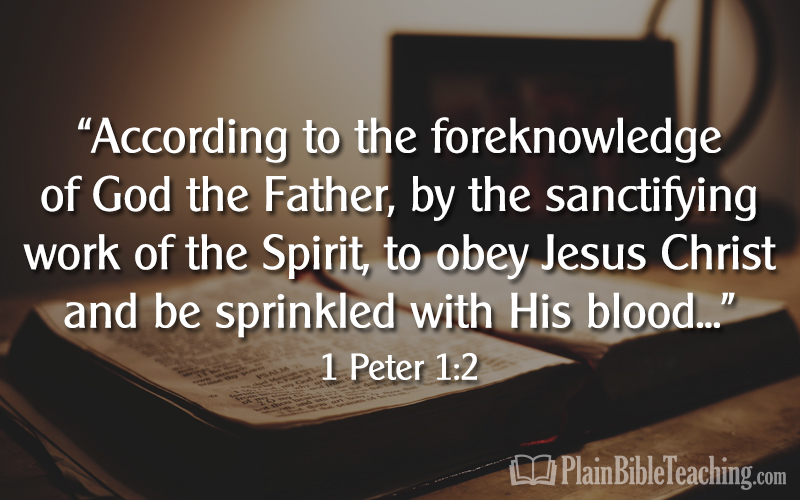
How had these individuals been chosen? Peter said it was “according to the foreknowledge of God the Father, by the sanctifying work of the Spirit, to obey Jesus Christ and be sprinkled with His blood” (1 Peter 1:2). Here the apostle mentioned four contributors that make salvation possible for us:
Continue Reading

Paul began his letter to the Ephesians by offering praise to God: “Blessed be the God and Father of our Lord Jesus Christ” (Ephesians 1:3). There are many reasons why God is worthy of all praise and honor; but in this passage, Paul directed our attention to the spiritual blessings we have from Him. We give glory to God because he has “blessed us with every spiritual blessing in the heavenly places in Christ” (Ephesians 1:3).
As Paul continued, he listed some of the spiritual blessings available to us:
Continue Reading

Each one of us is busy with obligations and responsibilities that have been placed upon us and that we have taken upon ourselves. Our lives can be hectic and we sometimes wonder how we will ever have time to do what we need to do. This is just as much of a challenge for Christians as it is for anyone else.
Paul provided some instructions about time management that would be good for us to heed:
“Therefore be careful how you walk, not as unwise men but as wise, making the most of your time, because the days are evil” (Ephesians 5:15-16).

You have successfully joined our mailing list.
What does “propitiation” mean? How is “justification” connected to salvation? What does “sanctification” look like in our day-to-day lives? The Bible uses some powerful words to describe God’s plan to save mankind. However, these words are not always easy to understand, especially when they are not part of our everyday vocabulary. This book explores key Bible terms that unlock the message of the gospel.
Big Words in the Bible examines five important words – Propitiation, Reconciliation, Sanctification, Justification, and Resurrection – using plain language to see how the Scriptures describe these concepts and how the apostle Paul employs them in his letter to the Romans. This book also contains an appendix with eleven additional articles to explore these topics further.
Whether you are new to the Bible and want to grow in your understanding or want a simple way to explain these core gospel doctrines to others, this book will be helpful. With a focus on the Scriptures, Big Words in the Bible helps break down these fundamental topics to shed light on the life-changing message of the gospel and the salvation found in it.
Available in print and digital format.
This work is licensed under a Creative Commons Attribution-NonCommercial-ShareAlike 3.0 Unported License.
If you have further questions about using any of the material on this site, please contact me.
Copyright © 2026 · Balance Child Theme on Genesis Framework · WordPress · Log in