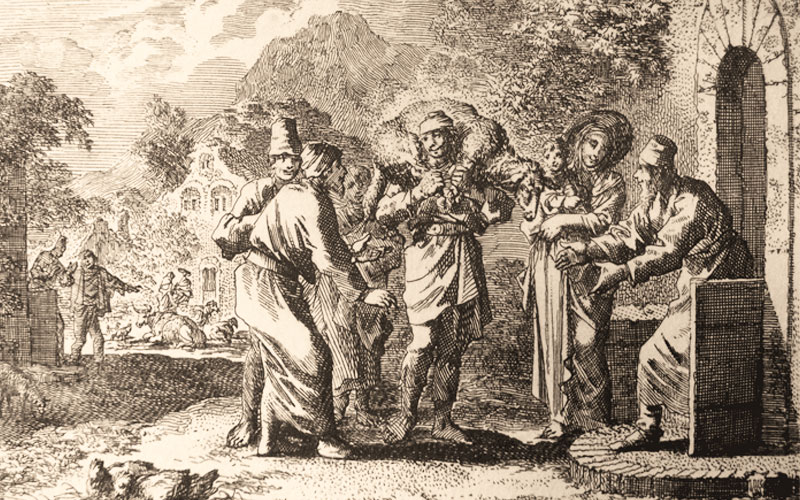
Why Jesus Came to Save Us

The Lost Sheep

Why did Jesus come to save us? There are several answers we could give that would be correct: He loved us (John 15:13), the Father loved us (John 3:16), He needed to fulfill “the eternal purpose” (Ephesians 3:11), He wanted to “bring us to God” (1 Peter 3:18), and so on. But why did we need to be saved? Notice what Jesus said:

For the Son of Man has come to seek and to save that which was lost” (Luke 19:10).

Simply put, Jesus came to save us because we were lost. In Luke 15, Jesus used three parables to describe things that were lost: the lost sheep (Luke 15:3-7), the lost coin (Luke 15:8-10), and the lost son (Luke 15:11-24). When we consider these three parables, we learn several lessons: (1) why being lost is dangerous for us, (2) why the Lord saw fit to seek for us when we were lost, and (3) what our responsibility is in being saved.
Continue Reading

“Made Like His Brethren in All Things” (12/21)

Thought from today’s Bible reading from Hebrews 1-6.

Therefore, He had to be made like His brethren in all things, so that He might become a merciful and faithful high priest in things pertaining to God, to make propitiation for the sins of the people” (Hebrews 2:17).

The Hebrew writer’s assertion that Jesus was made “like His brethren in all things” has been stretched by some brethren far beyond what is taught in the context. Some suppose this phrase means that Jesus desired to sin like we desire to sin. Some assume that Jesus was given a human spirit when He came and lived on the earth. Neither of these is taught in the context, nor are they taught anywhere in Scripture.

The Hebrew writer explained in this context what is meant by the phrase, “He had to be made like His brethren in all things.”
Continue Reading

The Sixteen Apostles

16

You may be wondering about the title of this article. After all, were there not just twelve apostles? That is what children learn in Bible class. That is the number that immediately comes to mind for most Bible students of any age. If you count the men that Jesus chose during His time on the earth, there were just twelve apostles. But if you count every person mentioned in the Bible as being an apostle, you find not twelve, but sixteen.

Before noticing who these sixteen are, let us remember what the word apostle means. It is from the Greek word apostolos, which means one who is sent. In the context of Scripture, an apostle was one who was sent out on a divinely ordained mission with a message that came from above. His duty was to proclaim the good news of salvation.

So who were the sixteen apostles? We typically think of the twelve that were chosen by Jesus: Peter, Andrew, James, John, Philip, Bartholomew, Thomas, Matthew, James the son of Alphaeus, Thaddaeus, Simon, and Judas (Matthew 10:2-4). Besides these, we read of Matthias (Acts 1:26), Paul (Romans 1:1), Barnabas (Acts 14:14), and even Jesus Himself (Hebrews 3:1) being called apostles.

Not every one of the sixteen was the same type of apostle – Barnabas and Jesus particularly were distinct in different ways, as we will notice. But what they all have in common is that their apostleships help explain how God has chosen to reveal His word and how He desires that it be spread. So with this in mind, let us consider the sixteen apostles.
Continue Reading

The World Could Not Contain the Books that Would Be Written (11/15)

Thought from today’s Bible reading from Luke 24; John 20-21.

The gospels record a relatively brief period in the life of Jesus on the earth. There are many things that Jesus said and did that were not recorded. John, at the end of his gospel, explained that it would not be possible to record everything.

And there are also many other things which Jesus did, which if they were written in detail, I suppose that even the world itself would not contain the books that would be written” (John 21:25).

If the gospels do not contain everything that Jesus said or did on the earth, then why did the gospel writers record what they did? Remember, Jesus promised to send the Holy Spirit to guide the apostles “into all the truth” (John 16:13). So why was it that the Holy Spirit had these men include certain things and omit other things? John gave the answer:
Continue Reading

What the Thief on the Cross Understood (11/13)

Thought from today’s Bible reading from Luke 23; John 18-19.

There are several lessons to be learned from the thief who was crucified next to Jesus. Notice what Luke recorded in his gospel:

One of the criminals who were hanged there was hurling abuse at Him, saying, ‘Are You not the Christ? Save Yourself and us!’ But the other answered, and rebuking him said, ‘Do you not even fear God, since you are under the same sentence of condemnation? And we indeed are suffering justly, for we are receiving what we deserve for our deeds; but this man has done nothing wrong.’ And he was saying, ‘Jesus, remember me when You come in Your kingdom!’ And He said to him, ‘Truly I say to you, today you shall be with Me in Paradise’” (Luke 23:39-43).

Continue Reading

Praying That the Hour Might Pass Him By (11/9)

Thought from today’s Bible reading from Matthew 26; Mark 14.

Jesus prayed in the Garden of Gethsemane before His betrayal. Some have interpreted His prayer to mean that Jesus was praying that He might be able to avoid the cross. Notice what Jesus said as it was recorded by Matthew:

And He went a little beyond them, and fell on His face and prayed, saying, ‘My Father, if it is possible, let this cup pass from Me; yet not as I will, but as You will’” (Matthew 26:39).

Some read of this desire for “this cup” to pass from Him and conclude that Jesus, in a moment of weakness, desired to escape the cross. In other words, though Jesus came to this world to save sinners, when the time was near for Him to offer the sacrifice, in an act of human weakness He wanted to abandon the mission. Can this possibly be true of our Lord?

Mark, in his gospel, offers us an inspired commentary explaining what Jesus’ words meant:
Continue Reading

“For This Purpose I Came to This Hour” (11/3)

Thought from today’s Bible reading from Mark 11; John 12.

And Jesus answered them, saying, ‘The hour has come for the Son of Man to be glorified. Truly, truly, I say to you, unless a grain of wheat falls into the earth and dies, it remains alone; but if it dies, it bears much fruit’” (John 12:23-24).

The time for Jesus to be glorified was approaching. But how was He going to be glorified? Many of the Jews were looking for their Messiah to defeat the Romans and rule over a physical kingdom from Jerusalem. But this was not the divine plan. Instead, as Jesus indicated here, it would involve death.

‘Now My soul has become troubled; and what shall I say, “Father, save Me from this hour”? But for this purpose I came to this hour. Father, glorify Your name.’ Then a voice came out of heaven: ‘I have both glorified it, and will glorify it again’” (John 12:27-28).

Continue Reading