“The Son of Man Has Come to Seek and to Save That Which Was Lost” (11/2)

Thought from today’s Bible reading from Luke 18:15-19:48.

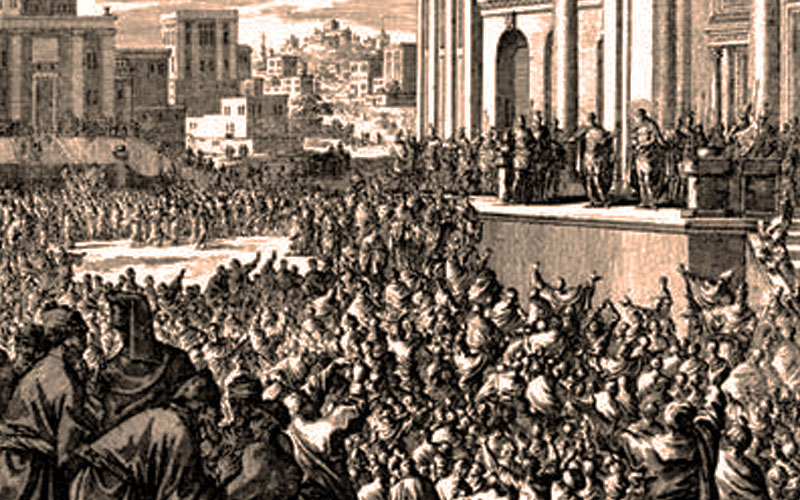
There were many who did not understand why Jesus would associate with tax collectors and sinners. Yet the reason why He did was because of the mission He had in coming to earth. Notice the example of Jesus with the tax collector Zaccheus who climbed a tree in order to see the Lord as He passed by.

When Jesus came to the place, He looked up and said to him, ‘Zaccheus, hurry and come down, for today I must stay at your house.’ And he hurried and came down and received Him gladly. When they saw it, they all began to grumble, saying, ‘He has gone to be the guest of a man who is a sinner.’

Zaccheus stopped and said to the Lord, ‘Behold, Lord, half of my possessions I will give to the poor, and if I have defrauded anyone of anything, I will give back four times as much.’ And Jesus said to him, ‘Today salvation has come to this house, because he, too, is a son of Abraham. For the Son of Man has come to seek and to save that which was lost’” (Luke 19:5-10).

Those who grumbled about Jesus meeting with Zaccheus may have been right that the tax collector was a sinner. But this was the type of person Jesus came to save. When others grumbled earlier on a similar occasion, Jesus said, “I have not come to call the righteous but sinners to repentance” (Luke 5:32).
Continue Reading

“We Have No King But Caesar”

Trial of Jesus

Pilate knew that the trial of Jesus was unique. Jesus explained to him that His kingdom was “not of this world” (John 18:36). Pilate then recognized that Jesus claimed to be a king (John 18:37), even though the Jews rejected Him as their king (John 18:33, 35). But the Jews’ rejection of Jesus was more than just a refusal to support Him as a king; they wanted to kill Him (John 18:31) even though Pilate was able to find “no guilt in Him” (John 18:38; 19:4, 6).

Then Pilate became “even more afraid” when the Jews told him that Jesus “made Himself out to be the Son of God” (John 19:7-8). How much of this Pilate believed is immaterial. The fact is that the events transpiring with the claims and charges being made were producing a volatile situation. So Pilate “made efforts to release Him” (John 19:12), but the Jews would not let him do it. Pilate then made one final effort to defuse the situation and allow the innocent Jesus to be released.

Now it was the day of preparation for the Passover; it was about the sixth house. And he said to the Jews, ‘Behold, your King!’ So they cried out, ‘Away with Him, away with Him, crucify Him!’ Pilate said to them, ‘Shall I crucify your King?’ The chief priests answered, ‘We have no king but Caesar.’ So he then handed Him over to them to be crucified” (John 19:14-16).

This case was not about some random insurrectionist. There was much more to this than Pilate could have imagined at the start. But in the end, the Jews – influenced by their leaders (Matthew 27:20) – very clearly and boldly repudiated Jesus and demanded His crucifixion. Why was this so significant? It has to do with what they rejected, and what they chose to focus on instead.
Continue Reading

The Blind Man’s Lesson for the Pharisees (10/24)

Thought from today’s Bible reading from John 9:1-10:21.

When Jesus healed a blind beggar, the Pharisees became upset because this was done on the Sabbath (they had a faulty notion that Jesus’ actions here violated the Sabbath law when they did not). So the man who was healed was brought before the Pharisees to answer for what had happened. After this they interviewed the man’s parents. Then they brought the formerly blind man back before them. During this second interrogation, this man taught the Pharisees of some important facts and showed them why they should believe in Christ.

They reviled him and said, ‘You are His disciple, but we are disciples of Moses. We know that God has spoken to Moses, but as for this man, we do not know where He is from.’

The man answered and said to them, ‘Well, here is an amazing thing, that you do not know where He is from, and yet He opened my eyes. We know that God does not hear sinners; but if anyone is God-fearing and does His will, He hears him. Since the beginning of time it has never been heard that anyone opened the eyes of a person born blind. If this man were not from God, He could do nothing.’

They answered him, ‘You were born entirely in sins, and are you teaching us?’ So they put him out” (John 9:28-34).

Continue Reading

“Before Abraham Was Born, I Am” (10/23)

Thought from today’s Bible reading from John 7-8.

There are many people in the world who believe that Jesus was just a regular human being and that He never possessed the attributes of Deity. Some among our own brethren believe that Jesus surrendered His deity when He came to earth. Both of these theories are debunked by Jesus’ own words.

Notice the conversation Jesus had with certain ones of the Jews who did not believe in Him:

‘Your father Abraham rejoiced to see My day, and he saw it and was glad.’ So the Jews said to Him, ‘You are not yet fifty years old, and have You seen Abraham?’ Jesus said to them, ‘Truly, truly, I say to you, before Abraham was born, I am.‘ Therefore they picked up stones to throw at Him, but Jesus hid Himself and went out of the temple” (John 8:56-59).

Continue Reading

Intending to Make Jesus King (10/18)

Thought from today’s Bible reading from John 6.

Many religious people are looking forward to the time when Christ returns and establishes His kingdom here on the earth. The alleged reason why Jesus did not do this when He came the first time was because the people rejected Him and would not make Him their king. Therefore, since Jesus was rejected by His people, He ascended back to heaven, the church was established instead, and believers now look forward to the coming kingdom.

The problem with this the above theory is that it is not taught in the Bible. The following verse debunks the claim that Jesus could not establish His kingdom because the people rejected Him. After feeding five thousand, the people were willing to risk their lives in a rebellion against the Roman Empire with the goal of establishing Jesus as their king. But this was not part of God’s plan.

So Jesus, perceiving that they were intending to come and take Him by force to make Him king, withdrew again to the mountain by Himself alone” (John 6:15).

Continue Reading

The Centurion’s Great Faith (10/11)

Thought from today’s Bible reading from Matthew 8:1-13; Luke 7.

When Jesus was informed of a centurion’s servant who was near death, He headed to the man’s house. But before He arrived, the centurion sent a message to Him. His message to Jesus proved to be a great expression of faith.

Now Jesus started on His way with them; and when He was not far away from the house, the centurion sent friends, saying to Him, ‘Lord, do not trouble Yourself further, for I am not worthy for You to come under my roof; for this reason I did not even consider myself worthy to come to You, but just say the word, and my servant will be healed. For I also am a man placed under authority, with soldiers under me; and I say to this one, “Go!” and he goes, and to another, “Come!” and he comes, and to my slave, “Do this!” and he does it.’ Now when Jesus heard this, He marveled at him, and turned and said to the crowd that was following Him, ‘I say to you, not even in Israel have I found such great faith’” (Luke 7:6-9).

Notice some characteristics of the centurions “great faith“:
Continue Reading

Why Do You Call Jesus, "Lord"? (10/9)

Thought from today’s Bible reading from Matthew 1:1-21; Mark 3; Luke 6.

There are many people today who would call Jesus their Lord. But are all of these people actually treating Him as Lord? Sadly, many are not. How are they failing to treat Jesus as Lord? Notice what Jesus said:

Why do you call Me, ‘Lord, Lord,’ and do not do what I say?” (Luke 6:46).

Jesus’ point is clear: if one will not obey Him, it is meaningless for him to call Jesus “Lord.”
Continue Reading