The Character of the Excellent Wife

Virtuous Woman

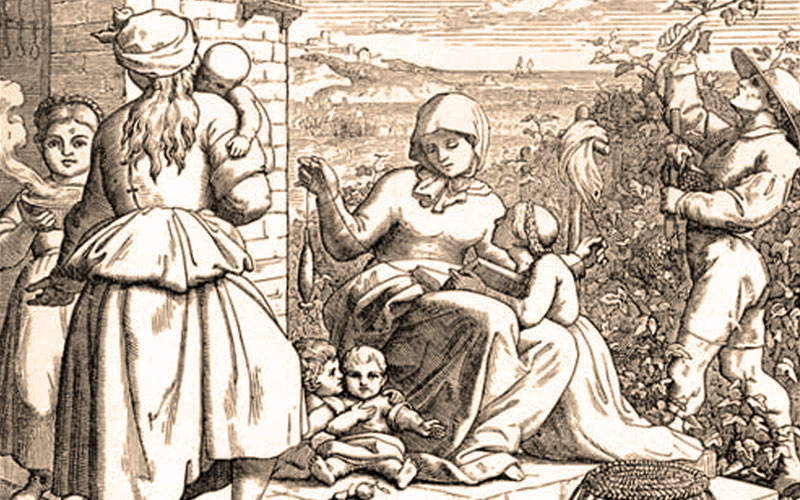
Many read the passage in Proverbs 31 of the “excellent wife” or the “virtuous woman” (KJV) and assume that the wise man is describing the ideal woman who does not exist in reality. However, even though culture and technology have changed since the time of the book of Proverbs, the “excellent wife” today is going to have the same focus as the one described in the following passage – fearing God, supporting her husband, serving her family, and helping others. There can be no change in culture or technology that would rightly call for a shift in focus from these four fundamental areas. Rather than think of the “excellent wife” of Proverbs 31 as an ideal that only exists in abstract terms, women today must look at her and see how they might imitate her in their lives.
Continue Reading

The Foundation for a Godly Society

Moses and the Ten CommandmentsThe Ten Commandments (Exodus 20:1-17) – the laws engraved onto stone which God delivered to Moses for the children of Israel – give us the blueprint for the foundation of any godly or righteous society. These Ten Commandments are regularly assaulted by those on the “left” as having no place in our government or our schools. The stated reason for their opposition is that the Ten Commandments represent a religious element that has no place in anything related to government. Yet the Ten Commandments represent more than just religion. The reason there is such strong opposition to the display of the Ten Commandments by the “left” is because the Ten Commandments stand in direct opposition to the Liberal’s ideal for society.



Many today view the Ten Commandments as part of the foundation of our religion. Yet they are part of the Old Law which was nailed to the cross (Colossians 2:14). Does this mean they are of no value for us today? Certainly not! But we must use them properly. The Old Testament was written and is preserved “for our instruction” (Romans 15:4). When we study the Ten Commandments, we find the foundations of a godly society.
Continue Reading

Bringing Up Children in the Lord (Part 2): The Home in Which Children are Raised

Bringing Up Children in the Lord

God created man in His own image, in the image of God He created him; male and female He created them. God blessed them; and God said to them, ‘Be fruitful and multiply, and fill the earth…” (Genesis 1:27-28).

God’s plan from the beginning was for a man and a woman to “be fruitful and multiply” (Genesis 1:28). By God’s design, the bringing forth of children would be carried out in marriage (Genesis 2:24). Unfortunately, this does not always work out – either through sin or tragedy – then single parents or other caretakers are left to do the best they can for the children. But the Scriptures emphasize marriage and the home. We must as well.
Continue Reading

Taking Along a Believing Wife

Couple Holding a Bible

In Paul’s first epistle to the Corinthians, he told them of the Lord’s intention that preachers be paid for their labor in the gospel (1 Corinthians 9:14). In this discussion about support for the work of preaching, Paul also had something to say about preachers’ wives:

Do we not have a right to eat and drink? Do we not have a right to take along a believing wife, even as the rest of the apostles and the brothers of the Lord and Cephas? Or do only Barnabas and I not have a right to refrain from working?” (1 Corinthians 9:4-6).

Paul was not married (1 Corinthians 7:8), yet many of his fellow-preachers were. The apostle, by inspiration of the Holy Spirit, told the brethren in Corinth that those who preach have just as much of “a right to take along a believing wife” as they do to “get their living from the gospel” (1 Corinthians 9:5, 14).

In this brief article, I want us to consider three lessons that are implied in the “right to take along a believing wife.” Though Paul was specifically addressing those who dedicate their lives to preaching, we will also consider principles that apply more broadly – to those who would support preachers in their work and to those who would marry. So let us consider these three lessons.
Continue Reading

Audio: The Entitlement Mentality

Our society has developed an “entitlement mentality” – particularly among the young, but anyone can be guilty of thinking that because they exist, they are “entitled” to certain things. The Israelites adopted this mindset in Egypt. Though they suffered and God delivered them, they often complained about not having what they thought they should have.

The “entitlement mentality” is contrary to certain characteristics we are to have as God’s people – contentment in what God has provided and submission to God’s will rather than seeking our own will. In this lesson we will consider some things that many believe they are “entitled” to today and contrast that belief with Scripture.
Continue Reading

“Few and Unpleasant” – The Years of Jacob

Jacob before Pharaoh

After Joseph revealed his identity to his brothers, Pharaoh gave permission and provided the necessary resources to move Jacob and the rest of the family to Egypt (Genesis 45:16-23). When they arrived, Joseph introduced his father to Pharaoh.

Then Joseph brought his father Jacob and presented him to Pharaoh; and Jacob blessed Pharaoh. Pharaoh said to Jacob, ‘How many years have you lived?’ So Jacob said to Pharaoh, ‘The years of my sojourning are one hundred and thirty; few and unpleasant have been the years of my life, nor have they attained the years that my fathers lived during the days of their sojourning.’ And Jacob blessed Pharaoh, and went out from his presence” (Genesis 47:7-10).

The fact that only one statement from Pharaoh to Jacob is recorded – the question about the patriarch’s age – is significant. Pharaoh looked upon the elder Jacob as one to be admired for his longevity. Besides this, Pharaoh would have already known that he was blessed by the number of sons that he had. Pharaoh’s initial response indicated that he believed that Jacob’s life was one that most would desire.
Continue Reading

Six Things Pornography Users Do Not Want

XXX key

Pornography is a huge problem in our society. Many Christians have even fallen prey to it despite Jesus’ plain warning:

You have heard that it was said, ‘You shall not commit adultery’; but I say to you that everyone who looks at a woman with lust for her has already committed adultery with her in his heart. If your right eye makes you stumble, tear it out and throw it from you; for it is better for you to lose one of the parts of your body, than for your whole body to be thrown into hell” (Matthew 5:27-29).

Many believe pornography is harmless (or they simply refuse to admit to understanding how destructive it is). But Jesus said that lusting after someone is so destructive that one ought to be willing to go to extreme measures to remove the opportunity to lust. This is the primary problem with pornography – lust.

However, one can be guilty of lust without ever viewing pornography. While it is true that sin is committed anytime one lusts after someone, pornography is particularly dangerous. There are reasons why people choose to feed their lust in this way. It is because there are certain things that pornography users do not want. We will notice six of these in this article.
Continue Reading