“Raccoon” John Smith: Hard Preaching

During the time when “Raccoon” John Smith (1784-1868) was preaching, the erroneous tenets of Calvinism were widely believed by those around him in the religious world. Smith himself had believed Calvinism early in his life before learning the truth. After learning the truth, he ardently opposed it in his preaching.

His wife Nancy, however, thought that he was “too hard” against Calvinism. In the following excerpt, Smith explained to her why he preached the way he did.
Continue Reading

The Four C’s of Effective Preaching

Speaker

Any preacher who is diligently striving to “do the work of an evangelist” (2 Timothy 4:5) will want to carry out that work as effectively as possible. But how can one effectively preach the gospel of Christ? In this article, I would like to consider four points explaining how this is done. These points are not based upon personal experience, human wisdom, or any sort of formal religious training. Rather, these points are taken directly from the word of God. If one wishes to preach the word of God effectively, he must learn how the Scriptures indicate that this is done.
Continue Reading

Aylette Raines: “I Understood the First I Ever Heard”

Aylette Raines (1798-1881) was sprinkled in the Episcopal church when he was four years old, but by the time he was a young adult, had become a Universalist. When he had the opportunity to hear Walter Scott, a preacher of the gospel, he went to hear him so that he might challenge Scott to a debate. In the excerpt below, Raines recalls his encounter with Scott and explains why a debate never happened.
Continue Reading

“These Were More Noble-Minded”

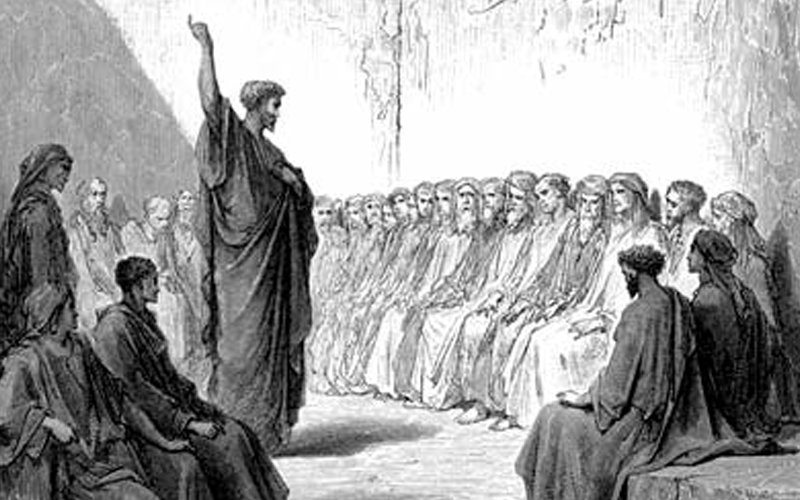
Paul preaching in Thessalonica

Paul was in Thessalonica for just three weeks when he had to quickly leave the city under the cover of darkness because of the uproar that was caused by his preaching (Acts 17:1-10). When he left, he went to Berea. Undeterred by his experience in Thessalonica, he preached in this new city as well. Luke noted the significant reaction of the Bereans:

Now these were more noble-minded than those in Thessalonica, for they received the word with great eagerness, examining the Scriptures daily to see whether these things were so” (Acts 17:11).

Luke compared the Thessalonians and the Bereans in their reaction to the gospel. The Bereans were “more noble-minded” in that they “received the word with great eagerness.” This does not mean that everyone in Thessalonica rejected the gospel – some were persuaded (Acts 17:4). This also does not mean that everyone in Berea accepted the gospel – the Jews of Thessalonica were able to come to Berea and turn “the crowds” against Paul (Acts 17:13). But there is an important difference between the first recipients of the gospel in each city – those in the synagogues (Acts 17:2, 10). Notice what Luke recorded about Paul’s custom in preaching.
Continue Reading

B.F. Hall: Choosing Truth Over an Education

B.F. Hall: Choosing Truth Over an Education

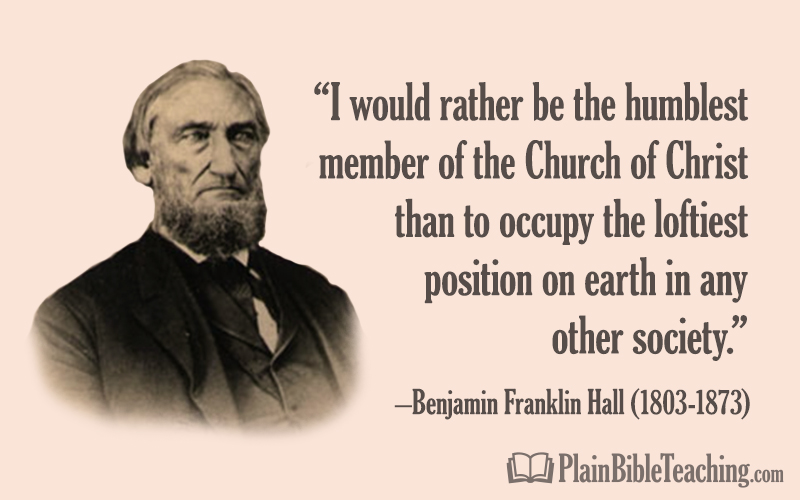
Benjamin Franklin Hall (1803-1873), at the age of 18 developed a desire to preach. But he felt that he needed an education in order to do it. His father was not a religious man and told him he could preach under one condition – that he leave home and never come back. So the young B.F. Hall left to pursue the education he thought would be necessary for him to preach.

Leaving home with nothing, Hall could not afford to pay for an education. But he had someone willing to pay for him – his brother-in-law. The only catch was that he join the Presbyterian Church. Hall was unwilling to do this, choosing to hold onto the truth rather than compromise to get something that he desired.
Continue Reading

Should Preaching About Homosexuality Be a Priority?

Louie Giglio, pastor of the Passion City Church in Atlanta, was invited to deliver the benediction during the President’s inauguration. He has since withdrawn from participating in the event after some “gay-rights” advocates protested. The following quote was included in the article linked above. It is from a sermon of Giglio’s from the 1990’s and was the cause of the opposition against his participation in the inauguration.

“If you look at the counsel of the word of God, Old Testament, New Testament, you come quickly to the conclusion that homosexuality is not an alternative lifestyle… homosexuality is not just a sexual preference, homosexuality is not gay, but homosexuality is sin. It is sin in the eyes of God, and it is sin according to the word of God. You come to only one conclusion: homosexuality is less than God’s best for his creation.”

I know nothing about anything else Giglio teaches or has taught, but his remarks above about homosexuality being a sin are exactly correct. In every dispensation, homosexuality has been an abomination in the eyes of God. The cities of Sodom and Gomorrah were utterly destroyed for this sin (Genesis 19:4-13; Jude 7). The Law of Moses clearly condemned the practice: “You shall not lie with a male as one lies with a female; it is an abomination” (Leviticus 18:22; cf. 20:13). Even in the New Testament, homosexuality is said to be “unnatural,” “indecent,” and “contrary to sound teaching” (Romans 1:26-27; 1 Timothy 1:10). Paul told the brethren in Corinth that the sin of homosexuality, if not repented of and abandoned, would prevent one from inheriting the kingdom of God (1 Corinthians 6:9).
Continue Reading

Soldiers, Athletes, and Farmers (12/24)

Thought from today’s Bible reading from 2 Timothy 1-4.

Paul used three analogies to describe the role of a preacher to the young evangelist Timothy. The examples that Paul used are common, even today, so that we might be able to easily see the points he was making.

Suffer hardship with me, as a good soldier of Christ Jesus. No soldier in active service entangles himself in the affairs of everyday life, so that he may please the one who enlisted him as a soldier.

Also if anyone competes as an athlete, he does not win the prize unless he competes according to the rules.

The hard-working farmer ought to be the first to receive his share of the crops” (2 Timothy 2:3-6).

Let us briefly notice the three examples Paul used to describe the role of preachers:
Continue Reading