
Shortly before Moses’ death and the Israelites journey into the promised land, Moses spoke to them about the choice they had before them. This choice was so important that it was literally a matter of life or death.
Continue Reading
Shortly before Moses’ death and the Israelites journey into the promised land, Moses spoke to them about the choice they had before them. This choice was so important that it was literally a matter of life or death.
Continue Reading

It is not uncommon to hear one talk about taking a leap of faith. Often this phrase is used to refer to some aspect of our response to God – believing in His existence, acknowledging His work in Creation, accepting the Bible, meeting His terms of salvation, or trusting that His way is best.
What is a leap of faith? While it may be true that people use this phrase in different ways, it seems that there is one way in which it is generally used. For many, a “leap of faith” is a willingness to believe something even if they have their doubts about it. If something cannot be proven, a “leap of faith” is required to accept it. Again, not everyone will use this phrase in this way, but this is generally the way in which it is used. Therefore, this is the definition we will consider in this article.
Continue Reading
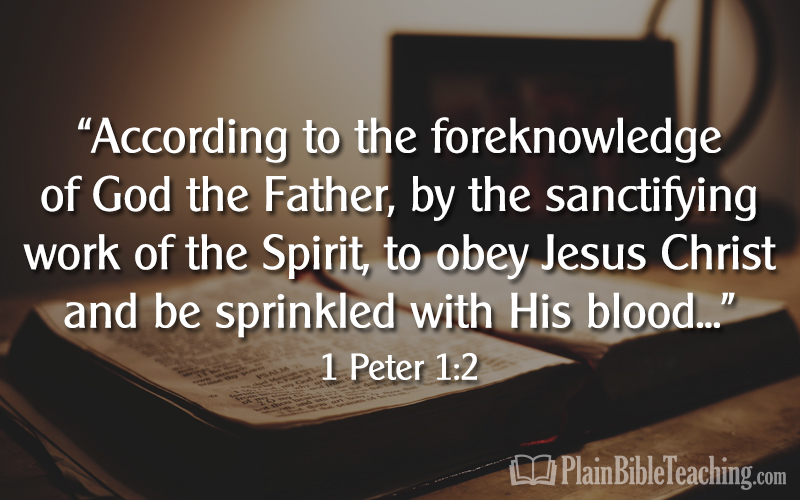
Peter wrote his first epistle to Christians that were scattered throughout Asia Minor. He addressed them as ones who were “chosen” (1 Peter 1:1). For what were they chosen? Salvation. They were “born again to a living hope” in order to “obtain an inheritance […] reserved in heaven” (1 Peter 1:3-4). They were waiting “for a salvation ready to be revealed in the last time” (1 Peter 1:5).
How had these individuals been chosen? Peter said it was “according to the foreknowledge of God the Father, by the sanctifying work of the Spirit, to obey Jesus Christ and be sprinkled with His blood” (1 Peter 1:2). Here the apostle mentioned four contributors that make salvation possible for us:
Continue Reading

A recent report has found that a minority of Presbyterians believe that “only followers of Jesus Christ can be saved.” Only 39% of members agree or strongly agree with that statement along with just 35% of pastors and 45% of elders.
Before you might jump to conclusions, understand that this was not a report done by a group that is biased against the Presbyterian church, making their findings unreliable. The article linked above cites the latest “Religious and Demographic Profile of Presbyterians” report and was released by the Presbyterian church itself.
Continue Reading
When Jesus ascended into heaven, the apostles were there to witness the event. Afterward, two angels appeared to them and said, “Men of Galilee, why do you stand looking into the sky? This Jesus, who has been taken up from you into heaven, will come in just the same way as you have watched Him go into heaven” (Acts 1:11). Christians today “eagerly wait” for the Lord to return, as the angels said He would, and bring the faithful home to heaven (Philippians 3:20-21; 1 Thessalonians 4:16-17).
That was about two thousand years ago. Yet we remain watchful, knowing that “the day of the Lord will come like a thief” (2 Peter 3:10). But there are many today who will ridicule this idea. They say we should live as we please here because this is the only life we will have. We should not be surprised that there are such people. After all, Peter wrote about them in the first century. As the apostle began discussing the day of the Lord, he wrote, “Knowing this first of all, that in the last days mockers will come with their mocking, following after their own lusts, and saying, ‘Where is the promise of His coming? For ever since the fathers fell asleep, all continues just as it was from the beginning of creation’” (2 Peter 3:3-4).
Continue Reading

As another year is quickly drawing to a close, we often use this time to take stock of our lives. We look back at where we have been and evaluate where we are now. We also tend to look forward to the new year and what might lie ahead, thinking about what we ought to do in order to get to where we want to be.
It is certainly a good exercise for us to consider where we are in contrast to where we have been and where we are going. While we are doing this, let us not forget our spiritual lives. It would be good for us to be taking stock of where we have been, where we are, and where we are headed.
Continue Reading

In Jeremiah 8, the prophet condemned the people of Jerusalem for their sins. The condemnation was not for an occasional misstep, but for the persistent practice of sin and their stubborn refusal to repudiate it: “Why then has this people, Jerusalem, turned away in apostasy? They hold fast to deceit, they refuse to return” (Jeremiah 8:5).
The deceit to which they held fast consisted of the lies of the scribes (Jeremiah 8:8) and of the priests who would say “‘Peace, peace,’ but there is no peace” (Jeremiah 8:11). They had become so accustomed to their sin that they were no longer “ashamed of the abomination they had done…and they did not know how to blush” (Jeremiah 8:12). They had replaced the Lord with “graven images” and “foreign idols” (Jeremiah 8:19).
After outlining this miserable state of the people, the prophet said, “Harvest is past, summer is ended, and we are not saved” (Jeremiah 8:20).
Continue Reading










What does “propitiation” mean? How is “justification” connected to salvation? What does “sanctification” look like in our day-to-day lives? The Bible uses some powerful words to describe God’s plan to save mankind. However, these words are not always easy to understand, especially when they are not part of our everyday vocabulary. This book explores key Bible terms that unlock the message of the gospel.
Big Words in the Bible examines five important words – Propitiation, Reconciliation, Sanctification, Justification, and Resurrection – using plain language to see how the Scriptures describe these concepts and how the apostle Paul employs them in his letter to the Romans. This book also contains an appendix with eleven additional articles to explore these topics further.
Whether you are new to the Bible and want to grow in your understanding or want a simple way to explain these core gospel doctrines to others, this book will be helpful. With a focus on the Scriptures, Big Words in the Bible helps break down these fundamental topics to shed light on the life-changing message of the gospel and the salvation found in it.
Available in print and digital format.

This work is licensed under a Creative Commons Attribution-NonCommercial-ShareAlike 3.0 Unported License.
If you have further questions about using any of the material on this site, please contact me.