Rushing to Judgment on Social Media (02/12/26)

Subscribe: Apple PodcastsSpotify | RSS

Plain Bible Teaching Podcast

This week, we’re talking about a common problem we see online – people rushing to judgment on social media and reacting before they have all the facts necessary to come to an informed conclusion to whatever may be under discussion. As Christians, we need to be careful not to fall prey to this. Instead, we need to exercise patience and show discernment. In this episode, we’re going to talk about this problem and how we need to evaluate our use of social media.Continue Reading
Fictitious Names

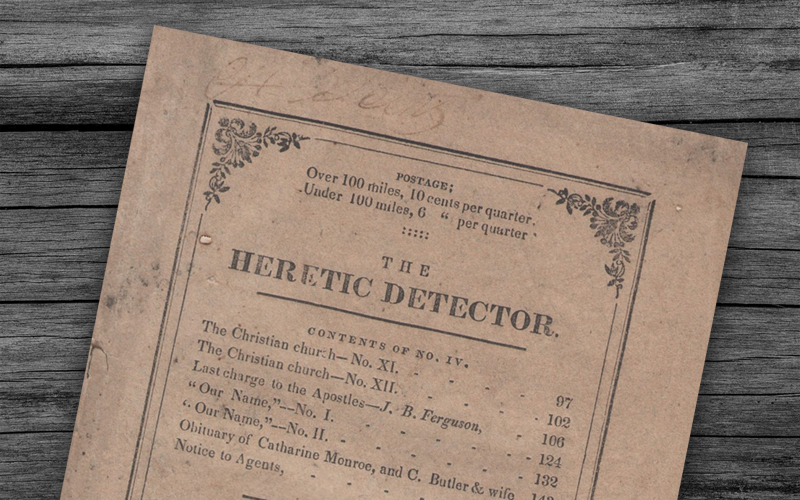
The Heretic DetectorIn the nineteenth century, religious journals were a common and effective way for those who were making the “restoration plea” to spread their message far and wide. Alexander Campbell’s Christian Baptist and Millennial Harbinger were two of the most prominent journals, yet others also received wide circulation, including Barton W. Stone’s Christian Messenger, Benjamin Franklin’s American Christian Review, and the Gospel Advocate, which was started by Tolbert Fanning.
In addition to these, numerous other journals were published across the country, including the curiously named Heretic Detector, edited by Arthur Crihfield (1803-1852) and published in Middleburgh, Ohio. In a letter to the editor, Crihfield received a letter from a man named Corbly Martin, criticizing the practice of writers using “fictitious names” in these journals.

“Dear Brother Detector:—

“Among the innumerable popular evils to be detected, there is one which, although not the least, I opine, has hitherto almost entirely escaped the notice of every ‘detector’ of this detecting age. It is certainly a part of the spirit of ‘all deceivableness of unrighteousness,’ and ought to be speedily detected

“‘Well, what is it?’ say you:—It is simply this: The practice of writing letters, essays, &c. over fictitious names. Is it in accordance with the avowed spirit of this reformation, with the simple and honest, truth loving, and unfeigning genius of the Christian religion, to publish what I would not acknowledge to be the effusion of my own pen, or head, or heart? What I could not patronize with the influence of my own proper name? Or what needed some fictitious name of great renown, of Latinized form, or of magical sound, as a passport to the world, or to the congregation of the faithful?”

“Why do not you Editors require of your contributors that which is just and equal? When you write yourselves, you assume ‘the responsibility:’—as an enterprising merchant you run the risk of ‘loss and gain.’—Why do you burden yourselves and ease your correspondents!” (The Heretic Detector, Volume 1, pp. 271-272).

Continue Reading

Book Review: Amusing Ourselves to Death

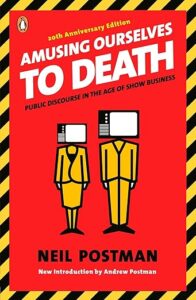
Amusing Ourselves to Death (cover)Over the past few years, I have posted reviews for two books by Chris Martin: Terms of Service: The Real Cost of Social Media and The Wolf in Their Pockets: 13 Ways the Social Internet Threatens the People You Lead. Both of these books examine how social media (or the social internet) affects us (and, in the case of “church leaders,” the people in their churches). Although social media has only been around for twenty years or so, the author frequently cited a book that was published in 1985, Amusing Ourselves to Death: Public Discourse in the Age of Show Business, by Neil Postman. I finally got around to reading this book for myself.

Postman’s book dealt with how television affected public discourse. As Martin explained in his books, social media has done the same thing, but at a much larger scale. So Postman’s book, although it is now forty years old, can help us understand how television (and now the internet and social media) affect the way we understand the world around us.

From the book’s description:

Originally published in 1985, Neil Postman’s groundbreaking polemic about the corrosive effects of television on our politics and public discourse has been hailed as a twenty-first-century book published in the twentieth century. Now, with television joined by more sophisticated electronic media—from the Internet to cell phones to DVDs—it has taken on even greater significance. Amusing Ourselves to Death is a prophetic look at what happens when politics, journalism, education, and even religion become subject to the demands of entertainment. It is also a blueprint for regaining control of our media, so that they can serve our highest goals.

Continue Reading

Using the Internet to Teach the Bible (08/01/24)

Subscribe: Apple PodcastsSpotify | RSS

Plain Bible Teaching Podcast

This week we’re talking about using the internet to teach the Bible. Many churches, preachers, and other Christians are doing this today. Yet there are still many others who are not. Perhaps they don’t think it’s a worthy endeavor. Or maybe they just don’t know how to start. We’re going to get into all of that in this episode.Continue Reading

Living a Double Life Online (07/25/24)

Subscribe: Apple PodcastsSpotify | RSS

Plain Bible Teaching Podcast

This week we’re talking about the number of people who live a “double life” online. In other words, the way they portray themselves online is different from how they behave when they interact with people in person. This is much more common among younger generations, but it is an issue to some extent in every generation. We’re going to talk about why we need to be careful about doing this.Continue Reading

Monthly News Roundup (11.30.23)

Subscribe: Apple Podcasts | Google PodcastsSpotify | RSS

Plain Bible Teaching Podcast

This episode is our monthly news roundup for November. In this episode, we’re talking about how valuable your teenager is to Instagram, how often abortion leads to depression, and an infant in the UK who recently died after government officials refused to allow her parents to pursue medical treatments elsewhere.Continue Reading

Monthly News Roundup (09.28.23)

Subscribe: Apple Podcasts | Google PodcastsSpotify | RSS

Plain Bible Teaching Podcast

This episode is our monthly news roundup for September. In this episode, we’re talking about how moms who use social media are more likely to think they are doing a bad job of parenting, a former Kentucky clerk who has been ordered to pay a huge fine for refusing to issue marriage licenses to same-sex couples, and a common misconception about baptism and salvation.Continue Reading