Add Knowledge (Season 12, Episode 4)

Subscribe: iTunes | Stitcher | RSS

Add Knowledge (Season 12, Episode 4)

In this season, we’re discussing Peter’s admonition to add to your faith (2 Peter 1:5-11).

One of the qualities are are to add to our faith is knowledge. In this episode, we discuss what this is, what it looks like with and without faith, and how we go about adding it to our faith.

Mentioned in this episode:

  • Plain Bible Teaching Quarterly Review – Free PDF for Plain Bible Teaching subscribers. Sign up here!

If you found this episode to be useful, please share it with others. Also, if you enjoyed the podcast, please leave a rating on iTunes or Stitcher. This also helps others hear about the podcast. Thanks.

Planning for the Future

Plan

The mind of man plans his way, but the Lord directs his steps” (Proverbs 16:9).

If we are going to be pleasing to God, there are two critical factors for us to consider – God’s instructions and our decisions. At the turn of every new year, many of us make resolutions and goals for the upcoming year. With this in mind, let us consider some passages from the book of Proverbs about planning for the future. As we move forward in the new year, we need to be sure we are acting with wisdom.Continue Reading

Identifying the Lord’s Church (Part 2): What Rule Does His Church Follow?

Identifying the Lord's Church

In the previous lesson, we discussed the question regarding the number of churches that Jesus built. We saw from the Scriptures that He built just one church. Yet we need to know how His one church can determine what to believe, teach, and practice. So in this lesson, we are going to ask this question: What rule does His church follow?Continue Reading

The Preacher’s Work

Man with Bible Standing on the Train Tracks

When Paul wrote to the church at Corinth, one of the matters he addressed was the support of preachers (1 Corinthians 9:3-14). He explained that although he did not take wages from them (1 Corinthians 9:15; cf. 2 Corinthians 11:8), he had a right to receive such support. To show that a man has a right to receive support for his work as a preacher, Paul cited three other types of work for which men may receive compensation.

Who at any time serves as a soldier at his own expense? Who plants a vineyard and does not eat the fruit of it? Or who tends a flock and does not use the milk of the flock?” (1 Corinthians 9:7).

The point of this article is not to discuss the right of preachers to be supported for their work.* Instead, I want us to notice the three illustrations that Paul used in the verse above. He did not simply pick three random occupations and say that since they have a right to receive a return on their work then preachers should be supported. Every legitimate work is worthy of pay (cf. Proverbs 14:23). Yet the inspired apostle mentioned three works that in some way resemble the role of a preacher. Let us consider these briefly.Continue Reading

“Raccoon” John Smith: Relying More on the Word Than the Holy Ghost

"Raccoon" John Smith: Relying More on the Word Than the Holy Ghost

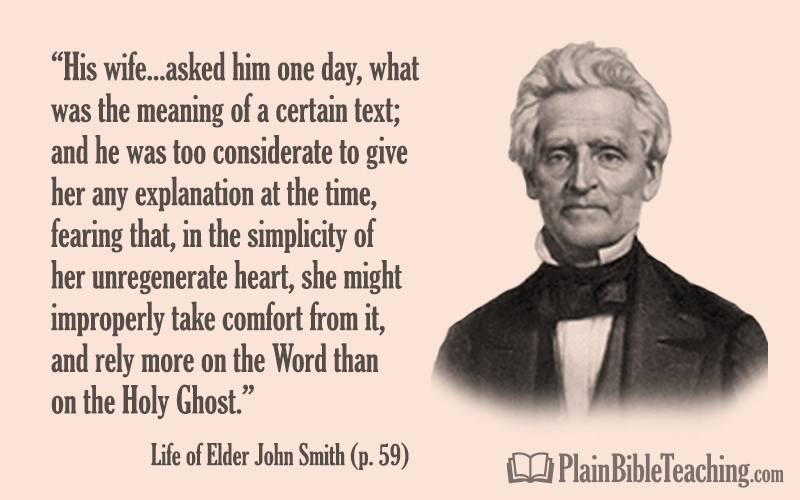
When “Raccoon” John Smith (1784-1868) began preaching, he was part of the Baptist church. As a result, he was heavily influenced by Calvinism. This led him to believe that no one could be converted except by a direct operation of the Holy Spirit on his/her heart. Without this kind of direct operation of the Spirit, no one could be saved.

At this time, his wife – who was “unconverted” when they married – developed an interest in religion. She asked him the meaning of a certain passage of Scripture; however, he would not answer her question. It was not because he did not have an answer or because he did not want her to know the answer. There was another reason behind his refusal to answer her Bible question:

“His wife, who was unconverted at the time of her marriage, soon became deeply concerned on the subject of religion. He was, of course, much interested in the progress of her experience; but he reverently and hopefully left her alone with her God. The young husband, who, in any other trouble, would have succored her, even at the sacrifice of his life, abandoned her in this, the most solemn and perplexing of her trials; for no obtrusive human agency, he thought, must interfere with the work of the Spirit. She asked him one day, what was the meaning of a certain text; and he was too considerate to give her any explanation at the time, fearing that, in the simplicity of her unregenerate heart, she might improperly take comfort from it, and rely more on the Word than on the Holy Ghost” (Life of Elder John Smith, p. 59).

Continue Reading

Two Philosophies

Two Men Talking

One person says, “Look at all of the people in all of the different churches. They all have different beliefs and practices. Surely they can’t all be wrong.”

Another person says, “Let’s look at the Bible because the Bible is right, even if I am wrong.”

The first person begins his reasoning with the beliefs and practices of men. The second person begins his reasoning by examining the Scriptures.

Which philosophy should we have? The following passages are helpful in answering that question:Continue Reading

The Thoughts of God and Man

Man at Sunrise

When we discuss matters of religion or spirituality with others, we will find that many people base their views upon what they think. Even when we might present some clear passage of Scripture to show them a particular point, they will often respond by saying, “Well, I just think…” This is common among those in the world. Sadly, we often see this among brethren within the church as well.

The problem with basing our beliefs and practices on what we think is that we are not God. Even with the best of intentions, what we think does not justify us. This is the idea behind the following text:

‘For My thoughts are not your thoughts, nor are your ways My ways,’ declares the Lord. ‘For as the heavens are higher than the earth, so are My ways higher than your ways and My thoughts than your thoughts.

‘For as the rain and the snow comes down from heaven, and do not return there without watering the earth and making it bear and sprout, and furnishing seed to the sower and bread to the eater; so will My word be which goes forth from My mouth; it will not return to Me empty, without accomplishing what I desire, and without succeeding in the matter for which I sent it’” (Isaiah 55:8-11).

There is an important difference between God’s thoughts and our thoughts. We must learn to recognize and respect the difference.Continue Reading