“Not One Stone Will Be Left Upon Another” (11/6)

Thought from today’s Bible reading from Mark 13.

As He was going out of the temple, one of His disciples said to Him, ‘Teacher, behold what wonderful stones and what wonderful buildings!’ And Jesus said to him, ‘Do you see these great buildings? Not one stone will be left upon another which will not be torn down’” (Mark 13:1-2).

It is common for man to be impressed with the beauty and greatness of physical, man-made structures. This was the reason for this disciple’s remark on this occasion. As they left the temple, the disciple noted the impressive buildings that surrounded them. There was nothing necessarily wrong with this. But Jesus wanted to be sure that His disciples kept the proper perspective about such things.
Continue Reading

“You Were Unwilling” (11/5)

Thought from today’s Bible reading from Matthew 23; Luke 20-21.

Calvinism teaches that salvation is unconditional and that grace is irresistible. The reason for this is that man (allegedly) has no free will. Therefore, man would be unable to make the decision on his own to serve the Lord. Many passages refute this idea. One such passage is the following:

Jerusalem, Jerusalem, who kills the prophets and stones those who are sent to her! How often I wanted to gather your children together, the way a hen gathers her chicks under her wings, and you were unwilling. Behold, your house is being left to you desolate!” (Matthew 23-37-38).

Jesus had just condemned the Pharisees and scribes for various sins. He concluded with this lament. Notice what Jesus said here about salvation:
Continue Reading

“He Is Not the God of the Dead But of the Living” (11/4)

Thought from today’s Bible reading from Matthew 22; Mark 12.

The Sadducees did not believe in the resurrection. When they confronted Jesus on this point, they thought they had an unanswerable argument that would prove the foolishness of believing in the resurrection.

They presented a scenario in which a woman was married to seven brothers, each one followed the death of the next older brother (Matthew 22:23-27). The Sadducees then asked Jesus this question: “In the resurrection, therefore, whose wife of the seven will she be? For they all had married her” (Matthew 22:28). Notice how Jesus responded:

But Jesus answered and said to them, ‘You are mistaken, not understanding the Scriptures nor the power of God. For in the resurrection they neither marry nor are given in marriage, but are like angels in heaven.’

‘But regarding the resurrection of the dead, have you not read what was spoken to you by God: “I am the God of Abraham, and the God of Isaac, and the God of Jacob”? He is not the God of the dead but of the living’” (Matthew 22:29-32).

Jesus’ argument “silenced the Sadducees” (Matthew 22:34). They had no answer for Him. If God said, “I am” the God of Abraham, Isaac, and Jacob, even after these men were dead, then one should necessarily infer that these men continued to exist, even after death.
Continue Reading

“For This Purpose I Came to This Hour” (11/3)

Thought from today’s Bible reading from Mark 11; John 12.

And Jesus answered them, saying, ‘The hour has come for the Son of Man to be glorified. Truly, truly, I say to you, unless a grain of wheat falls into the earth and dies, it remains alone; but if it dies, it bears much fruit’” (John 12:23-24).

The time for Jesus to be glorified was approaching. But how was He going to be glorified? Many of the Jews were looking for their Messiah to defeat the Romans and rule over a physical kingdom from Jerusalem. But this was not the divine plan. Instead, as Jesus indicated here, it would involve death.

‘Now My soul has become troubled; and what shall I say, “Father, save Me from this hour”? But for this purpose I came to this hour. Father, glorify Your name.’ Then a voice came out of heaven: ‘I have both glorified it, and will glorify it again’” (John 12:27-28).

Continue Reading

“The Son of Man Has Come to Seek and to Save That Which Was Lost” (11/2)

Thought from today’s Bible reading from Luke 18:15-19:48.

There were many who did not understand why Jesus would associate with tax collectors and sinners. Yet the reason why He did was because of the mission He had in coming to earth. Notice the example of Jesus with the tax collector Zaccheus who climbed a tree in order to see the Lord as He passed by.

When Jesus came to the place, He looked up and said to him, ‘Zaccheus, hurry and come down, for today I must stay at your house.’ And he hurried and came down and received Him gladly. When they saw it, they all began to grumble, saying, ‘He has gone to be the guest of a man who is a sinner.’

Zaccheus stopped and said to the Lord, ‘Behold, Lord, half of my possessions I will give to the poor, and if I have defrauded anyone of anything, I will give back four times as much.’ And Jesus said to him, ‘Today salvation has come to this house, because he, too, is a son of Abraham. For the Son of Man has come to seek and to save that which was lost’” (Luke 19:5-10).

Those who grumbled about Jesus meeting with Zaccheus may have been right that the tax collector was a sinner. But this was the type of person Jesus came to save. When others grumbled earlier on a similar occasion, Jesus said, “I have not come to call the righteous but sinners to repentance” (Luke 5:32).
Continue Reading

“We Have No King But Caesar”

Trial of Jesus

Pilate knew that the trial of Jesus was unique. Jesus explained to him that His kingdom was “not of this world” (John 18:36). Pilate then recognized that Jesus claimed to be a king (John 18:37), even though the Jews rejected Him as their king (John 18:33, 35). But the Jews’ rejection of Jesus was more than just a refusal to support Him as a king; they wanted to kill Him (John 18:31) even though Pilate was able to find “no guilt in Him” (John 18:38; 19:4, 6).

Then Pilate became “even more afraid” when the Jews told him that Jesus “made Himself out to be the Son of God” (John 19:7-8). How much of this Pilate believed is immaterial. The fact is that the events transpiring with the claims and charges being made were producing a volatile situation. So Pilate “made efforts to release Him” (John 19:12), but the Jews would not let him do it. Pilate then made one final effort to defuse the situation and allow the innocent Jesus to be released.

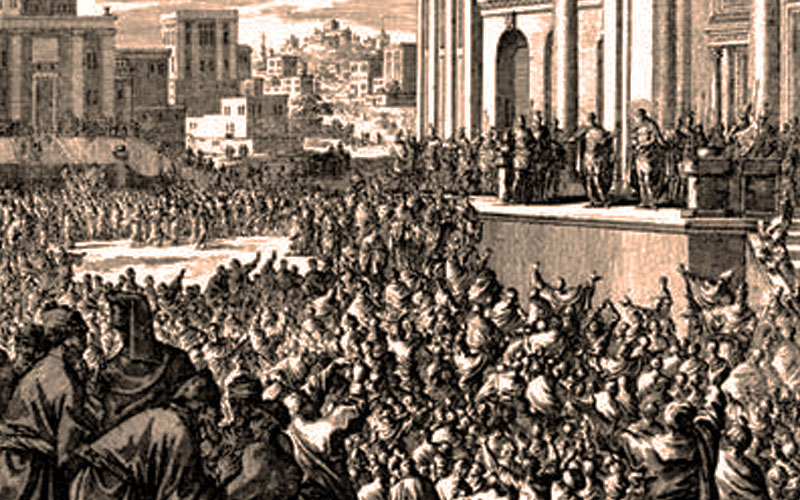
Now it was the day of preparation for the Passover; it was about the sixth house. And he said to the Jews, ‘Behold, your King!’ So they cried out, ‘Away with Him, away with Him, crucify Him!’ Pilate said to them, ‘Shall I crucify your King?’ The chief priests answered, ‘We have no king but Caesar.’ So he then handed Him over to them to be crucified” (John 19:14-16).

This case was not about some random insurrectionist. There was much more to this than Pilate could have imagined at the start. But in the end, the Jews – influenced by their leaders (Matthew 27:20) – very clearly and boldly repudiated Jesus and demanded His crucifixion. Why was this so significant? It has to do with what they rejected, and what they chose to focus on instead.
Continue Reading

“By What Authority Are You Doing These Things?” (11/1)

Thought from today’s Bible reading from Matthew 20-21.

After Jesus drove the money changers and merchants out of the temple (Matthew 21:12-13), it is not surprising that the chief priest and elders questioned Him about those things He was doing.

When He entered the temple, the chief priests and the elders of the people came to Him while He was teaching, and said, ‘By what authority are You doing these things, and who gave You this authority?’ Jesus said to them, ‘I will also ask you one thing, which if you tell Me, I will also tell you by what authority I do these things. The baptism of John was from what source, from heaven or from men?’ And they began reasoning among themselves, saying, ‘If we say, “From heaven,” He will say to us, ‘Then why did you not believe him?” But if we say, “From men,” we fear the people; for they all regard as a prophet.’ And answering Jesus, they said, ‘We do not know.’ He also said to them, ‘Neither will I tell you by what authority I do these things’” (Matthew 21:23-27).

Their question was a good one. What Jesus was doing was not something that was commonly done. Therefore, unless He was acting lawlessly, He had to have been given authority to do these actions by someone in a position to give Him such authority. Their problem was that they were not asking honestly, which is proven by their refusal to answer Jesus’ question. But their question itself was good.
Continue Reading








