Love for Others

David and Mephibosheth

King David has been described as a man after God’s own heart (Acts 13:22). While there are many qualities of David we should emulate, we will focus on one in this article – his love for others.

David showed love for a broad range of people. We can see the love and kindness he shared with his friends – namely Jonathan (1 Samuel 18:1; 2 Samuel 1:26). He loved his enemies, even sparing Saul’s life twice when he had opportunity to kill him (1 Samuel 24:1-4; 26:2-11). Both instances came when Saul was pursuing David in order to kill him. We also can see David’s love given to those in need with his example of caring for Mephibosheth (2 Samuel 9).
Continue Reading
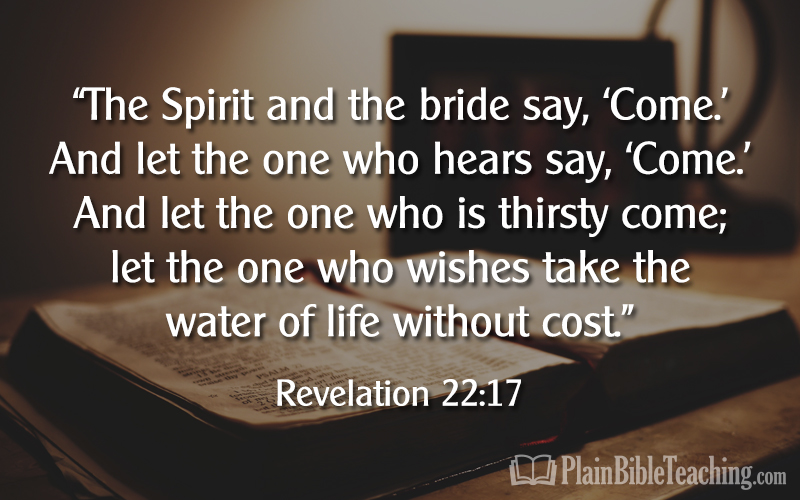

“Come”

Revelation 22:17

The Spirit and the bride say, ‘Come.’ And let the one who hears say, ‘Come.’ And let the one who is thirsty come; let the one who wishes take the water of life without cost” (Revelation 22:17).

This is an invitation for salvation that has been offered by Christ. It is for those who need the water of life. This means that it is for all, for “all have sinned and fall short of the glory of God” (Romans 3:23) and “the wages of sin is death” (Romans 6:23). All who wish to obtain the gift of salvation and be saved from their sins may come.
Continue Reading

The Disciples Were Called Christians

Antioch of Syria

The book of Acts records the establishment of the church and the spread of the gospel from Jerusalem to Rome. The church in Jerusalem thrived until persecution arose and caused the disciples to be scattered (Acts 8:1-4). Some of those who were scattered found their way to Antioch (Acts 11:19). Up to that point, the disciples who were scattered had only taught fellow Jews about the gospel; but in Antioch, some of them “began speaking to the Greeks also, preaching the Lord Jesus” (Acts 11:20). This preaching resulted in many being taught and turning to the Lord (Acts 11:21-26). It is here in Antioch – where we find the first congregation made up of both Jews and Gentiles – that “the disciples were first called Christians” (Acts 11:26).

What does it mean that they were “called Christians”? Where did this name originate? There are two possibilities. One idea is that the term Christian was a derogatory label used by the disciples’ enemies and was later adopted by the disciples. The other idea is that this is a divine calling and that Christian was a God-given name. I believe we can use the Bible to show that the latter is true – the name Christian was a name given to the disciples by God, not by their enemies (in fact, there is not even any mention in Acts of persecution in Antioch).
Continue Reading

Instrumental Music in Worship to God

One of the things that sets the Lord’s church apart from most denominations has to do with the music used in worship. Most denominations use instruments in their music for worship. Faithful brethren have rightly opposed this for years. The practice, however, is certainly not going away. There seems to be more and more in the church who see nothing wrong with the use of instruments in worship. Every so often it is necessary to remind brethren why we do not use instruments. To stop teaching on a topic can eventually lead to apostasy. So let us briefly examine why we do not use instrumental music in worship to God.

Before we begin this study though, I believe a point needs to be made. The issue of instrumental music in worship is important, but there is a much larger issue that is at the heart of this. It has to do with Bible authority. What has God authorized us to do? It is important to understand the issue over instrumental music – not just for this one issue, but because the principles we use to determine God’s will on the topic are what we need to use to determine God’s will in so many of the things that we do. With that in mind, let us consider this subject.
Continue Reading

Predestination

[This article was written by Tim Haile.]

The question is sometimes asked, “Do you believe in predestination?” Some will say yes, and others no. However, all true Bible believers do believe in predestination, for the Bible teaches it. The question should not concern the reality of predestination, but its nature. The question should be, “What is predestination?

Due to the widespread influence of Calvinism, many people automatically think of individual pre election when they think of predestination. They have the notion that God has arbitrarily chosen some people by name to eternal salvation and others to eternal damnation. This makes salvation wholly God’s doing. It is argued that if one has salvation there is nothing that he can do to lose it, and if one doesn’t have salvation there is nothing that he can do to obtain it. As we shall see, this concept is contrary to the nature of God, the nature of man and the nature of salvation.Continue Reading

The Ancient Paths

Path in the Woods

When it comes to religion, many are like the ones that Paul encountered in Athens. They “spend their time in nothing other than telling or hearing something new” (Acts 17:21). While it may seem interesting or exciting to follow after the next new thing, the pursuit of these new things keeps us from remaining on the path that leads to heaven. We are warned about being “carried about by every wind of doctrine” (Ephesians 4:14). Instead of following every new thing that comes along, we must stay on the right path.

The Lord, through Jeremiah the prophet, instructed the people of Jerusalem about the path they ought to follow: “Stand by in the ways and see and ask for the ancient paths, where the good way is, and walk in it; and you will find rest for your souls” (Jeremiah 6:16). The “good way” was found in the “ancient paths,” not in the new paths of modern religion and culture. The “ancient paths” are the paths we must seek out today.
Continue Reading

Do Not Worry

Worried

Many of us find it easy to worry about things in our life. Matters that relate to our jobs, families, finances, and more can cause anxiety. But Jesus told his followers, “Do not be worried about your life” (Matthew 6:25). Sometimes this is easier said than done. But notice what Jesus said about this subject:

For this reason I say to you, do not be worried about your life, as to what you will eat or what you will drink; nor for your body, as to what you will put on. Is not the life more than food, and the body more than clothing? Look at the birds of the air, that they do not sow, nor reap nor gather into barns, and yet your heavenly Father feeds them. Are you not worth much more than they? And who of you by being worried can add a single hour to his life?” (Matthew 6:25-27).

In these verses, Jesus asked three questions. As the master teacher, He was able to ask questions in a way that was more instructive than inquisitive. Notice the three points Jesus made that will help us deal with anxiety.
Continue Reading