“In an Unworthy Manner”

Communion Cup

Shortly before His death, Jesus instituted the Lord’s Supper as a memorial of His sacrifice – the bread represented His body that was to be hung on the cross and the fruit of the vine represented His blood that would be shed (Matthew 26:26-29; Luke 22:17-20). After reminding the Corinthians about the basic instructions regarding the practice of the Lord’s Supper which he “received from the Lord” (1 Corinthians 11:23-26), Paul warned them not to observe this memorial “in an unworthy manner.

Therefore whoever eats the bread or drinks the cup of the Lord in an unworthy manner, shall be guilty of the body and the blood of the Lord. But a man must examine himself, and in so doing he is to eat of the bread and drink of the cup. For he who eats and drinks, eats and drinks judgment to himself if he does not judge the body rightly” (1 Corinthians 11:27-29).

Paul indicated that Christians would be observing this memorial of “the Lord’s death until He comes” (1 Corinthians 11:26); therefore, we still partake of the Lord’s Supper today. Because of this, we need to seriously consider the warning that Paul gave to the Corinthians lest we become guilty of eating and drinking “in an unworthy manner.Continue Reading

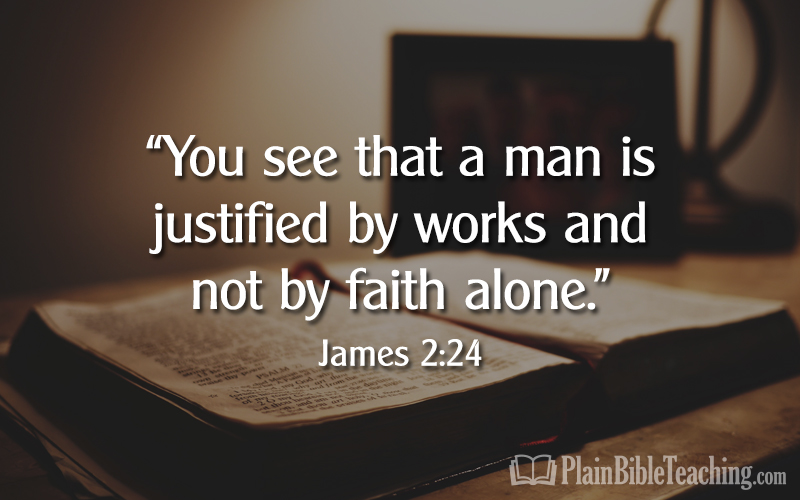
Justified by Works

James 2:24

One of the topics James discussed in his letter was the connection between faith and works. Many people have difficulty understanding this subject. The reason is not really that it is difficult; rather, they have simply been taught differently from what the Bible teaches. James used the example of Abraham to show how we can be justified by works.

Was not Abraham our father justified by works when he offered up Isaac his son on the altar? You see that faith was working with his works, and as a result of the works, faith was perfected; and the Scripture was fulfilled which says, ‘And Abraham believed God, and it was reckoned to him as righteousness,’ and he was called the friend of God. You see that a man is justified by works and not by faith alone” (James 2:21-24).

This is an important passage for us to understand – both for putting it into practice and also to be able to explain it to others.Continue Reading

Great Days in History (Part 8): Today

Great Days in History

For we have become partakers of Christ, if we hold fast the beginning of our assurance firm until the end, while it is said, ‘Today if you hear His voice, do not harden your hearts, as when they provoked Me’” (Hebrews 3:14-15).

In this final lesson, we are not going to keep moving further down a timeline. There is nothing past the day of eternity. Instead, we are going to talk about today to see what we need to do with what we have learned in this series.Continue Reading

Great Days in History (Part 7): The Day of Eternity

Great Days in History

But grow in the grace and knowledge of our Lord and Savior Jesus Christ. To Him be the glory, both now and to the day of eternity. Amen” (2 Peter 3:18).

In the previous lesson we discussed the final day when the Lord will return in judgment. But what happens after life on earth is over? Let us consider what the Bible teaches about the day of eternity.Continue Reading

“Come and See”

Philip and Nathanael

Philip found Nathanael and said to him, ‘We have found Him of whom Moses in the Law and also the Prophets wrote—Jesus of Nazareth, the son of Joseph.’ Nathanael said to him, ‘Can any good thing come out of Nazareth?’ Philip said to him, ‘Come and see’” (John 1:45-46).

In the first chapter of John, the apostle introduced his readers to Jesus. As this chapter unfolded, we read of others being introduced to Him as well. After Jesus called Philip (John 1:43), Philip told Nathanael that they had found the one who was the fulfillment of the prophecies contained in the Law and the Prophets. At first Nathanael was skeptical, so Philip offered a simple invitation: “Come and see.” Nathanael came and saw which led him to believe in Jesus (John 1:49).

In this article, we are going to consider this “come and see” type of invitation and how we might be able to use it to help reach others with the gospel.Continue Reading

Great Days in History (Part 6): The Day of Judgment

Great Days in History

Therefore having overlooked the times of ignorance, God is now declaring to men that all people everywhere should repent, because He has fixed a day in which He will judge the world in righteousness through a Man whom He has appointed, having furnished proof to all men by raising Him from the dead” (Acts 17:30-31).

In this sixth lesson, we will be discussing the day of judgment. Like the second lesson, this may seem like a bit of a jump to go all the way from the day of Pentecost to here. However, we are not skipping so much as we are going to be summarizing the time between these two days.Continue Reading

Why Would Christians Follow Diotrephes?

Leader

I wrote something to the church; but Diotrephes, who loves to be first among them, does not accept what we say. For this reason, if I come, I will call attention to his deeds which he does, unjustly accusing us with wicked words; and not satisfied with this, he himself does not receive the brethren, either, and he forbids those who desire to do so and puts them out of the church” (3 John 9-10).

In John’s third epistle, he warned about a man named Diotrephes. We often talk about this man and his desire for preeminence, his rule over the church, and the trouble he caused. However, we usually do not talk about his followers. In this article, we will consider the followers of Diotrephes and why they would follow him.Continue Reading