Trying to Reach Heaven (1/3)

Thought from today’s Bible reading from Genesis 8-11.

They said, ‘Come, let us build for ourselves a city, and a tower whose top will reach into heaven, and let us make for ourselves a name, otherwise we will be scattered abroad over the face of the whole earth’” (Genesis 11:4).

This was the reasoning of those who proposed to build what would be called the Tower of Babel. There are several errors of which they were guilty that we could consider. But probably the most notable was in their attempt to reach heaven. They were determined to do it their way, without any sort of assistance from God.* So God put an end to their ambitions.
Continue Reading

Book Review: Coming To Christ

Coming To Christ: A Study of the Detailed Conversions in ActsI recently finished reading Aaron Erhardt’s book, Coming to Christ: A Study of the Detailed Conversions in Acts. As you can probably gather from the title, this book examines the conversion accounts in the book of Acts in order to show the consistent pattern for God’s plan of salvation.

Aaron does a good job explaining these passages in a way that is easy to understand. The Scriptures teach the essentiality of baptism for salvation and Aaron points this out in every case. Of course, much of the religious world denies that baptism is necessary for salvation. So Aaron also has a chapter addressing several arguments that are made against baptism.

The material in this book would be good for anyone who needs to learn what the Bible says about obeying the gospel. It is also good for Christians so that they might be prepared to teach others who are outside of the body of Christ and be equipped to show them what God requires of man.

You can learn more about this book by visiting the author’s website: Erhardt Publications.

“What Prevents Me From Being Baptized?”

Standing by the Water

After leaving Samaria, Philip met a eunuch from Ethiopia traveling home from Jerusalem and reading from the prophet Isaiah (Acts 8:26-33). This man wanted to understand what he was reading so he asked Philip, “Please tell me, of whom does the prophet say this? Of himself or of someone else?” (Acts 8:34). At this point, “Philip opened his mouth, and beginning from this Scripture he preached Jesus to him” (Acts 8:35).

Every conversion, whether recorded in the New Testament or those that occur today, will begin with this. The story of Jesus is the heart of the gospel message (1 Corinthians 15:3-4). Jesus is the cornerstone of the foundation upon which we are built (Ephesians 2:19-21). Jesus is “the way, and the truth, and the life” (John 14:6). So Philip preached Jesus, just as we must do today.

The text implies the inclusion of baptism in Philip’s teaching about Jesus. The first thing we see after Luke recorded Philip preaching Jesus is this: “As they went along the road they came to some water; and the eunuch said, ‘Look! Water! What prevents me from being baptized?’” (Acts 8:36). This would be an odd question if Philip had not already been discussing baptism with the eunuch.
Continue Reading

Saved by Baptism Alone?

Baptism

The concept of salvation by faith alone is quite popular. Many have been deceived into thinking that all God requires of man is a simple mental affirmation of Jesus being the Savior. As long as one believes this, then he will be saved.

There are several passages that brethren use to refute the concept of salvation by faith alone. The clearest was written by James: “You see that a man is justified by works and not by faith alone” (James 2:24). If you get out your concordance and search for this phrase, you will find that this verse is the only one that says anything about “faith alone,” and it denies that we are saved on this basis.

The truth is that our salvation is attributed to many things – God’s grace (Ephesians 2:8), mercy (Titus 3:5), and love (John 3:16); the blood, death, and life of Christ (Romans 5:9-10); the gospel (Romans 1:16); our faith (John 8:24), repentance (Luke 13:3,5), confession (Romans 10:9-10), baptism (Mark 16:16), obedience (Hebrews 5:9), and more*. To claim that we are saved by faith alone is simply not compatible with Scripture.

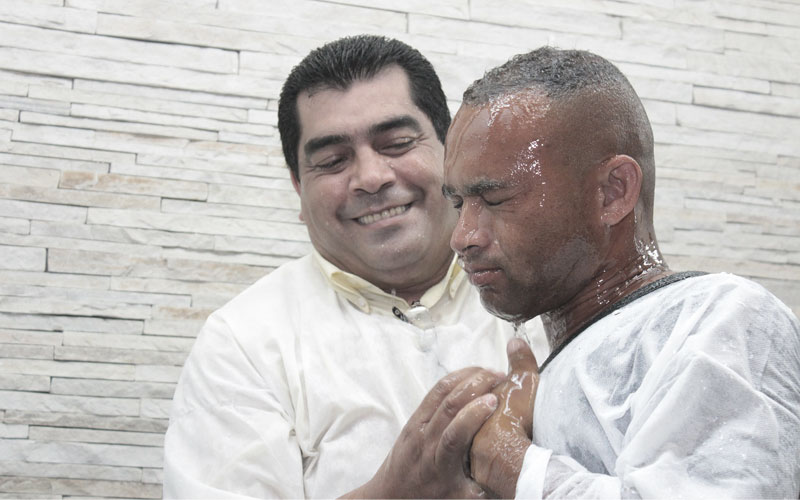
One item in the list above that is vehemently attacked by sectarians is baptism. Despite the fact that Peter said, “Baptism now saves you” (1 Peter 3:21), many will adamantly deny that baptism is necessary for salvation. In light of this, truth teachers will often spend a good deal of time explaining the vital role of baptism in our salvation.
Continue Reading

Repent and Be Converted

After Peter healed the lame man and had the opportunity to teach the crowd that had gathered, he told them, “Repent therefore and be converted, that your sins may be blotted out, so that times of refreshing may come from the presence of the Lord” (Acts 3:19, NKJV).

Most of the denominational world believes that conversion is necessary for salvation. Peter plainly affirmed this as he told the people here that the blotting out of their sins was dependent upon them being converted. But what conversion was Peter talking about here? This is where you will begin to get some disagreement. Is one converted when he prays a “sinner’s prayer” and invites Jesus into his heart? Is he converted when he makes a verbal confession that he believes that Jesus is Lord? Or is there something else that Peter has in mind?

Continue Reading

What Happened After Saul’s Conversion?

Saul escaping Damascus in a basket

We often talk about the conversion of Saul – later known as the apostle Paul – because of the important lessons to be found in it about how one becomes a Christian. But what about what happened after Saul’s conversion? There are important lessons here as well. Let us look at what Saul did following his conversion.
Continue Reading

Water Separates

Water

There are a variety of views in the religious world about water baptism. Some believe it is unnecessary. Some call it a good work. Others describe it as an outward sign of an inward grace. The Scriptures teach that baptism plays a significant part in our personal salvation. Notice what Peter wrote:

For Christ also died for sins once for all, the just for the unjust, so that He might bring us to God, having been put to death in the flesh, but made alive in the spirit; in which also He went and made proclamation to the spirits now in prison, who once were disobedient, when the patience of God kept waiting in the days of Noah, during the construction of the ark, in which a few, that is, eight persons, were brought safely through the water. Corresponding to that, baptism now saves you—not the removal of dirt from the flesh, but an appeal to God for a good conscience—through the resurrection of Jesus Christ” (1 Peter 3:18-21).

Peter reminded his readers of the flood in Noah’s day and stated that it parallels baptism. In the time of the flood, there were two groups of people – those who were saved and those who were lost. The ones who were lost were those outside of the ark. The ones who were saved were those in the ark who “were brought safely through the water.” The water made a clear distinction between these two groups.
Continue Reading