
Togetherness is a characteristic seen in the Lord’s church throughout the book of Acts. Let us briefly consider the examples of the church gathering together and see what lessons we can learn.
Continue Reading
Togetherness is a characteristic seen in the Lord’s church throughout the book of Acts. Let us briefly consider the examples of the church gathering together and see what lessons we can learn.
Continue Reading
Matthew recorded an occasion in which the religious leaders questioned Jesus about the things He was doing. After Jesus rode into Jerusalem receiving praise from the people (Matthew 21:1-11), drove the money changers and those selling animals out of the temple (Matthew 21:12-13), healed the blind and the lame who came to Him (Matthew 21:14-15), and then performed a miracle that caused a fig tree to wither (Matthew 21:18-19), the chief priests and elders confronted Him.
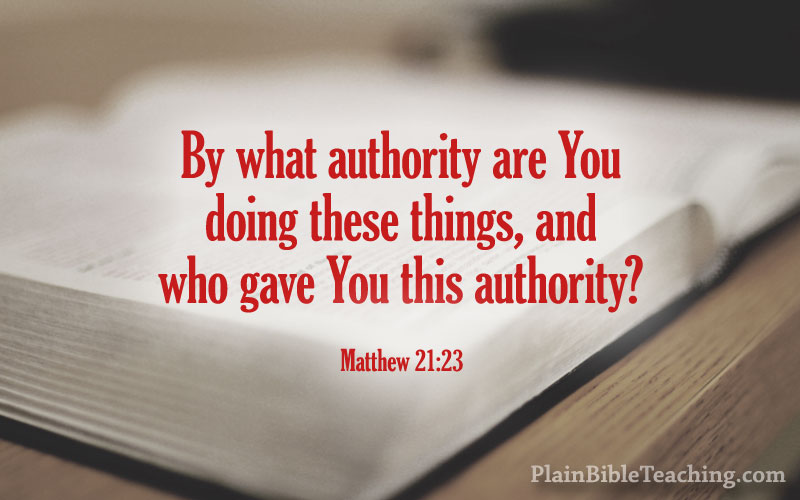
“When He entered the temple, the chief priests and the elders of the people came to Him while He was teaching, and said, ‘By what authority are You doing these things, and who gave You this authority?’” (Matthew 21:23).
This was actually a very good question. It is one that we need to ask ourselves and ask of others regarding the things that are done in service to God. Yet many are not at all interested in this question. They simply want to do what they have always done, what seems right to them, what their preacher says, or what their family has always done in religion. But it is important that we appeal to the proper source of authority.
Continue Reading
I recently read an article about the declining number of churches having a second worship service on Sunday evening (Whatever Happened to Sunday Evening Services?). The article mentioned several possible reasons for the decline – too demanding for busy families, too difficult for “pastors” to prepare two sermons each week, lack of attendance/interest by the members, etc.
Though the article was written from a denominational perspective, the discussion of this trend is also helpful for us in the Lord’s church. Often, God’s people follow the trends of the religious world around them. Even if we ignore current trends of eliminating the Sunday evening service, it is generally true that attendance is lower on Sunday evening than on Sunday morning in the majority of local churches. The reasons why Sunday evening services are in decline among the denominational world are often the same reasons why churches quit meeting on Sunday evening or why Christians simply choose not to attend the evening service. So in this article, I want to briefly discuss seven reasons why we assemble on Sunday evenings.
Continue Reading
 With the approaching Easter holiday, many of the churches of men are making preparations for their Easter services and programs. Such activities are so common that those in the Lord’s church are often asked by their friends and neighbors: Does your church do anything special on Easter Sunday?
Before answering that question, let us remember what Easter is. Easter is a holiday that is celebrated both religiously (to celebrate the resurrection of Christ) and secularly (Easter egg hunts, candy, etc.). Easter is not mentioned in the Bible, aside from a mistranslation of the word Passover in the King James Version (Acts 12:4).*
Does it matter that the religious observance of Easter is absent from the Bible? Absolutely! Notice what Paul wrote to the brethren in Colossae:
“Whatever you do in word or deed, do all in the name of the Lord Jesus, giving thanks through Him to God the Father” (Colossians 3:17).

As time goes on, more churches (even among brethren) are hosting meals as a function of the local church. But should churches be involved in this practice? As with every question, we must strive to determine if such activities are authorized. This will be determined by examining the word of God, not by observing the cultural norms in our society or the current trends in the religious world. So let us examine what Paul had to say to the church in Corinth.
“But in giving this instruction, I do not praise you, because you come together not for the better but for the worse. For, in the first place, when you come together as a church, I hear that divisions exist among you; and in part I believe it. For there must also be factions among you, so that those who are approved may become evident among you.
“Therefore when you meet together, it is not to eat the Lord’s Supper, for in your eating each one takes his own supper first; and one is hungry and another is drunk.
“What! Do you not have houses in which to eat and drink? Or do you despise the church of God and shame those who have nothing? What shall I say to you? Shall I praise you? In this I will not praise you” (1 Corinthians 11:17-22).

“I was glad when they said to me, ‘Let us go to the house of the Lord’” (Psalm 122:1).
David expressed the attitude that we must have when it comes to assembling to worship the Lord – gladness. The assembly of the saints ought to be something to which we look forward.
Unfortunately, many do not look forward to this time. But rather than acknowledging their own poor attitude and making efforts to change their mindset, they often attempt to shift the blame to others. They will say, “I’m not getting anything out of the assembly!” In their minds, this provides justification for them to complain, become sporadic in their attendance, or quit assembling altogether.
In this article, we will focus on the attitude of one who claims to be getting nothing out of the assembly of the church. It is a dangerous attitude and we must guard ourselves against it.
Continue Reading
At this time of year, much of the religious world is focused on the birth of Jesus. Yet do we understand why He was born? Jesus is eternal (John 1:1-2) and is the all-powerful Creator (John 1:3; Colossians 1:16-17). What purpose did it serve to have Deity come to earth to dwell in bodily form (Colossians 2:9)?
Continue Reading










What does “propitiation” mean? How is “justification” connected to salvation? What does “sanctification” look like in our day-to-day lives? The Bible uses some powerful words to describe God’s plan to save mankind. However, these words are not always easy to understand, especially when they are not part of our everyday vocabulary. This book explores key Bible terms that unlock the message of the gospel.
Big Words in the Bible examines five important words – Propitiation, Reconciliation, Sanctification, Justification, and Resurrection – using plain language to see how the Scriptures describe these concepts and how the apostle Paul employs them in his letter to the Romans. This book also contains an appendix with eleven additional articles to explore these topics further.
Whether you are new to the Bible and want to grow in your understanding or want a simple way to explain these core gospel doctrines to others, this book will be helpful. With a focus on the Scriptures, Big Words in the Bible helps break down these fundamental topics to shed light on the life-changing message of the gospel and the salvation found in it.
Available in print and digital format.

This work is licensed under a Creative Commons Attribution-NonCommercial-ShareAlike 3.0 Unported License.
If you have further questions about using any of the material on this site, please contact me.