At What Point Does a Non-Christian Become a Christian?

Water at sunset

When does a person cease being a non-Christian and become a Christian? Is it possible to make a distinction between the two groups?

As important as this question may be, you will not get the same answer from all professed Christians. Some believe that one is saved and, therefore, a Christian at the point of faith. Others believe this happens after one says a “sinner’s prayer.” Still others think that one can simply be a good person and be considered a Christian on that basis.

First, let us look at the word of God and see what is not the dividing line between the Christian and the non-Christian.
Continue Reading

Can One Earn His Salvation?

For by grace you have been saved through faith; and that not of yourselves, it is the gift of God; not as a result of works, so that no one may boast” (Ephesians 2:8).

Often, when one teaches that obedience is necessary for salvation, he is accused of teaching that we earn our salvation. Passages like the one above are sometimes cited as “proof” that there is nothing we must do to be saved. But is it even possible for salvation to be earned? Is it possible to live in such a way that God owes us a home in heaven?
Continue Reading

How to Become a Christian

Paul before Agrippa

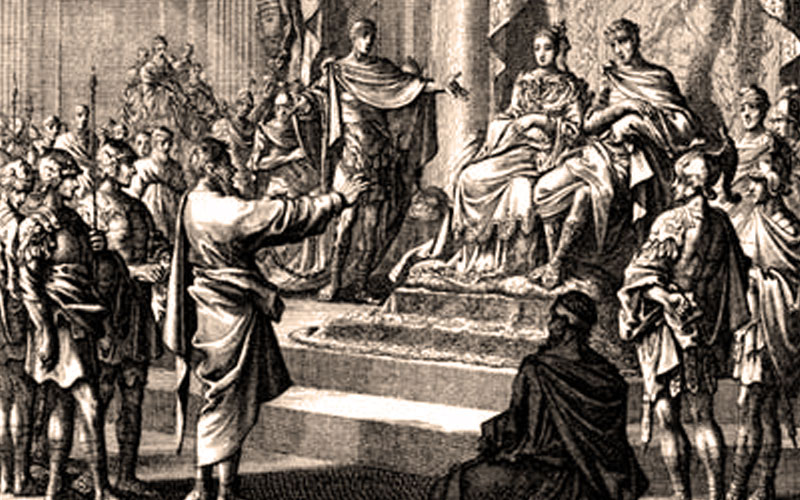
As Paul was provided time to make a defense before Agrippa, he took advantage of the opportunity to teach the king and all those who were present about the gospel. When Paul asked him if he believed the Prophets, Agrippa replied, “In a short time you will persuade me to become a Christian” (Acts 26:28). The wording of Agrippa’s response may be different in your Bible, depending on which translation you have. Another version says, “Almost thou persuadest me to be a Christian” (KJV). Regardless of which translation you use, it is plain to see that Agrippa understood Paul’s intention. He was trying to persuade the king to become a Christian.

Paul replied to the king, “I would wish to God, that whether in a short or long time, not only you, but also all who hear me this day, might become such as I am, except for these chains” (Acts 26:29). Paul was a Christian. He wanted all those around him to also be Christians. But how does one become a Christian? We can look and see how Paul became one and learn what we must do to become such as he is.
Continue Reading

Giving Thanks to God

As we approach the Thanksgiving holiday in this country, we tend to be more mindful of the blessings we have. We have many things to be thankful for and we ought to recognize God as the source of these blessings (James 1:17).

With this in mind, I want to briefly look at Colossians 3:15-17. These three verses contain three reminders to us to be thankful. These verses also give reasons why we should be thankful to God.

Continue Reading

The Eternal Gospel

Crosses

We generally divide Biblical history into three dispensations: the Patriarchal age, Mosaic age, and the Gospel age. When people speak of “dispensations,” they are simply referring to the method by which God revealed His will to man. First He revealed His will to the heads of families (Patriarchal age). Then He gave the nation of Israel the Law of Moses (Mosaic age). Finally, the gospel of Christ was revealed (Gospel age). We live in this third and final dispensation.

While these are perfectly acceptable distinctions, we need to recognize that the gospel is different from the other messages that have been delivered. In the book of Revelation, this final message is described as “an eternal gospel” (Revelation 14:6). When we talk about the three dispensations, we ought to recognize that the gospel had its beginning before either of the first two.

The term gospel simply means “good news.” The “good news” is the message of Christ and His salvation. As we can see from the Scriptures, this good news began long before we read of it in the New Testament.
Continue Reading

The Way, the Truth, and the Life

Jesus said, “I am the way, and the truth, and the life; no one comes to the Father but through Me” (John 14:6). This simple, concise statement reveals some important truths.
Continue Reading

Those Who Do Not Know God

When the Lord returns, He will come “dealing out retribution to those who do not know God and to those who do not obey the gospel of our Lord Jesus” (2 Thessalonians 1:8).

It may be understandable why those who refuse to obey the gospel will be punished. But what about those who never hear the gospel – those who do not know God? Is it really fair for God to punish people because they never heard? People have wondered this and even questioned God’s justice.
Continue Reading