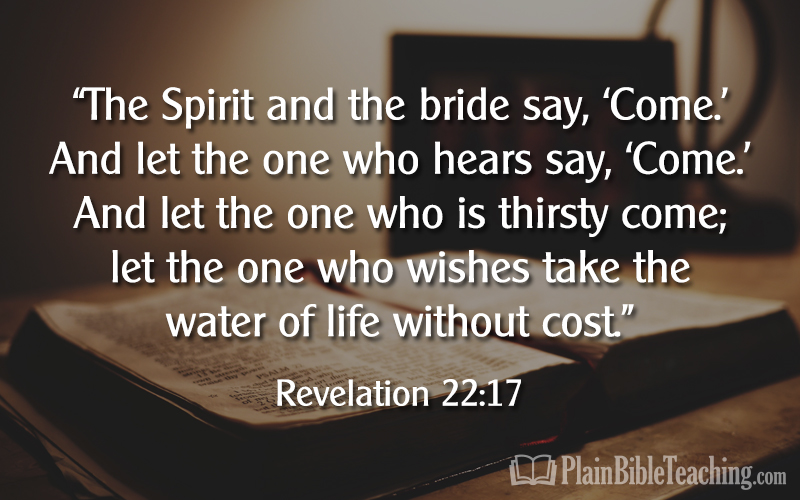
“Come”

Revelation 22:17

The Spirit and the bride say, ‘Come.’ And let the one who hears say, ‘Come.’ And let the one who is thirsty come; let the one who wishes take the water of life without cost” (Revelation 22:17).

This is an invitation for salvation that has been offered by Christ. It is for those who need the water of life. This means that it is for all, for “all have sinned and fall short of the glory of God” (Romans 3:23) and “the wages of sin is death” (Romans 6:23). All who wish to obtain the gift of salvation and be saved from their sins may come.
Continue Reading

Belief or Disbelief?

He who has believed and has been baptized shall be saved; but he who has disbelieved shall be condemned” (Mark 16:16).

This is a pretty easy verse to understand. Jesus specifically states two things that are necessary for salvation – belief and baptism.
Continue Reading

Put On the Full Armor of God

We are engaged in a war for the cause of Christ. This is not a physical war; instead, it is spiritual (2 Corinthians 10:4). It is a battle for the souls of men. In order to help us in this fight, God has given us the armor that we must put on so that we will be able to “stand firm against the schemes of the devil” (Ephesians 6:11). Let us notice the armor with which the Lord has equipped us.
Continue Reading

Unless You Believe

Therefore I said to you that you will die in your sins; for unless you believe that I am He, you will die in your sins” (John 8:24).

Belief in Christ is essential for salvation. But the belief that Jesus mentioned here is more than just a belief that he existed, came to earth, died for our sins, rose again from the dead, and ascended back into heaven. Yes, we must believe those things about Jesus, but if that is the extent of our belief, we will die in our sins.
Continue Reading

Emphasizing Jesus Christ

Crosses

Paul told the saints in Corinth, “For I determined to know nothing among you except Jesus Christ, and Him crucified” (1 Corinthians 2:2). Why did Paul place such an emphasis on teaching Jesus? He explained: “So that your faith would not rest on the wisdom of men, but on the power of God” (1 Corinthians 2:5).

The Corinthians had a problem of following after men. This resulted in division as some were saying, “‘I am of Paul,’ and ‘I of Apollos,’ and ‘I of Cephas,’ and ‘I of Christ’” (1 Corinthians 1:12). Paul later explained that when they claimed loyalty to these men, they were carnally minded and immature (1 Corinthians 3:1-4).

The inspired apostle sought to correct this thinking so that they would focus on following Christ and not men. This is the first problem he addressed in his letter (1 Corinthians 1:10-17). But notice how he subtly made this point before he explicitly stated it.
Continue Reading

The Great Conspiracy

Many people are fascinated by conspiracy theories. Some believe the attacks on the World Trade Centers on September 11, 2001 were a conspiracy by the U.S. government. There is the theory that we did not really land a spacecraft on the moon in 1969, but that it was staged in a secret location as part of a government conspiracy. While many of the conspiracy theories we may hear are probably not true, they are still a source of fascination for many.

What is a conspiracy? Generally, a conspiracy can be described as a secret plan by two or more persons intent on bringing harm to a person or group and/or causing the conspirators to gain power, wealth, or both. Conspirators have a goal, something they want to accomplish. This is not always apparent, of course, because it is secret. Conspirators have to hide the truth, both of their goal and their plan. But people generally will want answers or an explanation as to why certain things are happening. So they have to convince them of a lie or a partial truth. These things are generally true for conspiracies.
Continue Reading

The Gospel of the Grace of God

Paul and the Ephesian Elders

On his way to Jerusalem, Paul stopped in Miletus to meet with the elders from the church in Ephesus (Acts 20:17ff). In this farewell address, Paul reminded them that the message he brought to them was “the gospel of the grace of God” (Acts 20:24). This was the message that Paul preached “everywhere in every church” (1 Corinthians 4:17). He preached the gospel to those who were already Christians (Romans 1:15) and to those who had not yet heard of Jesus (Romans 15:20). The gospel is the message that Jesus told His apostles to preach (Mark 16:15) and is the message that we must preach today (Galatians 1:8-9).
Continue Reading