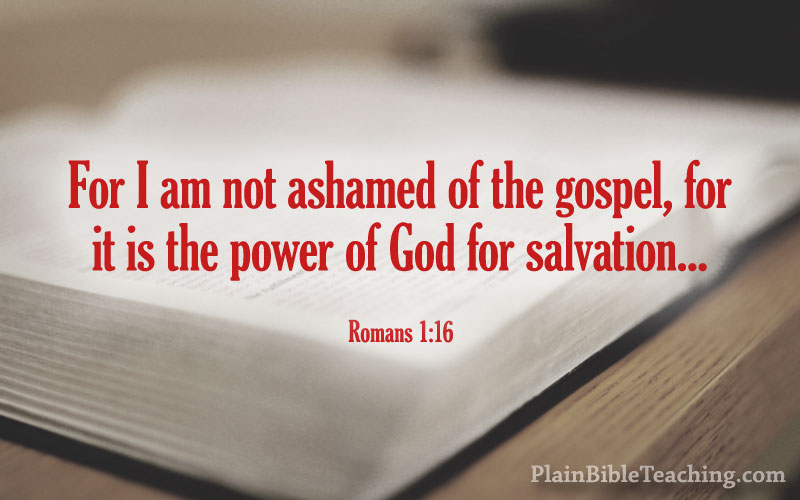
Not Ashamed of the Gospel

Romans 1:16

For I am not ashamed of the gospel, for it is the power of God for salvation to everyone who believes, to the Jew first and also to the Greek. For in it the righteousness of God is revealed from faith to faith; as it is written, ‘But the righteous man shall live by faith’” (Romans 1:16-17).

When Paul wrote to the saints in Rome, he said he was “not ashamed of the gospel” (Romans 1:16). Because of the confidence he had in Christ’s message, he was “eager to preach the gospel” (Romans 1:15) and do many other things in the cause of Christ.

We need to have the same confidence as Paul so that we can also say, “I am not ashamed of the gospel” (Romans 1:16). Can we say this? To answer that question, we need to consider what we would be willing to do with and for the gospel.
Continue Reading

The Future of the Church

Pews

This phrase is often used to refer to children growing up in the church. All parents – and everyone else involved – want to see these children grow up to be Christians. But even if they do, they are only part of the future of the church. In this article, I want us to consider the future of the church – in particular, as it relates to each local congregation – and notice what we can do in the present to help the future church.
Continue Reading

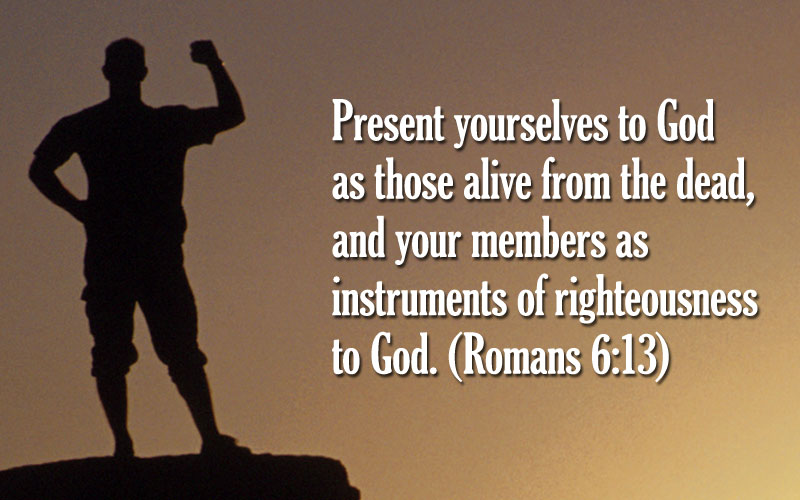
Using Our Bodies as Instruments of Righteousness

Romans 6:13

Therefore do not let sin reign in your mortal body so that you obey its lusts, and do not go on presenting the members of your body to sin as instruments of unrighteousness; but present yourselves to God as those alive from the dead, and your members as instruments of righteousness to God. For sin shall not be master over you, for you are not under law but under grace” (Romans 6:12-14).

Our bodies can be used one of two ways – either for God or for sin. As Christians, we are to present our bodies as living sacrifices to God (Romans 12:1). Our bodies are “for the Lord” (1 Corinthians 6:13); therefore, Paul said, “Glorify God in your body” (1 Corinthians 6:20).

How do we use the members of our bodies as instruments of righteousness? Let us consider what the Scriptures teach about this.
Continue Reading

Reading Denominational Authors

Reading

With the rise of social media in our modern age, it is easy to share information with others. The information we share often includes what books and articles we have read. I have observed that, in general, brethren read a lot that is written by denominational authors on spiritual topics – possibly more than they read the writings of other brethren.

It is not necessarily wrong for brethren to read the writings of denominational authors. In some cases it can even be helpful. However, we need to be careful. Let me offer the following considerations.
Continue Reading

Pardee Butler: “You Can Not Teach an Old Dog New Tricks”

Pardee Butler: You Can Not Teach an Old Dog New Tricks

Pardee Butler (1816-1888) was an evangelist who spent much of his time preaching in Kansas. He first came to Kansas in 1855 prior to it entering the union. During this time, there was an intense – often violent – debate over whether Kansas would be a free state or a slave state. Butler, with his abolitionist views, suffered physical attacks from pro-slavery settlers. Below is his reaction to a warning about the threat of such violence for refusing to support the sinful practice of slavery that was common in those days.
Continue Reading

Bringing Up Children in the Lord (Part 6): Raising Children to Be Christians

Bringing Up Children in the Lord

I have no greater joy than this, to hear of my children walking in truth” (3 John 4).

Though the passage above refers to Christians in general, the principle certainly applies to the relationship between parents and children. As parents strive to “bring [their children] up in the discipline and instruction of the Lord” (Ephesians 6:4), the ultimate goal is to lead them to the Lord. Naturally, parents will hope that their children enjoy good health and a degree of prosperity in this life. But in the end, what matters most is that their “soul prospers” as they walk “in the truth” (3 John 2, 4). So in this final lesson, we will focus on raising children to be Christians.
Continue Reading

Characteristics of Truth

Man Holding Bible

The sum of Your word is truth, and every one of Your righteous ordinances is everlasting” (Psalm 119:160).

David affirmed that the entirety of God’s word – the sum, not just some – is truth. This is what we should expect since the word is from God (1 Corinthians 1:10-13; 2 Timothy 3:16) and “it is impossible for God to lie” (Hebrews 6:18; cf. Titus 1:2).

While it is important that we understand that the word of God is truth (John 17:17), it is also important that we appreciate various characteristics of truth. Certainly there are those who do not accept the Bible as truth; but of those who do (or claim that they do), many simply do not understand the nature of this truth. It is not whatever we want it to be. Truth is from the mind of God whose ways are infinitely higher than our own (Isaiah 55:8-9; 1 Corinthians 1:25). So let us consider some of the characteristics of truth.
Continue Reading