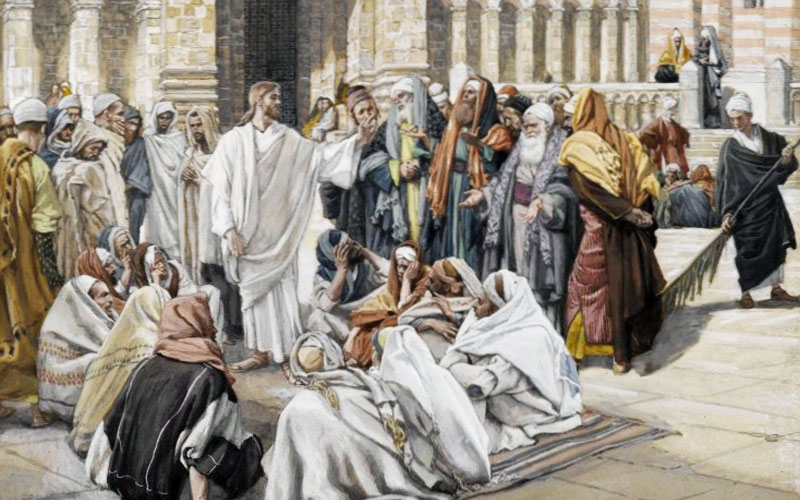
“I AM”

Jesus and the Pharisees

When God appeared to Moses and called him to lead the Israelites out of Egypt, Moses asked the Lord for His name so he could identify Him when he went to the people. God responded, “I AM WHO I AM…Thus you shall say to the sons of Israel, ‘I AM has sent me to you’” (Exodus 3:14).

When Jesus came to earth, He used this same name for Himself: “Truly, truly, I say to you, before Abraham was born, I am” (John 8:58). Even Jesus’ opponents recognized that He was claiming to be God because they “picked up stones to throw at Him” (John 8:59). This was not the first time something like this happened. Earlier the Jews sought “to kill Him” because He was “calling God His own Father, making Himself equal with God” (John 5:18).

By calling Himself “I am,” Jesus declared Himself to be Deity – God in the flesh (cf. Colossians 2:9). Since Jesus was and is God, there are other facts that are also true about Him. These are highlighted in other “I am” statements of Jesus recorded in the gospel of John.Continue Reading

Through Many Tribulations: Conclusion

Through Many Tribulations

As we have studied in these lessons, there are several different kinds of trials and tribulations that we will have to endure during this life. Some of these will come upon us because we are Christians. Others will come simply because we are human. Yet all of these present challenges to our faith.Continue Reading

The Problem with Division

Division

The first of many problems that Paul addressed in his first letter to Corinth was that of division. There were factions that had developed within the church as the brethren became loyal to different teachers (1 Corinthians 1:12). Paul appealed for them to have unity. He did so by explaining what the problem is with division.

Now I exhort you, brethren, by the name of our Lord Jesus Christ, that you all agree and that there be no divisions among you, but that you be made complete in the same mind and in the same judgment” (1 Corinthians 1:10).

Let us consider what Paul taught in the passage above.Continue Reading

Through Many Tribulations (Part 4): Persecution

Through Many Tribulations

As we continue looking at the apostle Paul, we will see that he did more than just sacrifice his time and effort in laboring for the cause of Christ, along with a degree of material and mental well-being. He also faced persecution for his faith.

He told Timothy, “Remember Jesus Christ, risen from the dead, descendant of David, according to my gospel, for which I suffer hardship even to imprisonment as a criminal; but the word of God is not imprisoned. For this reason I endure all things for the sake of those who are chosen, so that they also may obtain the salvation which is in Christ Jesus and with it eternal glory” (2 Timothy 2:8-10). Not only did Paul suffer as a criminal, but he willingly endured this. Why? He said he did so “for the sake of those who are chosen” (2 Timothy 2:10). He also told Timothy later in this same letter, “I have fought the good fight, I have finished the course, I have kept the faith; in the future there is laid up for me the crown of righteousness, which the Lord, the righteous Judge, will award to me on that day; and not only to me, but also to all who have loved His appearing” (2 Timothy 4:7-8). He endured persecution in order to obtain salvation – for himself and for others. In his second letter to the Corinthians, he described some of the ways he faced persecution.Continue Reading

The Blessing of Autonomy

Church building in the trees

One characteristic of the Lord’s church that makes it different from most churches of men is autonomy. Autonomous local churches are not linked together in or through some larger organizational structure.

Why did the Lord design the church to be this way? Obviously, we cannot always know every reason behind instructions that have been given in the Scriptures. Our responsibility is simply to follow the Lord’s instructions whether we understand the reason behind them or not. However, we can look to the Bible to see what has been revealed that would indicate certain blessings of autonomy.Continue Reading

Through Many Tribulations (Part 3): Sacrifices

Through Many Tribulations

When we first read of Paul in the New Testament – then referred to as Saul – he was looking on with approval as Stephen was stoned to death (Acts 7:58-8:1). Following that event, he began a zealous campaign against the church that took him to Damascus in order to find “any belonging to the Way” and “bring them bound to Jerusalem” (Acts 9:2). While on the road to Damascus, the Lord appeared to him and told him to go to the city where he would be told “what [he] must do” (Acts 9:6). The Lord then instructed Ananias to go to Saul to deliver His message to him (Acts 9:10-12; 22:12-16).

Paul was “a chosen instrument” of the Lord’s (Acts 9:15). Specifically, this meant that he was “called as an apostle of Jesus Christ by the will of God” (1 Corinthians 1:1). However, this did not mean that the Lord was going to see to it that Paul had an easy and comfortable life as he served Him. Instead, He told Ananias, “For I will show him how much he must suffer for My name’s sake” (Acts 9:16). When we think of the sufferings of Paul, we typically think of the persecutions he endured [we will discuss these in the next lesson]. Yet there were other sacrifices that Paul made that would be included in the things he was going to “suffer.Continue Reading

“If God Is For Us”

Man on a mountain

Paul’s words at the end of Romans 8 were meant to be a source of encouragement for the saints in Rome. They ought to be for us as well.

What then shall we say to these things? If God is for us, who is against us?” (Romans 8:31).

But in all these things we overwhelmingly conquer through Him who loved us” (Romans 8:37).

We must always remember that “God is for us.” Knowing this, we can make it through any challenge that may come against us. Let us take a closer look at the text.Continue Reading